Showing posts sorted by date for query samuel. Sort by relevance Show all posts

Sunday, December 12, 2021

Friends of Babbie's: Emily Nichols Hatch

Hatch in her studio w/ "Rosemary Enters" 
Goldenrod by the Sea, Belle Harbor, NY | 1904

Emily Nichols Hatch was born in Newport, Rhode Island, in 1871. She studied at the Artists and Artisans Institute, and the Shinnecock Summer School of Art on Long Island with Charles Hawthorne, Walter Shirlaw and William Merritt Chase. 

She made several trips to Europe and had a studio in Paris. She was listed as portrait painter, wood-block printer, lecturer, teacher, and writer. In 1912, she was the recipient of the Macmillan Portrait Prize from the Woman's Art Club of New York. She was a member of the Pen and Brush Club, and the National Association of Women Painters and Sculptors, where she served as President from 1921 through 1925. Elizabeth Cady Stanton served as President from 1928 to 1930. 

LHW Photo, Orchard at 49 N Main

Around 1917, Lizbeth Halsey White notes in her scrapbook: "The old mulberry tree in the orchard and the swing. Emily [Nichols] Hatch painted a picture of this which has hung in several exhibits. Babbie, Manda, Jo, Ibby, and Boo." 


On 6 July 1922, her work, "Rosemary Enters" [Portrait of a Woman] was included in an exhibit of paintings by the National Association of Women Painters and Sculptors at Memorial Hall. Additional work included Edith Stowe Phelps’ group “Mother and Children;” Hilda Belcher’s “Aunt Jennifer’s China”; Christine Hefler’s “French Woman,” and Lucy Taggart’s “Janet.” 

Rosemary Enters | 1914
The Southampton Press covered the opening saying, "There are portraits and child studies, landscapes, flowers, etc., all beautifully executive." On July 1, 1922, Babbie resigned her position as the Secretary of the Committee Building in Ithaca to study in New York City. It's extremely likely that she was at the art opening, sponsored by Samuel Parrish, which also included a musical program. 

In 1940, Hatch became the Director of the Art Center in Tarrytown, New York. Hatch died in 1959, and her papers are in the Archives of American Art at the Smithsonian Institution. 

Dora on the Beach at Belle Harbor | c 1900

Portrait of a Child | c 1952


A Dip in the Ocean | 1906

Prout's Neck Beach, Maine | 1920

Coastal View | 1920

Untitled Water Color


Wednesday, November 18, 2020

Church Service is Cut Short by $5,000 Blaze in Annex; Memorial Painting is Saved

17 March 1941 | Cincinnati Enquirer 

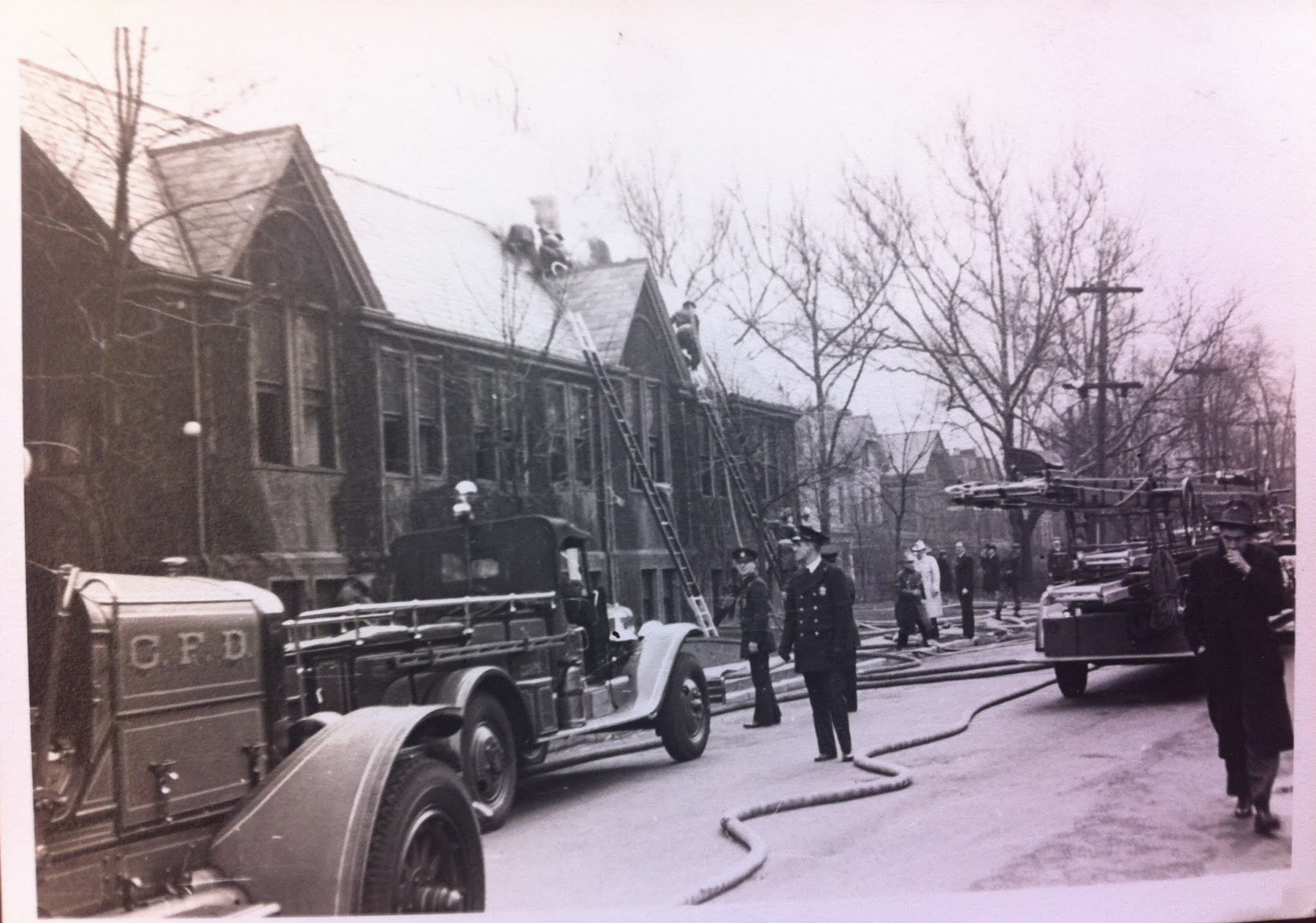
Fire of undetermined origin cause $5,000 damage to the two-and-one-half-story stucco annex of Seventh Presbyterian Church, Madison Road and Cleinview, Walnut Hills at noon yesterday during services.


The annex, which connects with the church, houses the pastor’s study, a library, a music room, an auditorium, and storage quarters.


The fire, starting in the upper half story of the storage room, burned fiercely under the slate roof, Assistant Chief Edward Shearwood and Marshal William Cunningham reported.


First news of the fire was given to Fire Company 23, a square away at Madison Road and Hackberry Street, when a motorist, George Hack, stopped to report that smoke was pouring from the building. The company hurried to the scene, followed immediately by other companies.


So quietly did the firemen approach that few among the congregation attending services were aware of the blaze until the pastor, Rev. Jesse Halsey, curtailed the almost completed service as smoke started to filter into the edifice.


The congregation filed out of the structure in orderly manner. Many then joined spectators on the sidewalk to watch the fire.


Rev. Mr. Halsey had been informed of the blaze some time before by the assistant pastor, Rev. Samuel Warr. Rev. Mr. Warr told his superior that firemen were on hand and that everything was under control.


Rev. Mr. Halsey and Mrs. Halsey thanked fireman and the Salvage Corps for protecting an oil mural in Rev. Mr. Halsey’s study with tarpaulins. The mural hung immediately below the point where the fire was most intense. The picture is one that Cleveland Woodward painted as a memorial to the Halseys’ son. William Halsey, who, when 7 years old, was killed by an automobile in front of the church in 1927. The building in which the fire started had been used earlier in the morning for children’s Sunday school classes. The children were out of the building, however, when the fire was detected.

Marshal Louis Schraffenberger and Captain Carl Rogers started an immediate inquiry . .   . 


Persons associated with the church were summoned to a hearing in Deputy Feldmeann’s office this morning.


Too Much Competition!


“There’s too much competition!”


Thus did Rev. Jesse Halsey, pastor of Seventh Presbyterian Church, impart to his congregation yesterday the knowledge that a fire in the edifice was too intense to permit him to complete the morning worship service. 


Rev. Mr. Halsey had been informed of the blaze previously by an assistant pastor, Rev. Samuel Warr. The clergymen had hoped that firemen, already on the scene, would be able to keep the flames under control sufficiently to avoid disruption of the services. 


Tuesday, December 3, 2019

Had the United States joined the League of Nations, such injustices as the Polish case would not exist.”


1 July 1937 | American Israelite
Public Opinion Is Called Sole Hope In Polish Horrors | President of Federation of Churches, City Official, and Rabbi Are Heard

Protests against Poland’s treatment of her Jews were adopted by resolutions Tuesday evening, June 29th, at the Cincinnati Jewish Center. Speakers included the Rev. Dr. Jesse M. Halsey, president of the Cincinnati Federation of Churches; John D. Ellis, city solicitor and acting city manager; and Rabbi Samuel Wohl of Wise Temple, chairman of the Emergency Committee for Jews in Poland.

The meeting was called by Oscar Berman for the American Jewish Congress and Rabbi Wohl for his Emergency Committee . . . Dr. Haley expressed hope that “the shining sword of truth” might be the weapon of victory against oppression in the Polish as in other modern crisis.

“Had the United States joined the League of Nations, such injustices as the Polish case would not exist,” he said. Dr. Halsey was sent by the U. S. State Department to Poland in 1917.

“It is our belief,” said Rabbi Wohl, “that the time has come when American Jews must express their complete solidarity with their stricken brethren in Poland and formulate a program to safeguard their lives and protect their status as human beings and as citizens.”

“It is important that we should indicate to the Polish government that the Jewish community of America is united in horror at what is taking place in Poland and that we are determined to protect our fellow Jews.

“The recent pogroms are the most sweeping that this generation has known and the result of the poisonous propaganda tolerated by the government. For three years, the Polish government did nothing to stop the cold blooded pogroms that destroyed the economic position of the Jew, pauperized him. It appears now that the Polish government is also tolerating blood pogroms.”

He asked the meeting to send a delegation from Cincinnati to join similar delegations from other cities in the country to go to Washington and confer with the President and the Secretary of State and be called for action which will make clear to the Polish government that the Jews of America will not sit by idly and watch their fellow Jews in Poland murdered in cold blood.

He urged that action be taken to indicate to the Polish government that the horror of the Jewish community of America, as indeed of the entire Jewish world, is shared by all right thinking citizens.

“The Jewish people have helped in the reconstitution of Poland and have been its most loyal citizens and sacrificed themselves on the battle-field, and we Jews of America, together with the non-Jews, have sacrificed life and blood that Poland may be free,” he said. “Treatment of the Jews by Poland violates the peace treaties, violates the consideration which guarantees civil rights to all its citizens. This treaty of Poland was also made with America and we must insist that no nation especially a nation that owes so much to the United States, shall flout and destroy its treaties and its constitution.

“The time has come that all honest Christians shall cry out in one voice that all outrages against the Jews must stop. We of Cincinnati are particularly happy to have the friendship and understanding of all enlightened citizens.”

“we are grateful to the president of the Federation of Churches, Dr. Jesse Halsey, and to the acting city manager, John Ellis, for their expressions of sympathy and cooperation.” . . .

Sunday, December 1, 2019

“In the name of humanity”Jews and Non-Jews Meet to Consider Hitler Situation Abroad


20 April 1933 | American Israelite
Campaign of Education is Planned for Cincinnati

A committee of 9 to keep Cincinnati informed on the German situation will be chosen this week. This is in accordance with action taken Thursday evening, April 13th, at the Cincinnati Club, when 46 Jews and non-Jews met on call “in the name of humanity” by Rev. Frank H. Nelson, Rev. Jesse Halsey, Dr. David Philipson, and Rabbi James G. Heller.

In his introductory remarks, Dr. Philipson, chairman, said: “Oh, my dear American brothers and sisters of whatever faith or creed you may be, put yourself in the place of these men and women, many of them as high-minded and as high-spirited as any sitting in this room. My appeal to you is not as a Jew or as a rabbi, but as an American who like you has imbibed the spirit of Washington and Jefferson, of Franklin and Lincoln as expressed in our Declaration of Independence, in the articles of the Constitution of the United States and I our entire American tradition of equality, political and religious. In our rights as citizens we know no racial distinctions.

This Nazi Doctrine
What strange language is this Nazi doctrine of Aryanism and Semitism, of Nordic superiority and Jewish inferiority! Upon this flimsy artificial basis the entire new political hegemony over there is being built up. Herr Hitler and his minions Goering, Goebbels and their fellows are declassing 600,000 men and women who have been among the most faithful and loyal citizens of their fatherland. Herr Hitler, a German citizen of one year’s standing, is degrading into a no-citizenship class descendants of ancestors who have been living on German soil for over 1000 years.

“Who deserves better of the fatherland—this distiller of hatred and inhumanity who is shaming the German name or the descendants of those toilers in days of peace and soldiers in years of war who brought honor to the country of their birth, their love, and their loyalty?”

Facing Ruin
“These German citizens of the Jewish faith are facing ruin and annihilation. They are powerless. They are being crushed under the iron heel of a despotic dictatorship that is absolutely ruthless in its methods. A policy of fiendish ingenuity and heartless systemic cruelty is being pursued.”

Rabbi Heller said: “Hitlerism is not solely a menace to German Jews, nor even primarily to them, but rather is a challenge to all humanity and a threat to the peace of the world.” He proposed a campaign of education. Rabbi Heller traced the hatred to injustices in the Treaty of Versailles.

Dr. J. Louis Ransohoff urged an anti-German boycott. Speakers included Dr. I. M. Rubinow, Rev. Nelson, Dr. Earle E. Eubank, and Rev. H. S. Bigelow.

Those attending the Cincinnati Club meeting included: Rev. Henry Pearce Atkins, Samuel Ach, William Albers, Dr. Julien Benjamin, Oscar Berman . . Dr. Albert Freiberg . . . Rev. Jesse Halsey . . . Adolph Rosenberg . . . Phil E. Ziegler

Wednesday, January 7, 2015

Wednesday, December 3, 2014

A Bit of Local History Written by the Late W.S. Pelletreau

Record of the Ownership of the Triangle between Main Street and North Sea Road Southampton Press

The recent burning of the Dawson dwelling and barns recalls an article written by our esteemed historian, the late William S. Pelletreau
--> [1840-1918], and published in the PRESS in May, 1917. The article has much value and interest to all living in that section of the village and is reprinted by request.

In old times, long before the Revolution, the entire triangle between the Main street and the North Sea road was owned by Abner Howell. He was the son of Col. Josiah Howell, and was a man of importance in his day and time. A small, brown tombstone tells us that Mr. Abner Howell died Sept. 16, 1775 in the 76th year of his age. About 1750 he gave his son, Phineas Howell, the lot where John Cavanagh now lives, and he built a house upon it which was standing in our boyhood days. At the same time there was another house exactly like it and this was owned by Mr. Peter Fournier and was where the Commercial House now stands. They were not only exactly alike in other respects but there was a peculiar style to the chimneys which attracted our attention. Both of these houses were torn down about 1849. Abner Howell seems to have divided the entire triangle between his two sons, Phineas and David, and Phineas had the north part and David Howell had the south portion. In 1788 Phineas Howell sold east part to Annanias Halsey and went to what was the “Western Country” and settled in the town of Tully, in what is now Onondaga County, New York, and he died there at a very advanced age. Annanias Halsey was the father of a family that had been prominent in Southampton. His son, Uriah Halsey, lived on the place now owned by Mrs. Wilmun Halsey and had two daughters. One married John Sherry of Sag Harbor and the other married Capt. Crowell of the same place.

Another son of Annanias was Eli P. Halsey, who was the father Edwin P. Halsey, who lived in the old house, next north of Herrick’s store.

Another daughter married Col. Samuel hunting, whose wealth has been of benefit to many families. Another daughter, Mary (or Polly, as she was generally called) married Mr. Daniel Fordham, whose descendants are numerous and well known. Another daughter, Susan (commonly known in our boyhood days as Aunt Susan Halsey) lived and died unmarried in a little old house that stood just north of Capt. Daniel Jagger’s house, now Mr. Donnelly’s. After her death the house was sold by Capt. Jagger to David Terry, who moved it to Tuckahoe where it still remains.

The part of the lot sold to Annanias Halsey was in later years sold to Capt. Harry Halsey, who is well remembered. The part where the little house stood is now owned by Miss Abigail Halsey, and the homestead by the Rev. Jesse Halsey. The old house and lot of Phineas Howell was sold by him to Ebenezr Jagger in 1772. He had a tan yard on the premises, and was the great-grandfather of Mr. Hubert Jagger. In later years the house and lot belonged to Mr. Aja Halsey, who tore down the old house and built a new one and which, after passing through several hands now belongs to John Cavanagh.

We may add that Abner Howell did not live on that tract. His home lot, which was that of his father’s before him, was where Mr. Livingston Bowden now lives. He was the village blacksmith and the relics of his shop were plainly visible some years ago, when the road was ploughed up on Bowden Square.

The south part of the triangle was given by Abner Howell to his son, David Howell, who built a house upon it about 1750. In 1770, the main street of Southampton was surveyed from the beach to the road at Long Springs and David Howell’s house is there mentioned. Like most houses of that time it was built on the line of the street. The present door yard has been taken in from the highway but no one is any the worse for it. David Howell was a silversmith and learned his trade from Capt. Elias Pelletreau. We have seen spoons made by him and stamped with his name. On May 10th, 1782, David Howell sold his house and lot to Col. Josiah Smith of Moriches for £400, or $2,00. As the lot included what is now Mr. Donnelly’s property, it is worth as much today. What became of David Howell we do not know but he may have gone West like his brother. Colonel Josiah Smith bought this place for his daughter Hannah, who married Elias Pelletreau, and they lived there many years keeping a store, which did a large business for those days. Flax was a staple article and was raised in large quantities and taken in trade but times have changed and there has not been an ounce of flax raised in Southampton for nearly 100 years. We may as well mention that another article of extensive sales was West India rum. In the latter part of his life Elias Pelletreau purchased a large farm at the south end of the village, with a house still standing and well known as the Hollyhocks.

After the death of Elias Pelletreau, the David Howell, house and lot was sold to Benjamin Howell and after passing through one or two hands it came into possession of Capt. Austin Herrick and is now owned by his descendents who are well known to us all. The house which still remains, was built originally after the standard style of those times, with a long sloping roof on one side, but at some later period it was changed, and by making gambrel roof with dormer windows, it was made practically a two-story house. In old times, when land was cheap, houses were built large on the ground, the upper part was a necessary evil, and it was not necessary to put one house on another. It has stood the storms of more than 160 years and will outlast many of the flashy houses of the present time.

The person who sees Mr. Dawson’s place would hardly believe that it is a hundred years old. So much has been added that it looks like a new house, but the original house has passed its 100th mark long years ago, and hereby hangs a tale.

In the early part of the last century, the farm at the north end, now owned by Mr. James E. Foster, was the homestead of John Bishop and his wife Jerusha, both models of short-sighted penuriousness. The story goes, and we have heard it repeated by those who evidently believed it, that they were left this farm and much other land, with the condition that they were to support two maiden sisters until their death or marriage. They seem to have been well convinced that the former would happen first and they might have to wait a long time for that, and they worried about certain sharp individuals, and there were sharp people even in those virtuous days, and they were Squire William Herrick, Rufus Sayre, and Joel Jacobs, made them the offer to take the girls off their hands and support them until they were dead or married, in exchange for their farm and some other lands, among which we believe was a lot at Halsey’s neck, now owned by Edward. H. Foster, Esq. They accepted the offer and congratulated themselves on their grand stroke of luck. One of the characters in “Uncle Tom’s Cabin” says, “Gals is mighty on certain things. If you think they have gone one way they are sure to be gone the other.” With that perversity, so peculiar to the female sex, these girls, who were expected never to marry, were both married within a year. The Bishops then repented in sackcloth and ashes, that they had parted with their land so easily. The house on the farm was sold to Paul Sayre, the grandfather of our well-known townsman, Mr. Rufus Sayre, and he moved it to its present site where he purchased a small piece of land of the proprietors. This is the 100th anniversary of its moving and it is certain that it was of some age at the time. Here Paul Sayre lived and died, and his daughter, Miss Nancy Sayre, with a sister lived there within our recollection.

As for the Bishops’ story we hardly know what to say. There are some things which make us doubt it, but as the Italian saying is, “If it is not true, it is well made up.”

The Jesse Halsey Manuscript Collection. Special Collections, Princeton Theological Seminary Library. 

Friday, November 21, 2014

"Eli and Samuel"

"Eli and Samuel" by Cleveland Woodward | 1930
Sunday, November 30, 1930
Cincinnati Enquirer 

"A few days ago we learned that a large mural painting picturing the dramatic story of 'Eli and Samuel' had been placed in the auditorium of the Parish House of the Seventh Presbyterian Church on Walnut Hills in memory of Wilmun Halsey, the young son of Rev. and Mrs. Halsey, whose tragic death occurred on May 20, 1928. The mural was presented to the church by Rev. Halsey and his family.

"It is a most appropriate symbol of the life and taste of the child, who ever loved the story of Samuel. The mural is the work of Cleveland Woodward, a Cincinnati artist, whose gifts for pictorial organization are well known. The work takes the narrative form, and the subject is one that many be admired as well as understood. Mr. Woodward selects the moment in Samuel's life when he hears the voice of the Lord and he comes to Eli in the temple. Both figures stand out in a great light against the dark light of a temple interior. The whole enshrines a beautiful associated thought, simple in idea and particularly appropriate as a memorial to a child whose heart was filled with aspirations and ideals. Such a little boy was Wilmun Halsey. He was much beloved by his schoolmates and teachers. At the Lotspeich School, where he attended, because he sought responsibility he was appointed bell ringer for the classes and every morning bright and early he was at his post, his eager little face showing the pride he took in his official position, and in the mural the face of Samuel was taken from a crayon portrait of little Wilmun which was done by Frederick Weber."

"Eli and Samuel" by Cleveland Woodward | 1949

Monday, September 15, 2014

Dr. Thomas and Miriam Marsh Haynes

Thomas and Miriam moved from Haverhill MA to Bennington VT between 1 March 1763 when their son Samuel was born in Haverhill, MA, and 4 January 1765, when their son Jonathan was born at Bennington.

Dr. Thomas Haynes was in the Battle of Bennington. Thomas served as surgeon in Gen. Amherst's army and was present at the taking of Ticonderoga, and accompanied the prisoners to Cambridge, MA.

[Ethen Allen had organized a volunteer militia, the Green Mountain Boys, to resist New York's bid to take over Bennington. At the outbreak of the American Revolution, the force offered their services against the British, and under orders from the CT legislature, captured Fort Ticonderoga 10 May 1775. In 1778 Allan appeared before the Continental Congress in behalf of a claim by Vermont for recognition as an independent state, and he and his brother Ira devoted most of their time to that end.]
On 27 April 1782, Thomas Haynes was one of the appraisers of the inventory of John Armstrong, late of Bennington. At the distribution of the estate, Sibbeus Armstrong was Administrator and Guardian to the minor children, and Thomas Haynes of Bennington was Surety.

In 1789 Thomas Haynes went to North Hero VT to look after some land which he owned there. He died at North Hero on 26 November 1789. His family afterwards moved to this place and continued to live there. North Hero was in Chittenden County in 1787-1792, Franklin County in 1792-1802, and Grand Isle County from 1802 on.

Probate Records
Guardianships of the Children.

Aaron Haynes was appointed guardian to Moses Haynes, minor son of Thomas Haynes of Bennington, deceased. Mr. Aaron Haynes and Samuel Haynes posted bond.

Mrs. Miriam Haynes, widow, was appointed guardian to Huldah Haynes and Miriam Haynes, minor daughters of Thomas Haynes late of Bennington, deceased. Mrs. Miriam Haynes and Samuel Haynes executed a bond L1000.

David Haynes was appointed guardian to Elijah Haynes minor son of Doctor Thomas Haynes late of Bennington deceased. Mr. David Haynes and Zepheniah Holmes executed a bond of L500.

Wednesday, September 10, 2014

Students Of Sabbath Schools Should Be Taught Philanthropy

ENQUIRER, CINCINNATI
WEDNESDAY, FEBRUARY1, 1911

"[Philanthropy] should become a part of the Sunday schools. It would be well to [hire] a director of social activity whose [thinking] should be to relate the Sunday school to social help for others," declared Rev. Samuel Tyler, rector of the Church of the Advent, at yesterday's supper of workers in the Baptist Institute at the Ninth Street Church. Mr. Tyler Is President of the Social Workers' Club of this city.

"The relation of the Sunday school and social service has been barely touched upon," said Mr. Tyler. "Religon is essentially social. The aim of present-day Christianity is to make the world a better place to live in. We must teach the child in the Sunday school the social character of Christianity. The principle of service is vital. We must try to make the children see their responsibility for the welfare of others.

"Especially can we follow this out in the public health and preventable disease. Every year over half a million deaths occur which could be spared. If Christ was the Great Physician his followers ought to be interested in the sorrow and waste of disease that need not be. "Our Sunday-school teachers must try to relate their teachings to life. The children, individually or in classes, should help poor families, visit philanthropic institutions or keep in touch with the movement for the social betterment. The public school children often clean the streets. There is no reason why Sunday-school children should not do so also. The better way to carry this out I would suggest the appointment in each school of a director of social activity to outline the ways of service . . ."

Tuesday, February 25, 2014

Walking Sticks

Jesse Halsey c1933
If the strong cane support thy walking hand
Chairmen no longer shall thy wall command
Ev’n sturdy carmen shall thy nod obey,
And rattling coaches stop to make thee way;
This shall direct thy cautious tread aright,
Though not one glaring lamp enliven night.
Let beaux their canes with amber tipt produce;
Be theirs for empty show, but thine for use.
Thus wrote John Gay in his “Trivia,” Gay, the friend of Voltaire of Addison and Swift. The London of Queen Anne is made real by his descriptions of his walking trips on which he always carried his cane. Not only he and his contemporaries—can you imagine Dr. Johnson without his stick?—but from the very dawn of history until the present time, men have used their walking sticks, in one form or another. It is man’s oldest friend and support. Its use is universal.

[On his staff man has leaned from time immemorial. It is the implement of his first cultural advance, the symbol of his superiority to the brute and an accoutrement of his sartorial adventures. It appears in the riddle of the Sphinx is the companion of man’s pilgrimage through the centuries and the emblem of self-imposed controls in government. It preceded the sword as man’s most primitive weapon, modified in a rod or scepter; a symbol of authority.]

Satan strides across the awful abyss with his great pine-tree staff, and the latest Literary Guild selection makes its heroine Madam Comyn vigorous and impressive by her cane.  From man’s lost paradise it must have come—one of the angels of Genesis appears with his staff, and it will be in vogue after Pageant is forgotten. Both Milton and Miss Lancaster are true to life, for both men and gods, alike, need the support of staves.

The Greek Gods had their sticks: Hephastios because he was lame; Hermes because he was swift; Juno because she was powerful and fecund. To no type is the staff inappropriate. Indeed, Pallas Athene in her wisdom leans upon the staff of her spear. Homer’s heroes, chief of whom is Agamemnon, carry staves as a badge of office and the patriarch Jacob worships, “leaning upon the top of his staff,” and so blesses his grandchildren.

Can you picture Elijah, even as he flees the wrath of Jezebel, without his staff? Elisha sends his staff by Gehezhi, as a projection of himself to lay upon the face of the dead boy. Could Samuel adequately judge Israel without his staff? Or the New England parson of our boyhood makes his pastoral rounds without his gold headed cane? Chaucer sends his “poor parson of the towne” into the country through the storm on an errand of mercy’ “and in his hand a staff . . . this noble ensample to his sheep he gaff that first he wroughte and afterward he taughte.”

Matthew and Luke say that Jesus sent out his Twelve Disciples on their first missionary tour without money or scrip or bread or staves, but John Mark, who was the travelling companion of St. Peter, records that the Master “commanded them that they should take nothing for their journey save a staff only.” This is a truer picture one must conclude; Jesus would surely allow them the comfort of their staves, for He who in the carpenter’s shop had fabricated such easing implements as yokes would know the value of a walking stick.

St. Peter, the legends say, sent his staff to Eucherius, the first bishop of Treves. After that Peter walked without a stick; so, since the time of Gregory VII—the same was Hildebrand—the Bishop of Rome has never carried a crosier. Having surrendered the pastoral stick, he takes, however, as his emblem, two swords!

On an old crosier preserved in Amiens these words are engraved: “Onus non honor.” But all had not so modest an inscription. The old abbots were invested with authority in these words: “Receive the stick of the pastoral ministry” and therewith received the crosier. They had great power and unlike the Bishops could also wield the sword. A twelfth century bishop, one Christian of Mayence who could not for conscience’s sake use a sword, had no scruples, however, about fighting with other weapons and with immense crosier killed nine men in one battle! A militant Christian this.

When a bishop walked in procession, his crosier’s crook faced outward, but the abbot must face in his when he left the borders of his monastic lands. In spite of all abuses of their power in Feudal times, ecclesiastics represented justice and protection for the poor; thus in the Middle Age a common saying among the people was, “It is better to live under the crosier than under the Feudal stick.”

In the East, the pastoral stick is straight, instead of bent. The Greek Patriarchs have crosiers crowned with T-shaped crosses. Sometimes in the West, serpents, emblematic of pastoral sagacity, surmounted the stick! Usually, however, the crosier is shaped after the fashion of the pontifical stick of the Roman augurs which they held in their hands while they gave their oracles. The dean of the cardinals carries a golden stick called the ferula apolistica, as a mark of dignity. In event of the death of the Holy Father this official becomes Pope ad interim.

Kings, too, have their sticks in the form of scepters. “For the stick is king of the world,” says an ancient proverb. The shepherd’s crook, his rod and staff, became the badge of office of the tribal chief. Later, armed with an iron point it became the primitive scepter. The office of king in those days fell to some mighty man of valour, head and shoulders taller than others in his army; his scepter was shod with iron and wielded by a mighty hand. Goliath and his brothers carried spears of this sort— “like a weaver’s beam,” as the saying goes.

The king’s scepter, that is to say his lance, never left his side. David, the outlaw, quietly glides into the camp of King Saul at night and steals the scepter—lance and with the sunrise sends his taunts echoing across the valley toward Abner and the recreant bodyguard. At length, gold, silver, and other embellishments replaced the iron of the spear just as moral force replaced physical force in government. The lofty name of scepter was first used in Rome by Cicero. Long before had “it ceased to be an arm, it had become an emblem.”

The Roman consuls carried scepters under the name of Scipio. The scepters were wands of ivory. The senators also carried one of a similar form. A legate had reached Egypt; his life was threatened by a mob. Wrapping his toga close, with his stick he described a circle in the sand around his person, “This is Roman soil,” and there he stood unharmed, much as others since have invoked the protection of the flag.

When the Gauls under Brennus entered Rome they found the senators and consuls seated in the curule chairs, each one holding his wand in his hand. At the sight the barbarians paused. One dared to touch the beard of the senator Papirus, who struck him with his wand and wounded him. It was the signal for a general massacre. “Never was the scepter so majestic as then,” says the French historian. Scepters of Kings have become unfashionable, but still Mussolini has his lictors go before him and in Italy today one sees the sticks—the faces—everywhere. And what of Hitler? What shall be his symbol?

“The husbandman, with a scepter in his hands, sits among the furrows without speaking,” says Homer, and Millet in his “Angelus” has the sunlight fall upon the implements of tillage on which his peasants lean as praying at eventide.

[Handwritten note on manuscript to JH from writing instructor: "A wealth of material, but paradoxically that is its fault! The piece is too much of a catalogue, with little or no comment to hold it together and give it unity. I should say that it contains the material for a good essay. Notice Lamb’s essay on ears and see how he lists too—but with different emphasis."]

Tuesday, February 18, 2014

Almost without warning death came to United State District Judge Howard C. Hollister.


Cincinnati Enquirer
25 September 1919

In the library of his home, Baker place, on Madison road, at Walnut Hills, a few minutes after 7 o'clock last night. Although not feeling well since his return September 8 from an extended trip with Mrs. Hollister to the Northwest. Judge Hollister did not regard his condition, to b at all serious. He contracted a cold while away, and complained of a difficulty m breathing. Yesterday morning Judge Hollister went to his courtroom and remained until 2:55 o'clock yesterday afternoon. He told his private secretary. Miss Bessie Colling, to phone to Dr. Emmanuel Schwab to make an appointment to see him.

On his way home Judge Hollister saw Dr. Schwab, who gave him a prescription and reassured him. Just before sitting down to dinner with Mrs. Hollister their daughter Evelyn, wife of William Perry, an Indianapolis railroad man, and two sons, John B. and George, Judge Hollister was taken violently. Dr. Schwab was summoned and Dr. Allen Ramsey also was called in. They did all possible, but Judge Hollister did not rally. He was fully conscious when he died. The cause of his death, Dr. Schwab said, was pulmonary oedema, superinduced by heart disease.

Transacts Court Business.
In spite of feeling badly in the morning, Judge Hollister attended to great deal of Count business. His last official act was to postpone the hearing from Saturday to Monday of the cases of Thomas Hammerschraidt and 12 associates, recently convicted of conspiracy to defeat the draft act, and who were seeking a new trial.

Howard K. Hollister, the only one of his children not at home when his father died, is in New York. Howard Clark Hollister was born on Southern avenue, Mt. Auburn, September 11, 1856. His father, George I Hollister, came to Cincinnati from Vermont, and for several years Judge Hollister represented that state on the Board of Governor of the New England Society. The mother of Judge Hollister, Laura Strait Hollister, was a daughter of Thomas J. Strait, one of the most successful of the early lawyers at the Cincinnati bar. He began practice in this city in 1826. On both sides Judge Hollister was of colonial and revolutionary stock. He had three great-grandfathers who were soldiers in the Revolutionary War. In his boyhood Judge Hollister attended the district Intermediate and High schools, he later took a course of preparation for Yale at Orelock Institute, Williamson. Mass., and, after entering Yale, was graduated from that institution in 1878, in the same class with William H. Taft, afterward President of the United States, and the late Judge William L. Dickson, who were friends of his days in the primary schools of Cincinnati. Another close friend was former Judge Rufus B. Smith.

Admitted To Bar in 1880. After studying law in his father's office Judge Hollister went to the Cincinnati Law School and in the spring of 1880 was admitted to practice by the Supreme Court of Ohio. He served as Assistant Prosecuting Attorney or Hamilton County In 1881 and 1882. He was elected Judge of the Court of Common Pleas in 1893 and re-elected for a second term, serving in all ten years on the Hamilton County Common Pleas bench. At the end of his judicial term Judge Hollister resumed practice of the law with his two brothers, Thomas and Burton P. Hollister. In March, 1910, his lifelong friend, President Taft, appointed Judge Hollister to be United States District Judge to succeed the late Judge Albert Thompson. During his nearly 10 years on the United State bench, Judge Hollister tried many cases, which attracted national attention. He presided at the trial and conviction of President John H. Patterson and other officials of the National Cash Register Company, accused of violation of the provisions of the Sherman anti-trust act. Later the verdict of the jury and rulings of Judge Hollister were reversed and the defendants acquitted. More recently was the Van Tress case. In which Roy Van Tress and his associates of the McAlester Real Estate Exchange, were tried and convicted of conspiracy to misuse the mails to defraud in connection with the sale of Oklahoma lands. Van Tress and his co-defendants were sentenced, but are awaiting the decision of the Circuit Court of Appeals on a new trial.

Fought County Organisation.
Judge Hollister was a strong Republican In national affairs, but (fought the Hamilton County Republican Organisation bitterly at times after his retirement from the Common Pleas bench. He was an elder in Walnut Hills Presbyterian Church and a devout member of that congregation.
Judge Hollister was married June 2 1887 to Miss Alice Keys, daughter of Samuel B. and Julia Baker Keys. The three sons of Judge Hollister entered the military service to their country during the recent war.

Tuesday, February 11, 2014

Rural Parish A.D. 1800


For McCormick Speaking | c1948
By Jesse Halsey

East Hampton lies well toward the east end of that sand-spit known as Long Island, which like a sperm whale has its head anchored toward Manhattan and throws its double-pronged flukes a hundred and thirty miles out into the Atlantic. Timothy Dwight, the president of Yale, made a journey down the Island in 1800 and leaves a report of his impressions in his journal. One of the objectives of his long trek by horse-back and coach along the sandy trails through the scrub oaks, and dunes, and beside the water roads, was a visit to his former pupil Lyman Beecher, then the minister at East Hampton. A deep mutual affection existed between the young parson and his old professor. Beecher was thoroughly grounded in Dwight’s type of theology—liberal for its time.

The East Hampton Church, like several of its neighbors, was founded in the 1640s. They were called individually, The Church of Christ in East Hampton, Southampton, Southold, and so on. Congregational of necessity at first, by 1800 they were Presbyterian, at least in name, and Long Island Presbytery was one of the constituents of the first Synod (1717). These churches were closely allied geographically, ethnographically, culturally, financially, and every otherwise with New England; most of their ministers came from Yale college.

East Hampton Parish consisted of 300 souls scattered in several hamlets and centering in “the village” which sprawled around the Church. This stood near it on the east side of the Town Pond, the cemetery, and the Common. Across the street stood the Clinton Academy, the first of its kind in New York state. The steeple of the church, the cupola of the academy, and three towering Dutch windmills dominated the skyline. Scraggly elm trees, long since become stately, bordered the wide village street; sandy in the summer, a quagmire of mud in the springtime.

The manse, a gray-shingled salt-box house stood hard by the church. Its wide-planked floors like all other in the town were powdered with clean white sand from the ocean beach. The minister’s bride had received a gift in money from an uncle with which Beecher bought a bale of cotton. This, spun and woven into fabric, Mrs. Beecher determined to make into a carpet. She tacked it to the attic floor and on it painted a bright floral design of roses. This in due season was fitted to the living room floor. Soon after Deacon Talmadge made a call. As the deacon hesitated to enter the preacher said, “Come in, deacon, it is made to walk on.” The old deacon threw up his hands and exclaimed, “All this, and heaven too?”

“Wide was the parish, with houses far asunder,” as Chaucer says of his parson, but like his prototype Beecher, on horse-back and on foot, covered the territory between the village and the Springs, on Montauk 15 miles away where dwelt the remnants of an Indian tribe. With the fervency of youth and the zeal of the old time religion, the pastor went his rounds visiting and “holding meetings.” The trip to the Indian settlement entailed a toilsome journey across a trackless waste of sand called Nappeague, the ocean on one side and the bay that opened into Long Island Sound on the other. Here along the route in season there were wild grapes, blackberries, huckleberries, beach plums, and cranberries: with these the preacher kept his growing household well supplied.

Beecher was also an ardent fisherman and no mean hunter. There were several brooks along the trails through his parish and he would often bring home fish for supper, as he always carried tackle in the pockets of his long-tailed coat. On one occasion he hooked some fish, slipped them into the big pocket of his Sabbath coat, and forgot them until he appeared in the pulpit on the next Lord’s Day, when as he extracted his handkerchief, the remnant of the fish were revealed.

The young minister introduced the country-side to horticulture. Like Jonny Appleseed, he started trees, budded them, developed an orchard and taught his parishioners and neighbors to do the same.

The duel in which Aaron Burr killed Alexander Hamilton called forth great indignation throughout the states. Beecher wrote a sermon condemning the practice, and after submitting it to his friend Lyon Gardner (the owner of a large island adjoining the mainland which had been entailed from his ancestors since 1638) preached it in his own pulpit, and again at a meeting of Synod in Elizabethtown, New Jersey, and in new York City, where it gained newspaper publicity. This, historians say, was the beginning of the active agitation that led to legislation that outlawed the practice. Moreover, it gave the young country minister a national reputation.

Beecher had been preceded in his pastorate by Dr. Samuel Buell who served nearly sixty years. It was he who converted Sir William Erskine, the British general in command during the occupation of Long Island by the British. The conversion was not from Anglicanism to Presbyterianism, but to the patriot cause so that the general resigned his commission and went back to England. Dr. Buell had promoted several successful revivals and this, both in his day and in Beecher’s, was the criterion of a successful ministry. Moreover, Dr. Buell practiced what was known as “the half-way covenant,” that is, children were universally baptized regardless of whether their parents had communicant church connections or not. Beecher did not believe in this practice and frankly said so. This led to at least minor frictions with his deacons and congregation. Nonetheless, the young minister went from strength  to strength, and for ten years, with a series of revivals and by consistent pastoral ministrations built up his church in membership and influence, and his own influence in the Presbytery, and his reputation throughout the Island and southern New England.

Catherine Beecher, the oldest daughter, was herself a pioneer in education, writing extensively in magazines and books, not only about pedagogical theory but practical methods, including kitchen arrangements—with drawings attached. Years afterword, when most of the family had become farmers, in writing to her brother, Charles, she tells many interesting things about the East Hampton home where she was born. “Strict discipline—‘Mind your mother’; ‘Quick!’; ‘No crying’; ‘Look pleasant!’ These were words of command, obeyed with almost military speed and precision. This strong government was always attended with overflowing sympathy and love.”

The parson’s chief daily recreations were frolics with his children. “I remember him more as a playmate than in any other character during my childhood.” He was fond of playing pranks, for his amusement as well as that of the children. Once he swung Catherine out of the garret window by the hands to see if it would frighten her, which it did not in the least. Another time, as he was running past a washtub he ducked her head into it to see what she would do. “He taught me to catch fish and I was his constant companion, riding in his chaise in my little chair to the villages around where he went to hold meetings,” she writes. “As I grew older I began to share his more elevated trains of thought. By this intellectual companionship our house became in reality a school of the highest kind in which he was all the while exerting a powerful influence upon the mind and character of his children.”

The ocean was nearly a half-mile from the house. The roar could be heard any hour of the day or night and white sails could be seen from the windows. On the occasions of a northeast storm, members of the family often went down to watch from the shelter of the beach banks. There was a cranberry marsh between the village and the beach, and the dunes were covered with beach plums in season.

The children who in summer constantly played on the beach often played tag with the surf—“Sometimes we were overtaken and drenched. “ As they learned to swim they were taught to watch out for the “sea-poose” made by two waves meeting from opposite directions then creating a sort of suction-vacuum in their furious race back to the ocean.

With the other villagers they watched for the “weft” when a whale was sighted off-shore. The first to see it removed his coat and waved it, ran up along the beach-banks shouting, “Whale off!” “Whale off!” “When it came its strange wild notes poured out over the town. It seemed as though I could almost fly so great was my excitement,” wrote one of the children. Once, at least, the preacher went off with a village crew chasing a whale ten miles to sea.

Beecher was fond of hunting the wild birds—ducks and geese—which came in profusion every spring and fall. He once took his two boys, William and Edward, with him to fish for eels and “they brought back nearly a cartload of them.” They gathered beach plums by the bushel and these, with quinces and cranberries, were the common table sweetmeats.

Because of straightened finances, Mrs. Beecher kept a school for young ladies. The boarding pupils lived with the family; two English girls, one from Honduras, and several from Island villages as much as fifty miles away, all lived with the family. Mr. Beecher had learned to play the violin while in college and for the benefit of the girls “every day played the liveliest airs, but if any of the girls began to take a dancing step, he would make the violin give a doleful screech and thus ended every attempt to dance.”

One of the girls, Eleanor Lawless from Honduras (“as wild and untamed as her name”) brought a piano with her, the first ever seen in the village. No wonder that the house was filled with wondering and delighted listeners. The manse overflowed with young people and “father’s constitutional mirthfulness developed itself more freely than ever afterwards.”

During his pastorate Beecher was seriously ill for over a year, unable to preach and journeyed as far as Baldston Spa looking for a cure. His salary was promptly paid, however, and the deacons took responsibility for the conduct of the services. Toward the end of the year, Deacon Fithian refused to pay his tithe. “Why is it,” asked the deacon, “that ministers are so greedy for money? “That,” replied the minister, “is the only way to save the souls of some of their parishioners, they are so greedy themselves that we have to take it from them!”

A series of revivals attended Beecher’s ten year pastorate: “times of refreshing from the Presence of the Lord.” On one occasion one hundred were added to the membership of the church. The Infidel Club that was in the town, headed by a school teacher and a doctor, quietly broke up under the influence of Beecher’s logical preaching and his friendly ways that included the doctor and teacher on fishing and hunting trips.

Methodist evangelicals were “undermining” the (stolid) Presbyterian constituency here and there on the Island. One such itinerant drove into East Hampton. Beecher immediately went to the tavern, took the preacher home with him, entrained him royally, rang the church bell that evening, and loaned him the pulpit. Next morning the Methodist brother was seen leaving town, driving back toward New York, the last visit of a Methodist during Beecher’s time.

Family obligations (four children were born) led Beecher to ask for an increase in salary, which the congregation refused. He then moved to Litchfield, Conn., where Henry Ward and Harriet (Beecher Stowe) were born. The old church building is gone long since, though Beecher’s high pulpit is preserved in the Clinton Academy. The old windmills remain and one of them still grinds grist.

Beecher and his family went on from strength to strength—Litchfield, Boston, Lane—so that at his funeral in 1860 the officiating minister (Rev. Bacon) could say with some truth that the country was made up of “Saints, Sinnerx, and Beechers.”

Preface to: A Living Hope


Suggestions for Funeral Services 
(Nashville: Abingdon Press, 1932)
By Jesse Halsey
 
In Loving Memory of 
Wilmun H. Halsey
1920-1928
“The Little Levite”

O give me Samuel’s mind
A sweet unmurmuring faith,
Obedient and resigned
To Thee in life and death,
That I may read with childlike eyes
Truths that are hidden from the wise.
--James D. Burns, Evening Hymns

The ministry of consolation makes large demands upon one’s reserves. Collected from many sources, these pages are offered by way of suggestion and guidance in the enrichment of the ministry.

Brevity without haste is to be desired; dignity without coldness; sympathy without sentimentalism. A Christian hope and faith should pervade all.

It is hoped that this material will be amplified by the brotherhood. The publisher or the compiler will be glad to receive contributions of helpful selections for use in future editions.

The funeral address is being less often used. The prose selections and the poems are offered in hope that they may supply the personal tough that was present, though often overdone, in the old type of funeral “sermon.”

[A decided trend in non-liturgical circles [is] to make the funeral service more simple and more stately, and in liturgical circles to add warmth.

The purpose of this book is to furnish material suitable for all occasions and in line with the present tendency. The funeral sermon or address is disappearing; some bit of appropriate prose from a worthy source, or some lovely poem may well take its place. A short but telling reference to the life and character of the departed is appreciated, whereas a long extempore eulogy is often out of place and offensive.]

The form is loose leaf, so that arrangement of the material selected for use on a given occasion may be assembled in consecutive order, thus avoiding fumbling of pages.

Many blank pages are left in each section. Obviously, as many as are desired can be added by the owner. Room is left in the General Index for growth of the book in the owner’s hands. Its usefulness will depend on the extent to which it is rearranged and added to by the user. There is no completely arranged service in the book, but there is material for many of the emergencies that a pastor is called upon to meet.

[Three of the services as used by the editor are available in print and may be given to the bereaved family with such additions as the minister may make.]

“The Skipper”

In Memoriam
The Rev. Jesse Halsey, D.D.
1882-1954

The sea was always in his eyes
As in his blood;
The English earth his heritage,
His sires, the skippers of proud ships
Out of Southampton’s
New World port
Two hundred years agone.

He lov’d the salt-tang’d air,
The restless, rolling water drew him
From a thousand miles,
Like tides upon his heart
Toward home and rest and peace.

His hands were seaman’s hands,
Busy, apt to any task
To build, to smooth,
To climb where few would dare,
To set a gentle flower,
To bind a wound,
To brush aside a tear,
To pray.

Like season’d oak, his heart,
Handwrought and mellowed,
Weathered fitting by the foul and fair;
He knew his craft—the hearts of men
And like his Master,
No stranger he to ax and plane,
Or storm-toss’d day,
The satisfying weariness of eventide;
His art—the ships he built—
The lives he sent out from his ways
Sound wrought and rigged,
To wrest and bring
A hard-won cargo safely home.

His heart a skipper’s Heart,
The Master’s Order, his;
And certain as a chart that fact
To all
Who signed on in his company.

No wonder to his mates,
The Master, satisfied,
Called out, “Cast off!”
And he obeyed.

By Samuel Gregory Warr
Assistant to Dr. Halsey, Seventh Presbyterian Church, Cincinnati, Ohio, 1940-1941.

Tuesday, April 23, 2013

"He . . . had his reason only at intervals."

C. H. Halsey to Samuel McCorkle
October 8th, 1861
Southampton

Dear Sir

I now sit down to write you a few lines to inform you of my health which is good at this time, hoping this may find you enjoing the same great blessing. I received your last letters which was dated July 25th in due time, and was glad to hear of your good health and that of your crew. I am now looking every day for a letter from you on your arrival at St Helena and hope you may have been successful in taking some of those large sperm Whales which are sometimes taken on that ground. I hope you may have received those letters which was sent by the way of England to St Helena, on your arrival at that port. I think we mailed them in February. It was but a short time after that my dear Brother Jesse was taken sick with Bilious Intermittent Fever, and died after a short illness of 8 days. He had taken a hard cold some too weeks before, but thought he was much better even the day before he was taken down to his bed. He was handled very severly [sic] and had his reason only at intervals. You Dear Sir can better imagine than I can describe our feelings as we stood around his dying bed and saw his eyes close in death, Methinks I see him now as he reaches out his hand and calls Mother Father. You to have lost Brothers and a dear Father and know by experience the feelings of those who mourn the loss of dear departed friends. I feel assured of your ready sympathy and it affords us much consolation to think he was with us and that all was done for him that could be both in Medical attendance and nursing to save life. God has in his Providence seen fit to sumon [sic] him, perhaps from the end to come, and we hope although his body lies moulding in the dust his spirit is now singing the praises above. He was indeed a lovely youth, beloved by all who knew him and I need not tell you how much we miss him, at the family alter, at the table, on the farm there is an empty seat, a vacant place. God has said he does not afflict willingly but that it is for our good that we may profit thereby.

Our hearts were made glad by the safe return again of our dear Brother Willie on the 18th of August last. He is very well and thinks to go up to N. York with uncle Edward tomorrow. Father’s health is somewhat better than it was last spring, when he was very unwell and I was afraid [sic] he would never be much better.

Your Brother Robert has gone out to Pikes Peak and I have not heard from him since he left. I am very anxious to hear how he stood the journey and of his health. I hope it may have improved but it seems like a great undertaking for one to go so far and that to with a team. Father and Mother wrote to your Mother a few days ago and informed them of this opportunity to send letters. I received one last eve directed to you and shall send it in care Mr. S. P. Reeves. Mr. Phillips still occupies the House—and has been punctual in paying the rent. He was making enquiries a few days ago what you intended to do when you go home. I told him I could not tell until I had heard from you. I have fenced off six acres in the east Lot joining the pasture Lot in Sabboick Lane and hired it out on Town Meeting day for pasture for $21.50, West Lot $16.25, Barn Lot $8.25. The mowing grass which was sold 25th of June last amounts to the sum of $57.18. I am in hopes to have some money to send to your Mother this Fall if Mr Lincoln does not take it all to carry on the war. The taxes will probably be very high this fall on account of the $150,000,000 loan which you and I have got to dig and delve to pay. There is a certain class who love or whose object it is to free the Blacks South only to make slaves of us, for I consider that slavery enough to be burdened to death with taxation and this question has been the sole cause of the present state of things. I hold to maintaining the Government but I want it done on Constitutional grounds, that is—give the South her rights as they are under the constituion. There is now about 400,000 men drawn up against each other, in nearly equal numbers in and around Washington and it is said that a struggle between these immence [sic] armies cannot long be postponed. James Post has joined a regiment and expects to go on to Washington when called for. He has been home to bid his friends Good bye. Charley Bishop is agoing [sic] in one of the Gun Boats on the Mississippi. I recieved [sic] a letter from Charley Fowler dated St Helena July 25th I thought to have recieved [sic] one from you but I supose [sic] you have anumber [sic] to write and could not get time. I hope you will write however before you leave port and let me know when you expect to be home and what you wish me to do about hireing [sic] out the pasture land &c. If you should get home by the first of April you could attend to that your self; if you do not I shall not hire out the Barn Lot as you may wan tto use it your self. Good Luck Much Love Good Bye

Yours as Ever
Chas H Halsey

P. S. Your secret is safe as is my slave as yet.

From Incident on the Bark Columbia: Being Letters Received & Sent by Captain McCorkle and the Crew of his Whaler, 1860-1862; ed. Helen Halsey, New Haven, April 27, 1941; The Cummington Press, Cummington, MA.