Showing posts sorted by relevance for query samuel. Sort by date Show all posts

Friday, November 21, 2014

"Eli and Samuel"

"Eli and Samuel" by Cleveland Woodward | 1930
Sunday, November 30, 1930
Cincinnati Enquirer 

"A few days ago we learned that a large mural painting picturing the dramatic story of 'Eli and Samuel' had been placed in the auditorium of the Parish House of the Seventh Presbyterian Church on Walnut Hills in memory of Wilmun Halsey, the young son of Rev. and Mrs. Halsey, whose tragic death occurred on May 20, 1928. The mural was presented to the church by Rev. Halsey and his family.

"It is a most appropriate symbol of the life and taste of the child, who ever loved the story of Samuel. The mural is the work of Cleveland Woodward, a Cincinnati artist, whose gifts for pictorial organization are well known. The work takes the narrative form, and the subject is one that many be admired as well as understood. Mr. Woodward selects the moment in Samuel's life when he hears the voice of the Lord and he comes to Eli in the temple. Both figures stand out in a great light against the dark light of a temple interior. The whole enshrines a beautiful associated thought, simple in idea and particularly appropriate as a memorial to a child whose heart was filled with aspirations and ideals. Such a little boy was Wilmun Halsey. He was much beloved by his schoolmates and teachers. At the Lotspeich School, where he attended, because he sought responsibility he was appointed bell ringer for the classes and every morning bright and early he was at his post, his eager little face showing the pride he took in his official position, and in the mural the face of Samuel was taken from a crayon portrait of little Wilmun which was done by Frederick Weber."

"Eli and Samuel" by Cleveland Woodward | 1949

Tuesday, October 9, 2012

MEMORIALS OF THE NORTH END: Part Two

by Lizbeth Halsey White

We often wonder what has become of our old houses for they were built to last for generations, but having no fire protection, except buckets and a well sweep, very many of them were reduced to ashes. The old David Jagger homestead on the North Sea road, built in 1707, was burned February 8, 1891. This farm was allotted to John Jagger I, before 1667, and some of the land is still owned by his descendents. For many years a lane opened this farm out to the North End of Main Street. The road passed just to the south of the Samuel Bishop homestead but it was closed some years ago. The Revolutionary Patriot of the Jagger family was Ebenezer Jagger and it was his son, Ebenezer, who in 1805 bought from the estate of Isaac Post the farm now owned by Hubert A. Jagger.

This frontage extended as far north as the road to Seven Ponds. In many of the records this road is known as Bishop’s Lane, but the name seems to have fallen into disuse. Let us see to it that the old names of our streets are retained.

The Albert Jagger farm across the street descended from his grandfather, Deacon Moses Culver. In 1799, Daniel Foster and his wife, Phebe, sell to Moses Culver, Blacksmith, his house and home lot, bounded north by Samuel Bishop, south and west by land of Samuel Post. Mr. Albert Jagger also was a “Fortyniner” and his letters written during this adventure have preserved to us the story of the Sabina and the ensuring experiences in the gold fields. He is also noted in the village for the daguerreotypes which he made so successfully and which have preserved for us the likenesses of his contemporaries.
Next north to the home of John Bishop were those of Daniel Sayre and his brother Francis. These were sons of Thomas and brothers of Job, for whom Job’s Lane was named. The home lots of Francis and Daniel Sayre would extend today from Mrs. Wilmun Halsey’s north and would include Roe’s Hotel. There is a curious record dated June 2, 1701: “It is ordered by the trustees that John Foster Jr. and Isaac Halsey Jr. shall go to Daniel Sayre and give him legal warning to throw out the Town’s land that he has taken in upon ye front of his home lot adjoining to ye Main St. within one month or expect to be sued by the Town for trespass.” Daniel Sayre moved to Bridgehampton and as he died only six years after this incident he must have moved soon after he had set back his fence. The property of Daniel Sayre is known to us as “Charles Selden’s” and is now the home of his son, Charles R. Halsey, and his daughter Mrs. Anthony Wilde. The place has descended to them from the Great-Grand-Sire, Paul Halsey, whose name is among the Patriots of the Revolution. Layton Avenue was laid out through this farm and the let on the north was originally a part of it. This for some time was owned by Joshua Halsey, whose name is also on the honor roll of the Revolution. The house now standing on the property was built in the 70s by the Eldredge brothers of Sag Harbor but for a number of years it was associated with the name of Daniel Y. Bellows who with his family made it their home. The house when built was an innovation, for it was close on the street with a basement entrance, and steps on either side leading up to the main floor. Its builders had visions of a city block, which even yet has not materialized.

On the land to the north occupied by Francis Sayre his descendants lived for one hundred and seventy years.

In 1822, Stephen Sayre and his wife Elizabeth sold to Moses Culver a “tract of land with dwelling house and buildings” 20 acres, price $1,000. This is the quaint old Cape Cod house still standing, given to Phebe Culver by her father. Phebe married Samuel Sanford who in 1843 was one of a committee to purchase land for the Methodist Church in Good Ground. In 1851, they sold the place to Septa Jackson who moved here from East Hampton. It is from the lips of his daughter, Mrs. Sarah Terry, that we have heard much delightful reminiscence of the neighborhood she knew as a girl. Their nearest neighbor on the south was Cabel Halsey, and on the north Peter Fournier. Across the street was only open fields from Lewis Sandford’s (whose home was where Leon Terry now lives) as far as Albert Reeves (now owned by Albert Roger). This field was known as Post’s Lot, as it was owned by Capt. George Post, and here Edward White says he drove the cows to pasture when a boy.

It was in the early 70s that Capt. Daniel Havens built the house on the hill which was his home for many years. With its terraced garden it has always been an attractive landmark. Here, Principal John G. Peck lived for several years when he first came to Southampton. The hill, still vacant, was purchased by the Catholic Society with the intent that their church would be built there. It is still owned by them and the North End children have a coasting place in winter.

John Rogers built his home at the foot of the hill and in the late 70s the Thompson Bros. built for a boarding house the building, which for some time has been owned by the family of the late Henry N. Clark.

The store at the north was added to accommodate The Sea-Side Times, Southampton’s first newspaper. This paper was established in 1881 by Walter R. Burling, who established local newspapers in several other villages and he was known as the veteran newspaper editor of Long Island. Two of his sons remain in Southampton to carry on his important contribution to the community.

The Sea-Side Times after a time became the property of Charles A. Jagger, who was its editor at the time of his death in 1914. Dr. Jagger edited also a series of periodicals known as the Southampton Magazine, which has preserved to us many incidents of early and more recent local happenings which otherwise would have been lost to the future.

The home of Peter Fournier is now a part of the south wing of Ree’s Hotel. The grandfather of Peter Fournier came to this country about 1750 and settled in Southold. He went as a Refugee to Connecticut during the Revolution and fought in the third line. His name is signed—Francis Fournier, Frenchman. So we know that he was one of the many gallant representatives of that country who gave not only their sympathies but their service also to the struggling colonists in their efforts to achieve independence.

After the war he settled in Red Creek and he was known for his vineyards. Of the large family of Peter Fournier, only two remained in Southampton. John Fournier built the house next north and nearest the Railroad Station and “Arabella” will be long remembered for her quaint eccentricities.

It was Mrs. Sarah Terry who told us of the building of Mr. Wm. R. Post’s house, which she said was called a mansion because it had a cupola.

As long ago as 1836, a piece of land of several acres on the north side of the Pelletreau property was sold to Captain James Parker, who was a whaling captain. In 1849, he went with the Sabina to California, where he died April 29, 1851. His stone is in the old North End Cemetery with that of his four wives, the last of whom we knew as “Aunt Milly Parker.”

Captain Parker’s daughter Charlotte became the wife of Wm. R. Post who bought the property of the estate of his father-in-law and built the palatial home which was the wonder of its day and still remains one of the most beautiful homes of the village.

Wm. R. Post was born in the South End—the son of Captain James Post and his wife Hannah Rogers. He was a man of excellent business ability and became the leading citizen of the community. He was Supervisor of the Town, Elder in the Presbyterian Church, and Superintendent of its Sunday School. If there was anything anybody wanted to know they went to Mr. Post. He was very tall and well proportioned and carried himself with the dignity, which befitted his position in the community.

He was very fond of young people and had a way of asking questions about things in our geography or arithmetic, which we ought to know and didn’t know. The writer remembers sitting upon the high stool before his office desk and one of the questions asked she has never forgotten. She had never to her knowledge heard anyone say, in school or out, how many towns there are in Suffolk County, but it didn’t take her long to find out. Many children thought him stern but our mother’s children knew him for his kindly smile and friendly greeting as he came to the back door each morning for the milk.

Mr. Post married for his second wife, Mary, one of the five daughters of Jonathan Fithian. Squire Fithian came to Southampton as a very young man (1818) and taught first in the District School and afterwards in the Academy. He was born in East Hampton, where his ancestors had settled early in its history. He married Abigail, daughter of Thomas Sayre, and their home was built upon the lot now occupied by Willis Corwin. The large acreage next north now owned by Edgar Hildreth was for many years known as the “Fithian Lot.” Five lively girls and a genial father and mother made their home a popular social center and the name of the “Fithian Girls” became a synonym for life and mirth and wholesome fun. They all married except one, but this is another tragedy of the California gold-lure.

Squire Fithian filled the office of Town Clerk in Southampton for twenty years. He was Justice of the Peace from 1828 until his death in 1865. He also served several terms as Supervisor of the Town. In Volume IV page 288 of the Town Records, Wm. S. Pelletreau, who at that time was Town Clerk, has included a memorial to the memory of Jonathan Fithian. In the published address of Mr. Pelletreau, delivered at the 250th anniversary of the settling of the town (1876) after eulogizing the soldiers of the Civil War, he concludes, “Let the greenest wreath and the fairest flower of today be brought as a tribute to the memory of Jonathan Fithian, the incorruptible magistrate, who living enjoyed the confidence of this citizens and dying left no nobler soul behind.”

After the death of her husband, “Aunt Abbie” went to live with her daughters “up the river” in Newburgh. As her life went out there was born across the street from her old home in the North End, a baby girl and Abigail Fithian lives on, a reminder of the neighbor and friend so greatly beloved.

Courtesy Lizbeth Halsey White Files, Southampton Historical Museum Archives and Research Center

Monday, September 15, 2014

Dr. Thomas and Miriam Marsh Haynes

Thomas and Miriam moved from Haverhill MA to Bennington VT between 1 March 1763 when their son Samuel was born in Haverhill, MA, and 4 January 1765, when their son Jonathan was born at Bennington.

Dr. Thomas Haynes was in the Battle of Bennington. Thomas served as surgeon in Gen. Amherst's army and was present at the taking of Ticonderoga, and accompanied the prisoners to Cambridge, MA.

[Ethen Allen had organized a volunteer militia, the Green Mountain Boys, to resist New York's bid to take over Bennington. At the outbreak of the American Revolution, the force offered their services against the British, and under orders from the CT legislature, captured Fort Ticonderoga 10 May 1775. In 1778 Allan appeared before the Continental Congress in behalf of a claim by Vermont for recognition as an independent state, and he and his brother Ira devoted most of their time to that end.]
On 27 April 1782, Thomas Haynes was one of the appraisers of the inventory of John Armstrong, late of Bennington. At the distribution of the estate, Sibbeus Armstrong was Administrator and Guardian to the minor children, and Thomas Haynes of Bennington was Surety.

In 1789 Thomas Haynes went to North Hero VT to look after some land which he owned there. He died at North Hero on 26 November 1789. His family afterwards moved to this place and continued to live there. North Hero was in Chittenden County in 1787-1792, Franklin County in 1792-1802, and Grand Isle County from 1802 on.

Probate Records
Guardianships of the Children.

Aaron Haynes was appointed guardian to Moses Haynes, minor son of Thomas Haynes of Bennington, deceased. Mr. Aaron Haynes and Samuel Haynes posted bond.

Mrs. Miriam Haynes, widow, was appointed guardian to Huldah Haynes and Miriam Haynes, minor daughters of Thomas Haynes late of Bennington, deceased. Mrs. Miriam Haynes and Samuel Haynes executed a bond L1000.

David Haynes was appointed guardian to Elijah Haynes minor son of Doctor Thomas Haynes late of Bennington deceased. Mr. David Haynes and Zepheniah Holmes executed a bond of L500.

Tuesday, February 28, 2012

Lt. Richard Terry Geneaological Record


GENEALOGICAL RECORD: Lt. RICHARD TERRY to BREWSTER TERRY
 
Prepared by the Rev. Jackob Mallman, Shelter Island N.Y. [This MMS. which was prepared by Rev. Jacob Mallman, is the property of Mrs. Edward P. White, Southampton, N.Y.]

ABSTRACTS FROM THE TERRY GENEALOGY: FIRST GENERATION

Liet. Richard Terry, born in England 1618, married about 1649 died at Southold 1678.

Abigail _______, born ____ ______, died after 1686.

CHILDREN
1.     Abigail, born March 7, 1650, married about 1672, Thomas Rider.
2.     Gershom, born Nov. 7, 1652, married about 1680, Deborah Wells.
3.     Nathaniel, b. Jan. 1658,; m. Nov 30, 1682, Mary Horton, (M.I. 809)
4.     Sarah, born August 1658.
5.     Richard, b. Mar. 25, 1660/ 1, m. July 1719, Wid. Martha Benjamin (S.R.)
6.     John, b. May, 1662, M. Hannah Moore (S.T.R., Vol. 1, p. 40).
7.     Samuel, born April 1664.
8.     Elizabeth, born April 2, 1668. (Shouldn’t this be 1666? Y.O.W.)
9.     Mary, born February, 1668.
10.   Bethiah, b. Sept. 13, 1672,           m. 1st. June 7, 1693, Thomas Goldsmith
2nd, 1710 Thomas Mapes
3rd, 1714, Richard Steer (M.I., p. 82)
                        Bethiah died October 11, 1739, ae. 67 (S.R.)

The record of the names and births of the children of Richard Terry are entered on the Southold Town Records, p. 117, Lib. B., by Richard Terry himself. (See the printed Records, Vol. 1, p. 464). Richard Terry was Recorder of the Town from 1661—1672—4.

Richard Terry, ae. 17; Robert Terry, ae. 25; and Thomas Terry ae. 28; left England for New England on July 13, 1635, in the “James,” John May, Master, having a certificate from the minister of the parish, stating their “conformity” in religion to the State Founders of N.E., p. 39).

In Drake’s Founders of N.E., Richard Terry is spoken of as going to New Haven, and in 1640 as going to Southold with the Rev. John Young, c. (See Hallock’s Genealogy by Rev. Wm. A. Hallock.)

Thomas Rider’s Will, dated April 11, 1699, speaks of brother-in-laws, Nathaniel and Gershom Terry. (Early L.I. Wills, p. 176)

Nathaniel Moore’s Will, dated April 10, 1698, speaks of son-in-law, John Terry. (Early L.I. Wills, p 159)

The family of Terry was an early one, and furnished officeholders repeatedly. There were four original and early settlers on Long Island.

Richard Terry was a witness to a sale of land by Pankamp to William Salmon in February, 1645. (S.T. R. Vol. 2, p. 276)

Thomas Terry, who signed an agreement with Captain Howe, of Lynn, for settlement on Long Island, and Richard Terry, fixed themselves at Southold; and two of them, at least, left families.

Robert Terry, who came with Thomas and Richard from England, became an early settler of Long Island, being a witness to an Indian deed in 1640. He was a patentee of Flushing, L.I., in 1666, and was living there in 1670. (Moore’s Address, Southold Celebration, p. 147)

Richard Terry lived next to Thomas Scudder in Southold. About 1673, he moved to Cutchogue where he owned a large tract of land including a part of Pequash, or “Quasha” Neck. (History of Suffolk County, Munsell, 1882.) (S.T.R., Vol. 1, p. 39).

Richard Terry is called “Lieutenant” by his son Gershom in a release which Gershom gives to his brother Richard. (See Release, p. 5)

1635.    Sailed from England, ae17, with Thomas, ae 28, and Robert, 25, in the “James” for New England.
1662.    Admitted freeman of Connecticut Colony, residing at Southold.
1665.    Deed (Richard & Abigail) to Thomas Moore, commonage.
1665/6.  An appraiser of William Salmon’s Estate.
1676.    Will proved. Lib. 1, N.Y. 237
1683.    Widow Terry rated 97
1686.    Abigail Terry having one male and two females in her family. (M.I., p. 39)

ABSTRACT OF RICHARD TERRY’S WILL

Richard Terry, Southold, leaves to wife, Abigail, during her life “the commodations in Town and house and lot that properly belong to the house; that is the 4 acres joins to the house, with the orchard. And 8 acres of land that lies at the North Sea, and 2 acres in Calves Neck, and one acre in the old field, and two acres of meadow in the Great Meadow at Catchache.” To son, Samuel, the other half “and a piece of meadow that was my brother Thomas Terry’s.” Leaves to daughter, Abigail, 20 acres of land lying in the Forth Neck to her and heirs. “that is to say, Thomas Rider’s heirs.” Leaves to sons Nathaniel and Richard “my house and the land which I live upon here at Squash Neck,” with the meadow in Fresh Meadow, when Richard is 21. Leaves to son John, after his wife’s decease, “the house and accommodations in Towne.” “I leave all my children to be at my wife’s command to be educated and brought up both for the good of their souls and Body’s” till the sons are 21 and the daughter, 18. Leaves to son Samuel, 2 acres of meadow at Ackabache. Will not dated. Makes wife and son Gershom executors. Witnesses Barnabas Wyndos, Sarah Wyndes.

“Postscript.—When my wife sees cause to live in the Towne, my three eldest sons are to fitt and repair her house in a habitable and comfortable manner.” The Will having been proved at last Court of Sessions in Southold, the Executors were confirmed May 13, 1676. (Abstract of Wills, Vol. 1, p. 35, N.Y. Hist. Society.)

SECOND GENERATION.

Gershom, s. Lieut. Richard and Abigail Terry, b. Nov. 7, 1652; m. about 1680; died Mar. 14, 1724/5 ae. 74 (S. R. ) M. Deborah Wells da. of the 1st William Wells of Southold; b. about 1662. (C.B. Moore Children:--

Richard, b. about 1683, M. ___ Martha Pain
Gershom, b. Sept. 1, 1684, M. __________ Mary________
Deborah ____
Bathseheba or Barsheba, ______
Abigail
Mehetable_______
David, b. probably after 1698, m. Feb. 23, 1737/8, Mehetable Aldridge.
Mary, b. ________ under 18, 1725 (M.I.)   

1724/5   Feb. 27, d. , Terry, Gershom, June. (S.R.)
1724/5   Mar. 14, 1724/5. Terry, Gershom, Sen., ae 40-5-27 (M.C.)
1676.    Land at C. given to him by his f’s Will.
1678.    United in deed to Edward Petty, common land.
1683.    Rated at 84.
1686.    2 males and 2 females in his family.
1702/3. Deed to Richard Terry, 10 acres near Inlet.
1703/4   Deed from Providence Rider, 20 acres wood, Fort Neck.
1703/4   Deed Mordicai Homan, wood on Pinsquash Neck.
1714.    Deed to John Terry, 25 acres near the Inlet.
1714.    Deed to his brother, John, several parcels. (M. I. P. 116)

Joshua Wells calls Gershom Terry his “Brother-in-law” in a deed dated Feb. 3, 1706. (T.S.R., p. 320). Will of Nathaniel Pain, dated Dec. 17, 1731, mentions son-in-law, Richard Terry.

GERSHOM TERRY’S RELEASE, 1709, TO NATHANIEL AND RICHARD TERRY

To all Christian People to whom these present shall come. Gershom Terry, of ye Town of Southold in ye County of Suffolk in the Colony of N.Y. in America, yeoman, Sendeth greeting;--Whereas Lieut. Richard Terry, lateof ye said Town, Deceased: and father of him the said Gershom Terry, by his last will baring date July the 6th, 1675, amongst other bequests did give unto his 3rd son, Richard Terry, with his 2nd son, Nathaniel Terry, all his land and meadow at Squashneck within town ship of Southold aforesaid, as by ye said will reference being thereunto had will plainly appear; wh said land & meadow is since divided between said Richard & Nathl his brother, and in the possession of each of them according to ye true intent and meaning of ye said wil, & whereas it is thought that ye said will doth not make a sufficient title unto ye said Richd Terry of ye Town and country aforesaid yeoman; as for divers good causes & considerations him thereunto moving: as also for the sum of 5 shillings lawful money of the said Colony to him ye said Gershom Terry by ye said Richd Terry well and truly paid at & before ye signing & Delivering here of: the receipt whereof he ye said Gershom Terry doth hereby ackowledge himself therewith fully satisfy and paid, and every part thereof doth clearly acquit exonorate & discharge ye said Richd Terry his brother. Heirs, executors & administrators for ever by these present, hath remised, released & forever quitt claimed, and by these presents for him selfe and his Heirs doth remise, release & for ever quit claime unto ye said Richd Tery in his full & peaceable possession & seizing, and to His Heirs and assignes for ever all such right estate title interest & demand whatsoever as he ye said Gershom Terry had or ought to have in or to all the said lands and meadows soe given unto ye said Richd Terry by ye said will as above mentioned by an waies means whatsoever to hve and to hold all the said lands & meadows soe given unto ye said Richd Terry by ye said will as above said with ye appurtenances thereunto belong unto him the said Richd Terry his Heirs & assignes: to ye only use and behoofe of him ye said Richd Terry, his Heirs & assignes for ever, soe that neither he the said Gershom Terry nor his Heirs, nor any other person or persons for him or them or in his or their names or in ye name & right or stead of any of them; shall or will or any way or means hereafter; have claim, challeng or demand any estate, right title or interest of in or to ye said premises or any part or parcel thereof, but from all & every action right, estate, title, Interest & Demand of in or to ye premises or any part or parcel thereof they and every oof them Shall be utterly excluded & barred for ever by these presents: & also ye said Gershom Terry & his heirs the said lands, meadows & other ye premises with ye appurtenances to ye said Richard Terry his Heirs & assignes: to his & their own proper use & uses in manner & forms afore specified against their Heirs & assignes & every of them, shall warrant & forever defend by these presents: In witness whereof ye said Gershom Terry hath hereunto sett his hand & fixed his seale on ye 27 day 1 Oct. & in ye year of our Lord hrist, 1709.

Gershom Terry
In ye presence of us
John Dains, Benj. Youngs.

NOTE [J.M.]
I have not been able to find any will of Gershom Terry, Sr.

***
NOTE: The following Abstract of Gershom Terry’s Will, Dated Feb. 25th, 1724/5 will establish the line of descent, as it not only mentions the names of his own family, but his brother’s name, Richard Terry, thru whom the line of descent from the first Richard Terry to Dr. Arthur Terry, is traced. (J.M.)

ABSTRACT OF GERSHOM TERRY JR’S WILL.

In the name of God, Amen. Feb. 25, 1724/5, I Gershom Terry, Jr., of Southold in Suffolk Co., being very sick, I leave my wife, Mary, one third of he lot of land where my new dwelling house stands, and one third of all my buildings and one third of my land on the south side of the highway, over against the house lot, to improve the same during the itme she shall remain my widow and no longer. Also two oxen, “one choice horse,” three cows and six sheep and two feather beds, “one that was her father’s and one that she shall choose.” Also forty pound worth out of my household goods. I leave to my second son, David Terry, all my lot of land in the second division at Accobouge, and one half of my lot of land in Corchoque division, lying between the land of Barnabas Wines and Widow Martha Reeve. Also that parcel of land which I purchased from Joseph Wood in Corchoque division of lands. Also one choice horse, one gun and five pounds. I leave to my daughter Mary Terry, one good feather bed and furniture and thirty puond when she is eighteen. I leave to Gershom Terry my first and eldest son, all the rest of my house and building, and the rest of my meadows to my three children, Gershom David and Mary. I appoint my wife Mary and my brother Richard Terry executors.

NOTE: Craven’s History of Mattituck makes mention, p 49 of the above property and the passing of same from Gershom to his son David, by will, 1725. (Y.O.W.)

Witnesses, James Reeve, Joseph Goldsmith, Thomas Reeve.

Proved Nov. 26, 1726, ‘Abstract of Wills, Vol. II, p. 334, N.Y. Hist. Soc’y.

Note: An important quit-claim of Gershom Terry, Sr., appears in the S.T.R., Vol. II, p 285. Mentions bortheres John and Samuel.

Gershom Terry Jr., (son of Gershom Terry and Deborah Wells) was born 1684/5 died Feb. 27, 1724; married Mary (perhaps) Case who died after 1742/3.

Gershom Terry, 3rd, (son of Gershom Terry Jr., and Mary Terry) was born 1710, died April 1777; married Mary Wells (daughter of Joshua Wells). Born _____ died ______, married Nov. 1, 1733.

Brewster Terry (son of Gershom and Mary (Wells) Terry) was born Jan. 29, 1732, died Aug. 23, 1796, married Elizabeth Davis (daughter of Elija or Elijah Davis who was Qr. Mr. in Capt. David Mulford’s (Fourth Company) Mather’s Refugees pp 1060, 1061)). Elizabeth Davis Terry born Jan. 6, 1748, died at Farmingville, 1843, married 1764.

Their children viz:---
Mary                 born August 1, 1765, died May 9, 1855, married David Tuthill (Great-grand parents of Mrs. Arthur H. Terry).

Daniel (NOTE: Lizbeth Halsey White: "my great grand father")
                        Born Aug. 11, 1767, died Sept. 20, 1846, married Lydia Homan (born August 5th, 1775), Aug. 31, 1794. Dau. Ebenezer Homan—See Mathers p. 592, 998, 1057, 1060.

Brewster, Jr.,      born March 29, 1770, married Hannah Hulse. Their son Brewster married Uramia Davis, dau. Bryant Davis.

Charlotte            born March 5th, 1772.

Joshua               born May 28, 1775.

David                born April 5th, 1777.

John                  born August 22, 1782. [died before 1790]

Nancy                born June 11, 1784

Elijah                born Feb. 14, 1787; died Sept. 26, 1850; married Caroline Overton (Born May 28, 1802), June 6, 1825. She died Jan. 4, 1881.

John (after the death of the first John)
                        born October 16th, 1790.

Frances              born Sept. 7, 1794.

WILL OF RICHARD TERRY. (Richard Terry was brother to Gershom Terry, Jr.)

In the name of God, Amen. Feb. 7, 1767. I Richard Terry of Southold, in Suffok Co. I leave my eldest son Richard, all my lnad wh I bought of Nathl Drake, in the town of Roxbury, N.J. and £5. I leave to my son Gershom all the land where I now live “containing 2 lots commonly called The Two Hundred Acres,” with all buildings. Also all my meadow in the madow called Great Meadow at Cutchoque, and 10 rights in the commons of Southold. And he is to pay my son Jonathan £50, and to my son Joshua £200. “He is also to pay my bond given to support the gospel in Cuchoque. “His mother is also to possess and enjoy the east room in my new dwelling house and kitchen, “and have her fire wood brought to her door, fitted to burn” and 2 cows, and ¼ of an acre of land for a garden, and 12 bushel of wheat, and 12 of corn, and 12 pounds of wool, & 20 of flax, & 708 lbs. of Beef, 15 of Tallow, ¼ of all the fruit. I leave to my son Jonathan, two rights of Meadow Common in Southold, and a lot of meadow I bought of William Coleman. “And all my right of land in the old Manor called “The Old Sheep Manor”; and 2 rights & ½ in Patnet of St. George, lying between Peconic River and the Old Country Road. Also a lot on the South side of Peconic River, of undivided land. I leave to my son Joshua 3 Rights of Common Meadow, not laid out in Southold. Also ½ of a lot on the south side of Peconic River. I leave to my son Elijah, all my land lying in the Indian Neck, be it more or less, and all my meadow admjoing thereto. Also my 2 & ½ lots in the patent of St. George, lying between the old Country road and the Wading River Patent. Also a lot on the south aq side of Peconic River. Also all my Right lying in Cupsoque, and all my rights in Southampton Commons. I also leave him £36. I leave my wife Martha, all the rest of my movable estate during her widowhood, and then to our daughters Martha Well and Deborah Goldsmith. I make my son Joshua, & my wife executors.

Witnesses: Joshua Case, Jonathan B. Norton, John Wells.
Proved: Dec. 16, 1767.

NOTE: The Cupsoque meadows are on the South Beach at the line between the towns of Southampton and Brookhaven. (W.S.P) (Abstract of Wills, Vol. 7, p. 150. N.Y. Hist. Soc’y)

Handwritten note: This Richard Terry was a grandson of Richard1

ABBREVIATIONS: 
S.T.R. Southold Town Records, In 2 Vols.
M.I. Moore’s Index
S.R. Salmon Recod
C.B. Moore  Author of Moore’s Index and Moore’s Address
M.C. Mattituck Cemeterry.
T.S.R. Stuart T. Terry’s Salmon Record
M.C.R. Mattituck Church Records.
S.C.R. Southold Church Records

Thursday, September 20, 2012

Last Will and Testament | Charles H. Halsey | 1906

Last Will and Testament | Charles H. Halsey

I, Charles H. Halsey, widower; a resident of the Town of Southampton, in the county of Suffolk and State of New York, being of sound mind and memory, do make, publish and declare this my last Will and Testament in manner following, that is to say:

First. I direct that all my just debts and funeral expenses be paid.

Second. I give, bequeath and devise to my son Jesse Halsey my Homestead, situate on the west side of Main Street, Village of Southampton, N.Y.; north of the property of the late Daniel Jagger, Decd., and the farm utensils, grain, stock and all the appliances of the place. Also various tracts of land, viz;

A lot situated on the west side of the North Sea Road, in this village south of the Railroad, of about twenty-five acres, more or less, two tracts of land on the northerly side of the Railroad, this village; One tract is bounded north by land of Samuel Bishop, east by land of Ira W. Skinner and south by land of Frank H. and Wm. Aldrich, containing about five and five sixth acres. The second tract is bounded north by land owned or occupied by Joseph Wood, east by estate of D. S. Havens, decd., and south by land of U.R. Havens (formerly Elizabeth Fowler’s land).

My Camp Pond Lot, in the North Woods, bounded north by land of Stephen Haynes, decd., east by land of Edward J. Halsey; south by land of A.M. Cook; and west by land formerly of Jesse Halsey, decd.

A wood lot adjoining the Twelve Acres, bounded north and south by land of the heirs of Stephen Sayre; east by land of Henry Post and George F. Edwards, west by land of J.W.F. Howell and heirs or legatees of Franklin Jagger decd.

My Sandy Hollow Lot, bounded north by the estate of E.E. Hubbard, east by the highway, south by the Sebonac Road, and west by land of the estate of Geo. Woldman.

A lot of about ten acres, in the north woods, that I bought of E. Post, bounded north by H. H. Post, east by the Parsonage land, south by Wm. R. Penny and west by F. W. Cook.

A lot near Millstone Brook, in lot #51, bounded north, east, and west by Valentine Schenck, west by the road.

Two tracts of land near the Methodist Camp; one is bounded north by Edward J. Halsey and Everett Halsey, east and west by D. H. Rose. The other tract is bounded north by the heirs of Samuel Halsey, east by Edward J. Halsey, south by D. H. Rose and west by James Pierson.

I also give to my son, Jesse Halsey, the box that was my father’s and the small boxes containing paper, all that is in the bureau in my bedroom and the contents of the boxes therein, the bedstead and bedding and all that is in my room that belongs to me at my death.

I make my son Jesse my sold residuary legatee of any and all remainder of my property or effects of any kind or character, after all the gifts and legacies named in this instrument are paid and disposed of.

Third. I give to my daughter, Elizabeth M. White, the bureau that was my mother’s, the Organ and Stand, one half of my silver and one half of what remains of her mother’s not otherwise disposed of (she dividing equally with her sister Abigail), and the sum of Seven Hundred dollars.

Fourth. I give to my daughter, Abigail F. Halsey, the furniture in the east champer of my present dwelling house, also a home in said house as long as she remains unmarried, and the large looking glass, and equally with her sister Elizabeth, one half of my silver and one half of the undivided property that was her mother’s, and the sum of Seven Hundred Dollars.

Fifth. I give to my sister in law, Mrs. J. Augusta Halsey, the sum of one hundred dollars, to be paid out of my personal estate.

Sixth. I give to my niece, Edna A. Halsey and Mary Cross, the sum of twenty-five dollars each.

North End Graveyard, Southampton, Graves of Henry and Eliza Halsey and their children Amanda, Mary Rose, and Jesse
Seventh. I give the Southampton Cemetery Association of the village of Southampton, the sum of fifty dollars, the income from the same to be used for the care of my lot in said Cemetery, viz: Lot 1, Block 22 at the discretion of and under the direction of the Trustees of said Cemetery Association. I also give a further sum of fifty dollar to said Association, to be used, or as much thereof as may be needed for the removal of the remains of my father, mother, brother, and two sisters from the old ground onto my before mentioned lot in the new cemetery of said association, or the interest thereof to be used for the care of the plot in the old cemetery as my children may deem advisable: i.e., my children at my decease are to say whether the remains named shall be removed or cared for where they are.

Lastly, I hereby appoint my son Jesse Halsey and my friend Edward H. Foster executor of this, my last Will and Testament; hereby revoking all former wills by me made.

In Witness Whereof, I have hereunto subscribed my name the 19th day of April, in the year One thousand nine hundred and six (1906).

CHARLES H. HALSEY

Attestation Clause
Albert J. Post
Hubert A. White

Probated Sept. 19, 1906.

Thursday, October 18, 2012

from "Job’s Lane, Southampton, 1663-1927: Part E"

Lizbeth H. White | Read before a meeting of Southampton Colony Chapter, D.A.R. March 15, 1927

Continued from last week:

When the library was built in 1895, Job’s Lane as a street was still unimproved. From an old scrapbook we glean the following: “Job’s Lane beginning at Main Street; its course is due west and it ends in Windmill Lane. Its grade is downward and having only surface drainage, at every heavy rainfall two roaring torrents rush westward to find sea level, tearing ugly gullies on either side of the way. The sidewalks are above the level of the street and their edges chopped and ragged, with grass and weeds unkempt.

“This ancient thoroughfare which for more than 200 years has been a quaint by-way has suddenly become a popular and populous mart. Here are the emporiums of Howell, Gray, Bellows, Schenck, Fanning, Bishop, and Post. The merchants too have devised horseblocks place din front of their stores to facilitate the exit of ladies from their carriages for victorias and dog carts are many in the land.”

After the incorporation of the Village in 1894 with Mr. Albert J. Post as President, J.W.F. Howell, George H. Hallock, and George F. Wines as Trustees, improvements came rapidly. The Telephone Co. and Electric Light Co. were established within a year and Job’s Lane rivaled Main Street in the attention of the new officials. One of their first efforts was to widen the narrow street to the required three rods and this was gradually done as improvements were made and shops rebuilt.

The first section after the Library was built, Mr. Samuel L. Parrish, to whose interest and enterprise Southampton owes so much of her development, carried out his conception of an Art Museum and botanical gardens. Some time before this he had purchased from Dr. John Nugent the Zephaniah Rogers corner on Main Street and made it his home. Failing to secure the desired frontage for his plan on Main Street, he turned his attention to Job’s Lane and there just beyond the Library he purchased the property which was the beginning of the Art Museum.

The central part of the building was completed in 1897 and a remarkable collection of art objects were placed within. Each year the collection has been developed and the building several times enlarged until the Parrish Art Museum stands today an impressive memorial—speaking in terms most eloquent of the deep interest and abiding affection for Southampton and her people of Mr. Samuel L. Parrish and his brother, James.

We could continue indefinitely the story of Job’s Lane and its inhabitants who through the years have played their part and passed into history. The Howell boys built their homes on the Lane on either side of the store. These all have passed to others except one—Aunt Jane remains with face as rosy and smiling as when she came a bride forty odd years ago. The old Howell home is now owned and has lately been remodeled by Mr. Wallace Halsey and here Principal Sabine made his home during the first years of his residence here.

A fire recently destroyed much of what was the Howell’s store but the portion which was the feed annex has been for several summers the exclusive shop of Peck & Peck.

Mr. Albert Reeves years ago removed his barn and farmyard from the Lane, improving it with the building which in October 1902 became the home of the Southampton Press. So even the newspaper came to Job’s Lane! Somewhat later Mr. Reeves removed from the corner the house which—though several times remodeled—had marked the entrance to the Lane for two hundred years. This stands on the south end of the lot on South Main Street, leaving the corner vacant and so it has remained until the present time but, as we write, the foundations are being laid for a block of stores which are to be ready for occupancy in June. “Normandy Farmhouse” is the design of the architects, we are told, unlike anything Southampton has yet seen, and a far departure from the simplicity of the Colonial designs, which are both the charm and heritage of our ancient town. Though we are sure the building will be an improvement which was sure to come, let us long remember the vacant lot in the heart of our business section with its rows of rambler roses along the Lane.

To return again, it is pleasant to recall the stores of Hirshfield, the clothier,--(was not this our first--?), Raynor, Mabs, the tailor, Rosen, Jedlicka, Platt, Post and Kent, Martin and Lefevre, and ------

On the north side of the street, Mrs. Isham has built her home and Mr. Wich his drug store. Oh! forty years ago, Mr. W.J. Post bought the home of Frederick Fanning and built his shoe store beside it. The store is now the McGurn Market and the house is owned by Robert Day. After W.D. Van Brunt removed his plumbing business to Main Street, the building was used for a number of years as a meat market by Valentine Schenck and after him came the Gilmartin Bros., to have a part in the more progressive Southampton. The modest shop of Fordham & Elliston has become a landmark of Job’s Lane as have also its proprietors. Let us not forget Simon Rhodes, another of God’s handymen, who counted his time as nothing and charged only for materials. He could do anything from mending a skate to painting a picture of a whaleship and do it well. The shop is still there quite recreated by artist Hollenbeck. In assign we must not forget Mr. Biggs. It was indeed a tiny shop where you could buy almost anything from a marble to a house lot, even an ice cream cone. We cannot resist relating here the incident of the small boy—now one of Southampton’s leading physicians—who went to the City with his mother to do Christmas shopping. She noticed that he looked around a good deal but evinced no desire to do his errands. When she inquired the reason he said he had decided to wait until he returned home for he could “do better at Biggs’s.”

It would be interesting to speak of the man new shops, which, during the past few years, have made Job’s Lane a busy and attractive place especially in the summer season. Gown shops, Real Estate, offices and automobile showrooms have sprung up like mushrooms and so transformed the Lane that even two years have wrought a complete change. Too much cannot be said of the work of the Village Improvement Association, which under the efficient leadership of Mrs. Arthur B. Claflin has created sentiment, which has so transformed the Lane that every little shop, new or old, has been recreated. A touch of bright colored paint, a box of flowers, a row of hollyhocks to screen a wall or driveway, has worked wonders. It is no wonder that tourists who have traveled the length and breadth of our country come to us and say they have seen nothing anywhere more beautiful than our beloved Southampton.

To be sure, Job’s Lane is narrow and congested and without the diversion of traffic to Nugent Street which has taken place in very recent years the problem would be far more difficult.

If we think of it, as it has always been in reality, a bridge between two important sections of the Village, Job’s Lane becomes no longer a narrow street.

The men of ancient days who opened the street, Job Sayre and Edmund Howell, could think only in terms of the slow moving ex-team but could they have foreseen the tings which were to come to pass in this, our twentieth century, we are sure they would have given us a much wider street and have marveled unceasingly at all that the future should unfold.

Text courtesy Lizbeth Halsey White Files, Southampton Historical Museum Archives and Research Center

Tuesday, October 9, 2012

from "A Dry Skin Whale—A Rally and Capture Way Back in 1873"


As told by Samuel Berry to Lizbeth Halsey White

April twelfth, 1873, was a beautiful day. The farmers were getting their ground ready for the oat crop and some were sowing oats; others were working on the steamer Alexander LaValley—the French steamer that came ashore at Southampton the twenty-third of January that year. The wages the men got working on the wrecked steamer paid better than farming.

Edgar Green was aboard the wreck. He looked south over the ocean and thought he saw a whale spout. He kept looking and he was sure there was a right whale. . .

I steered Captain Barney Green that day. Our boat’s crew was made up as follows: Captain Green boat herder, Samuel Berry boatsteerer, James A. Hildreth, Edward J. Halsey, Emmett Sayre, and Edward H. Foster.
….
On that twelfth of April in 1873 the boats kept chasing the whales but could not get near her. The men were getting discouraged. Captain Green and the boat crew held a council of war and we made up our minds that we could chase that whale till doomsday and then not get her, so we started in towards the shore. We went about a mile and a half from the other boats and lay there, lighted our pipes, and had a good smoke.

I was just about turning around to ask the captian to go alongside the wreck and get some beer to put new life in us. What is that ahead of us under water? There is the whale. Pull ahead.
….
Some wanted to take boats out and try to get the whale but it was foolish to think of such a thing, the sea was too rough. Pyrrhus Concer, a colored man who had steered one of the boats at the time we killed the whale, took the train to Westhampton and got Capt. Frank Jessup to take him over to the beach. He found the whale and was just in time for a few minutes later a boat came from Pine Neck and if they had found the whale first probably we would have had to pay salvage. Of course our harpoon was in the whale but the could have cut them out and we had had one case of that kind and that was enough.

When Pyrrhus left for Westhampton he could have bought whale shares cheap but after he got back and told about finding the whale there was great rejoicing.

Courtesy Lizbeth Halsey White Files, Southampton Historical Museum Archives and Research Center

Thursday, September 13, 2012

THE FOUNDERS' MEMORIAL

Celebration of the Two Hundred and Seventy-fifth Anniversary of the Founding of the Town of Southampton, N. Y.
Edward P. White, Marshal
In this two hundred and seventy-fifth year of the settlement of our historic town the question of a permanent memorial to those early colonists became paramount. Just what form this memorial should assume was a subject for much discussion on the part of the committee which had in charge the anniversary celebration. While several plans were in high favor, the committee were unanimous in feeling that such a memorial should lend its expression in some project of educational value rather than in a monument of granite or bronze.  

The Colonial Society had upon two occasions — in 1900 and again in 19 10 — held a Loan Exhibition, when a rare and beautiful collection of articles representing the earlier life of the village were placed upon exhibition in The Memorial Hall of the library. These exhibitions were enthusiastically patronized and proved our locality rich in treasures of the past. The society has for long looked forward to making permanent an exhibit of this kind —  something which historical societies everywhere are doing,  and often with a background of incident far less picturesque  than that which Southampton possesses.   In the light of a permanent memorial to the memory of those early heroes, it was felt that no monument more fitting could be established than to provide a place where the long cherished plan of the society could be realized.   Mr. L. Emory Terry and Mr. Samuel L. Parrish, both members of the Colonial Committee as well as trustees of the library, were instrumental in devising a plan which has met with enthusiastic approval and support. Since the building of the beautiful auditorium in connection with the High school the Memorial Hall of the library had fallen into disuse. Those associated in the work of the library had long felt the need of added reading and stackroom facilities. It was proposed to place in Memorial Hall a ten-foot ceiling, giving ample space below for a much needed children's reading room, and abundant height above  for a hall well suited to the needs of the Colonial Society.  

Plans for these were drawn by Mr. Grosvenor D. Atterbury of New York, the approach to the Memorial Room to be made by a Colonial staircase with an entrance to the west opening out upon the beautiful gardens of the Parrish Art Museum. So enthusiastically indeed has the plan been received that the $8,000 needed has been readily forthcoming. The village appropriated  $500 a year for five years. Friends who so generously subscribed to the expenses of the celebration fund, raised through the kind offices of Mr. J. W. Fletcher Howell,  subscribed at that time also to the memorial. Too much cannot be said in appreciation of the efforts of Mr. Samuel L. Parrish, interested always in all that makes for the uplift and advancement of Southampton. Mr. Parrish not only subscribed most generously himself, but has been instrumental in promoting an interest in the generous gifts  which has made possible this twin memorial — the children's  room, spacious and cozy, and the beautiful Colonial room.  Here youth and age have clasped hands in a memorial most fitting to the memory of those early heroes,  a memorial indeed which shall pass on to the future the  story of the past in no uncertain way — a past of which  we are all justly proud and which otherwise would be lost  in oblivion.   

--Lizbeth Halsey White |  June 12, 1915

Wednesday, November 18, 2020

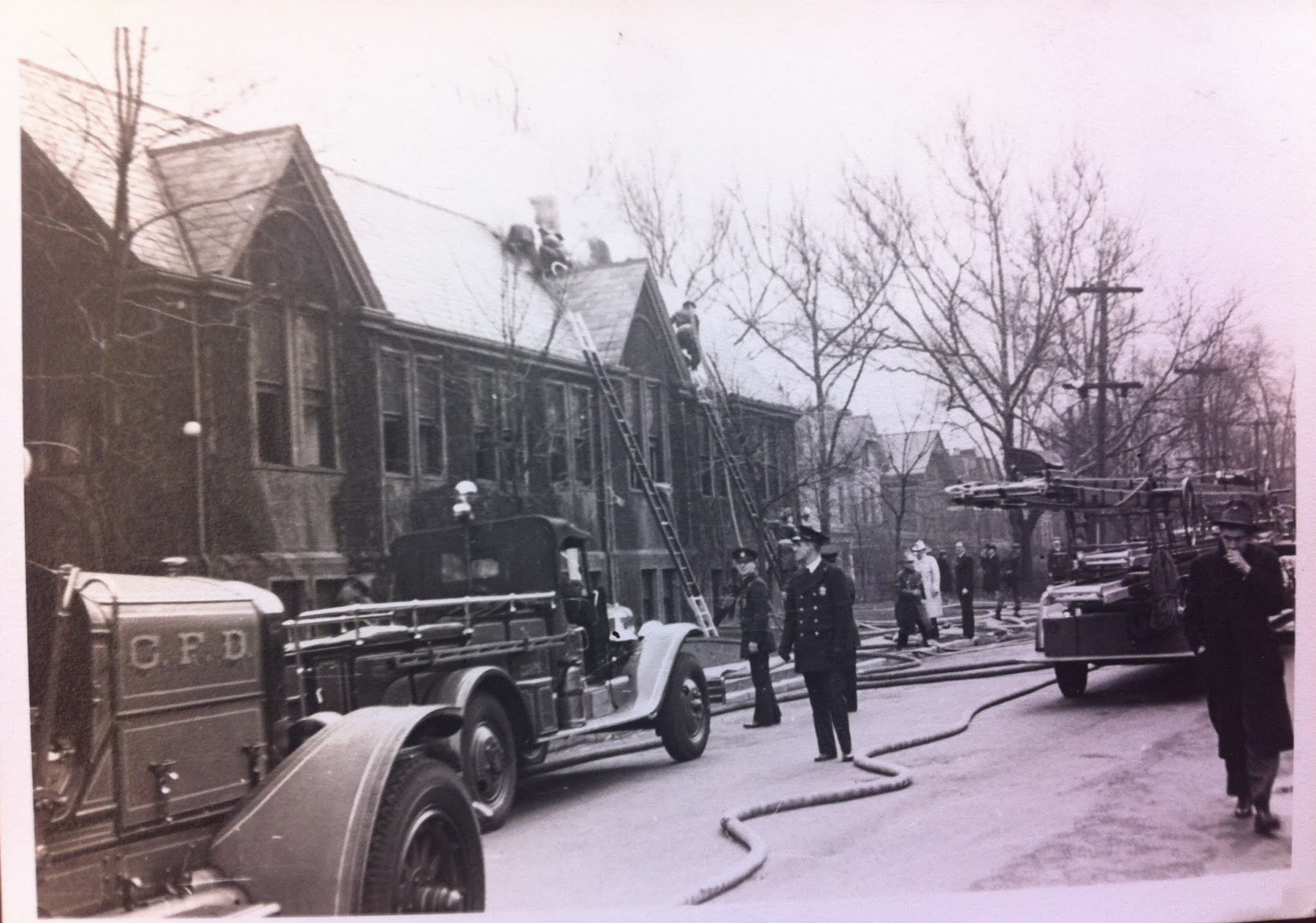
Church Service is Cut Short by $5,000 Blaze in Annex; Memorial Painting is Saved

17 March 1941 | Cincinnati Enquirer 

Fire of undetermined origin cause $5,000 damage to the two-and-one-half-story stucco annex of Seventh Presbyterian Church, Madison Road and Cleinview, Walnut Hills at noon yesterday during services.


The annex, which connects with the church, houses the pastor’s study, a library, a music room, an auditorium, and storage quarters.


The fire, starting in the upper half story of the storage room, burned fiercely under the slate roof, Assistant Chief Edward Shearwood and Marshal William Cunningham reported.


First news of the fire was given to Fire Company 23, a square away at Madison Road and Hackberry Street, when a motorist, George Hack, stopped to report that smoke was pouring from the building. The company hurried to the scene, followed immediately by other companies.


So quietly did the firemen approach that few among the congregation attending services were aware of the blaze until the pastor, Rev. Jesse Halsey, curtailed the almost completed service as smoke started to filter into the edifice.


The congregation filed out of the structure in orderly manner. Many then joined spectators on the sidewalk to watch the fire.


Rev. Mr. Halsey had been informed of the blaze some time before by the assistant pastor, Rev. Samuel Warr. Rev. Mr. Warr told his superior that firemen were on hand and that everything was under control.


Rev. Mr. Halsey and Mrs. Halsey thanked fireman and the Salvage Corps for protecting an oil mural in Rev. Mr. Halsey’s study with tarpaulins. The mural hung immediately below the point where the fire was most intense. The picture is one that Cleveland Woodward painted as a memorial to the Halseys’ son. William Halsey, who, when 7 years old, was killed by an automobile in front of the church in 1927. The building in which the fire started had been used earlier in the morning for children’s Sunday school classes. The children were out of the building, however, when the fire was detected.

Marshal Louis Schraffenberger and Captain Carl Rogers started an immediate inquiry . .   . 


Persons associated with the church were summoned to a hearing in Deputy Feldmeann’s office this morning.


Too Much Competition!


“There’s too much competition!”


Thus did Rev. Jesse Halsey, pastor of Seventh Presbyterian Church, impart to his congregation yesterday the knowledge that a fire in the edifice was too intense to permit him to complete the morning worship service. 


Rev. Mr. Halsey had been informed of the blaze previously by an assistant pastor, Rev. Samuel Warr. The clergymen had hoped that firemen, already on the scene, would be able to keep the flames under control sufficiently to avoid disruption of the services. 


Tuesday, October 9, 2012

Stories of the American Revolution

by Mrs. Edward P. White | circa 1932

Many local stories have come down to us from the days of the American Revolution. Tradition sometimes speaks louder than historical fact. With this in mind let us listen to some of the tales told by our great grandfathers, and remember that they heard them from their grandfathers who had really lived in Revolutionary times.

One of the most famous characters of those days was Pompey, a slave in the Mackie family. He was born in the colonies, was shrewd, a man of good sense, of much force, always ready to make or take a joke. Some English dragoons were quartered on his master in the winter of 1778. They made the mistake of insulting Pomp, and one day to get even he mixed pounded glass in the feed of some of the horses. Suddenly the horses were found dead in their stalls, Pomp was questioned by his master and cross-questioned by the officers, but was ignorant and innocent of any knowledge of the calamity. Sometime after the English troops had been withdrawn from these parts, Pomp’s master said to him one day, “Tell me, now, Pomp, what really happened to those horses.”

“Ground glass mighty good for hosses, Massa, ground glass mighty good for hosses.”

On another occasion he had difficulty with a soldier who was interfering with Pomp’s barn yard arrangements. The dragoon drew his sword. Pomp quickly charged at the soldier with his pitchfork and routed the man from the fields. (Howell’s History of Southampton)

Mrs. Betsy Bush of Southampton has the original bill of Pomp’s sale to his master.

MRS. LEMUEL PIERSON             Major Cochrane was the commanding officer in Bridgehampton. He is still remembered as a merciless tyrant. Bridgehampton suffered much from lawless soldiery by day and night. Cattle were carried off, forage seized without payment, and sometimes they even destroyed furniture in the houses of the inhabitants. One day they came to the home of Mr. Lemuel Pierson and turned him out. He was determined to take some of his furniture with him, and although the soldiers stood over him with drawn swords he gained his point. His wife proved to be as good a fighter as he for when the soldiers called another day in her husband’s absence, she met them at the door with a teakettle of hot water and threatened to scald the first man who came in. She was unmolested. (Howell)

EDWARD TOPPING                        In a house on Main Street and Corwith Avenue, Bridgehampton, lived Edward Topping. One night a number of English soldiers with blackened faces and coats turned inside out came to his house on mischief or trouble intent. Mr. Topping was awakened by their noise, and seizing his gun ran to defend his house. One man raised a window and started to enter. Topping commanded him to get out and said he would shoot if the man persisted. No attention was paid to his warning, and he shot. The man fell back dead and was carried off by his companions. The next morning word was sent to General Erskine in Southampton. General Erskine came down to learn the facts. When he learned the truth, the General said to his soldiers, “Is this one of the flower of the British army?” Then kicking the body, he said, “Take him down to the ocean and bury him below high water mark, and let me hear no more of it.” The same affair under Major Cochrane might have had a different ending for Mr. Topping. (Howell)

MARTHA HALSEY                        There is a pretty story of Martha Halsey, a young girl who lived in Southampton at the time of the English occupation. One day an English soldier approached her and asked her for a kiss. She angrily reached up and pulled off his hat and trampled it on the ground, much to the amusement of his companions, who jeered at him. Muttering, “You cursed little rebel,” he picked up his dusty headgear and slunk away. (Howell)

DR. SILAS HALSEY                        The town furnished four surgeons for the war of the Revolution: Henry White, Shadrack Hildreth, William Burnett, and Silas Halsey. Dr. Silas Halsey was a very determined man. There are many stories told of him. He lived in the Old Post House on Main Street at this time. It is said that once in crossing the ford at Water Mill, he met a squad of English soldiers, who threatened to capture him. In that day everyone was terribly afraid of small pox. They had reason to be, because vaccination was unknown. Dr. Silas on this occasion pulled a vial from his pocket and shook it at his captors.

“I’ve small pox enough here,” he shouted, “to pepper the whole British army. Let me go or I’ll fire it among ye.” No one stopped the doctor. He afterward moved to Connecticut among the refugees. His wife died there, and when the war was over, he moved to Ovid, New York, where his descendants live today. (traditional)

CAPT. DAVID HAND                        Captain David Hand had been a prisoner of war five times before his twentieth year. He was one of those unfortunate prisoners on the old Jersey, worst of prison ships. He was a man of great courage and daring. He was at one time robbed and plundered of his clothing by English sailors. He marched up to the captain of the ship and demanded it saying, “All I ask now is to begin at your traffrail and fight the whole ship’s crew forward and die like a man.” He was taken to Halifax, and footed it home across New England in winter. After tramping through the slush all one day, he thought he had taken his last step on earth, but he fell in with kind folks who nursed him back to health. He returned to Sag Harbor where he lived to the age of eighty-one, having had five wives. Their five gravestones may be seen today in Oakland Cemetery, Sag Harbor, and on his own this inscription:
            “Behold, ye living mortals passing by,
            How thick the partners of one husband lie;
            Vast and unsearchable the ways of God,
            Just but severe his chastening rod.”  (Adams)

CAPT. JOHN WHITE                        Deacon John White of Sagg was one of the refugees who had gone to Connecticut. While the English were in possession of Sag Harbor on May 23, 1777, he piloted the Meigs expedition which successfully crossed Long Island Sound, transported their whale boats across the north side of the island, crossed Peconic Bay, landed at Sag Harbor, arrested the English garrison and destroyed twelve English brigs and sloops, one hundred tons of hay, ten hogsheads of run, and a large quantity of grain. They returned to Connecticut in twenty-five hours without the loss of a single man. (Mather)


REV. SAMUEL BUELL                        One of the most noted characters of this section was the Rev. Samuel Buell, minister in the East Hampton church at this time. Although a staunch patriot, he made friends with the English officers, and was able by his friendly relations to do more for his people than if he had been unwilling to meet the invaders half way. He and General Erskine were very good friends and often went hunting together. One day General Erskine brought one of his young officers over to East Hampton to meet the minister. “And what division of His Majesty’s army do you have the honor to command?” Dr. Buell said pleasantly.

Lord Percy, young and arrogant, said quickly, “A legion of devils straight from hell.”

Not to be outdone in repartee, the old minister bowed low and said courteously, “Then I suppose I have the pleasure of addressing Beelzebub, Prince of Devils?”

Another time when General Erskine said, “Dr. Buell, I have just ordered your townsmen to appear with their teams at Southampton at seven o’clock tomorrow (Sunday) morning.” Dr. Buell replied, “Your Excellency, you are in command six days a week. Sunday is the Lord’s day. I am in command then. I shall countermand your order.” The teams did not go out the next day. (East Hampton History)

These are a few of the stories of the Revolutionary war, listened to by girls and boys of Southampton for generations. In recounting them we are reminded of Emerson’s Concord Hymn:            “The foe long since in silence slept,
                                    Alike the conqueror silent sleeps.”

The enemies of one hundred and fifty years ago are firm friends today, and England and America stand together, leading the world in understanding and friendship.

Courtesy Lizbeth Halsey White Files, Southampton Historical Museum Archives and Research Center.