Showing posts with label Sir Wilfred Grenfell. Show all posts

Tuesday, January 11, 2022

"I sometimes wish that modern female youth were not so conscious of its modernity."


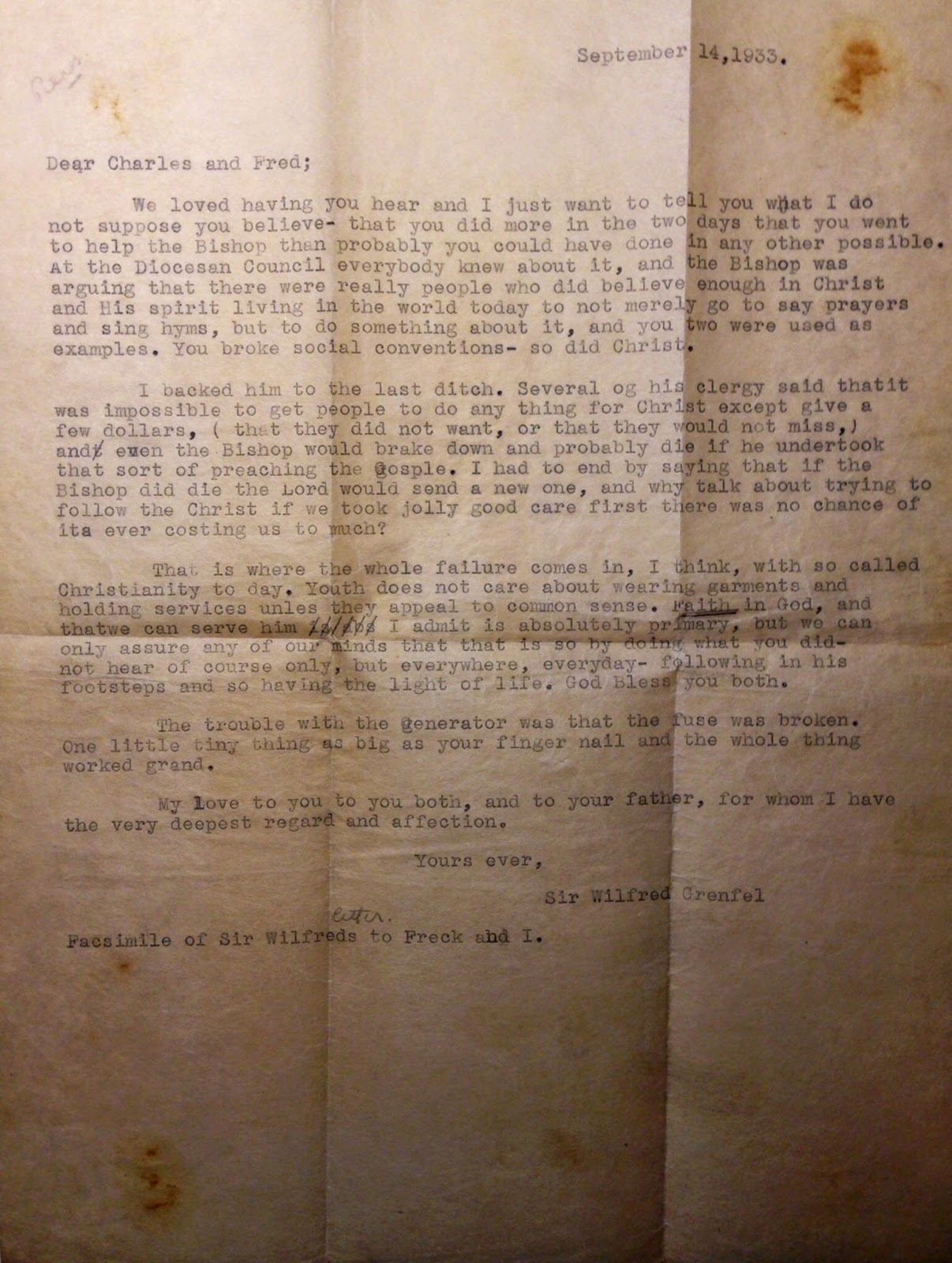
4 July 1939 | Sir Wilfred Grenfell to Jesse Halsey

Dear Jesse:


Thanks for your little affectionate thought and action. What big things little things may be. Don’t I wish you were coming on the journey. We sail on Monday.


When I get back, most certainly come down and bring Mrs. Halsey and put in a few days with us. I know the communion would be helpful to me. 


The wops keep up in number, and I am still as optimistic as ever about the coming of the Kingdom of God. Christ still means to me the hope of humanity. I sometimes wish that modern female youth were not so conscious of its modernity.


Be sure to come. You can drive here so easily on route #7.


My love to you both.


Yours ever, 

Wilfred Grenfell


Friday, December 9, 2016

ALL SOULS Acts 27:37

This is much that I love in this 1934 sermon written by my great-grandfather, Reverend Jesse Halsey, and much which still seems so relevant 82 years later. But these lines in particular strike me as  important: "Serious thought has been forced upon us and as we revamp our plans for the future, in the Spirit of Christ, regardless of what our traditional religious prejudices have indicated, we ought to go forward with our main reliance on the Ethical Gospel of our Lord. There is salvation in no other Name; and that, in the barest terms, He said, was to love God with heart, soul, and mind--and one's neighbor as one’s self."
Jesse Halsey, Sir Grenfell, Charles Halsey, c. 1930 | Peconic Bay
ALL SOULS Acts 27:37
“And we were in all in the ship two hundred, threescore and sixteen souls."

The ship in which Paul sailed toward Rome can be taken as a cross-section of society—then or now. The capitalistic owner and galley slaves. Sailors and land lubbers. Prisoners and police. Soldiers and civilians. A minister of the gospel, a writer, a physician—all sorts and conditions of men.

The Morro Castle disaster apparently is not the first time when sailors showed the “white feather.” Under pretext of putting out an anchor, the sailors on the SS “Castor and Pollux” sought to escape in the one remaining lifeboat. Paul’s word to the Centurion, “Except these abide in the ship, ye cannot be saved,” is a good word for each individual and group in our divided society, today. Each needs the other. It is impossible for the nation to come to its best or to go forward in any marked way, without the contribution that each group can make. There must be some common denominator.

This is equally true for all groups. The Catholic has something to add to our national life. We deeply sympathize with his insistence that religion enter into the education of children and if, by constitutional means, he can secure public funds, as good citizens and believers in democracy, I suppose, we will submit. On the other hand, we will make a vigorous fight to prevent this very thing, believing that our best contribution will be in support of a non-sectarian school system. The trouble with this situation is that most Protestants are anti-Catholic rather than pro-Protestant. For traditional and real causes they will fight Catholics, but when it comes to a positive support of their own churches, they are sadly lacking. Witness the attendance at worship in this church this morning, or in any other Protestant church in the city, unless it happens to be some anniversary or special occasion. A Protestantism that represents only animus toward other groups is entirely beside the point and unworthy.

I am ashamed to make any reference to my next point. It seems so obvious that denominational bounds within Protestantism are outgrown and “out-moded,” and yet we are farther away from any kind of coherent church unity than we were when I began my ministry, twenty-five years ago. The “world” outside, that incidentally contains many discerning people of good will, has little sympathy with our “unhealthy divisions.” They are a crying shame to heaven.

The first step toward a larger unity has been made in the Federal Council, which has had widely representative and capable leadership. No man today speaks with more spiritual authority and keen intelligence than Bishop McConnell, who speaks in our city next Sunday night. He has been one of the guiding spirits of the Federal Council.

The report on the steel situation fifteen years ago, violently opposed at the time, is now recognized as a masterly document that solved a problem in the field of labor that the government in Washington had failed to adjust. This report is an ample vindication of the Council and of future efforts in that direction from the same source, provided they be guided by the principle, which I would call Bishop McConnell’s “Principle of Prophesy,” which briefly is this: On the basis of the best information available, unprejudiced and gathered by experts from all sources, let the Church, in the name of justice and good will, indicate to economic and industrial groups the just policy, and you will have a prophetic voice speaking in no uncertain tones along lines that can be profitably followed. Put human interests ahead of property interests, with all the sanity and knowledge available! Apply the basic principles of the Gospel and the Church can still exercise its prophetic function. That endowment of power in other days came upon individuals, and that may happen again. But, more likely, it is destined in the future to speak through the combined intelligence of the Group.

Yes, we need each other. The Pacifist, in this present evil world, still needs the Militarist. Somewhere, between the two extremes, the public course must be charted. There are too many dangers for complete disarmament. On the other hand, all the enthusiasm of the sincere lovers of peace, all the good sense of statesmen, is needed to prevent the recurrence of war. It is an open question whether war ever accomplished any good commensurate with its awful cost. Nine-tenths of all our present day poverty, moral and economic alike, the world around, can be charged up to the Great War. On this I feel strongly and would defend the right of any lover of peace, no matter how extreme, to have his say. But I am enough of a realist to know that in order to make substantial progress, any program, whether it be promoted by churchmen or politicians, must give the assurance of national security to citizens of my country in order to gain their support, tacit or enthusiastic. But more of this next Sunday, which happens to be Armistice Day.

In the present county elections the ugly form of Nazism rears its head. We owe a great debt to our Jewish citizens. In this city they are among our most intelligent and generous philanthropists. This has been true for nearly a century. In the religious field, they have been given a surprising number of outstanding leaders in our city. Culturally and economically they have been a great asset. In the last decade they have proved stalwart supporters, and furnished striking leadership for, the desperate political situation of this municipality. But, I predict that the election next Tuesday will temporarily eliminate some of our most useful public servants simply because they are Jews, for an over-seas hatred, due to historical and racial reasons, finds a strong reflection in “Zinzinnati.” “My beloved brethren, these things ought not so to be” . . . . “Except these abide in the ship, ye cannot be saved.”
Now I ask you, as I ask myself, what are the forces that cohere? What are the things that bind us together? This multitude of all sorts, who travel in the same ship of state. [With us, as of old, there are prisoners, and the problems of the under-world and the gangsters are forced home upon us every day. What have we to offset this and the hundred other ills that afflict us?

This was a food ship, in which St. Paul traveled, carrying to Rome the wheat for the daily dole. Our relief situation is nothing new. Make it acute enough however, and you have the seeds of revolution sprouting fast.]

I should say that very likely in American life the thing that most nearly binds us together into anything like a common unity is the Public School, which is worthy of our support in the present or any other tax levy; not for the mere learning of the Three R’s, but enough money available for adequate equipment and a well-paid teaching staff that has had access to all the educational and cultural advantages of our time, that they may pass these on, consciously and unconsciously, to our children. Not a stereotyped, inflexible system that teaches by rote the ‘Law of the Twelve Tables’ or an interpretation of the Constitution sanctioned by the Sons of the Revolution—or the Daughters, but an intelligent, constructive educational policy that teaches the value of all that is good in the past and yet recognizes the inevitability of change. Over every public school might be written into the motto: “Prove all things; hold fast that which is good.”

Organizations like the Boy Scouts, the Red Cross, the present non-sectarian policies of the Y.W. and Y.M.C.A; these, and any other groups for young people or adults, that give them a cross-section of the community, that force people of all sorts and conditions to mix and to mingle—as they must have done on the little ship that sailed to Rome, these “two hundred, three score and sixteen souls,” learning to dislike each other and, in emergencies, to admire each other and depend upon each other for mutual help and support; all the things in our common life that acquaint us with each other, our strong cohesive forces.

And, the religion of Christ, by all means, ought to be one of these unifying factors. If Protestantism has been divisive, let us change its character. Paul said that Christ came to break down “a middle wall of partition” and that without this the Cross of Christ would become of no effect. Whatever the first century Christians may have done in this regard (there are the marks and wounds of strife in the Book of Acts), whatever they may have done or failed to do, our present interpretation of Christianity in Protestant circles is far from “breaking down” any walls. We have as many prejudices as have our Catholic neighbors, only theirs take a different form. Their united front and policy, of opposition to all who do not agree with them in theory, of course, is the very antithesis of the Gospel. Let it be a lesson to us.

Like these ancient mariners, we have thrown overboard much of the tackling of the ship. There is not much water between our keel and the rocks. Shipwreck may be ahead. If all abide in the ship, if there is a unified purpose of good will, all will come safe to land, though it may be on broken pieces of the ship.

No one is wise enough to predict the future. There are certain great and abiding principles that ought, however, to direct our life, individual and social. These have been defied; that is our trouble today. Old-fashioned honesty, a simple faith in action; these have been largely lacking in the setup of the last twenty years. We have become too sophisticated. There are many new helps to navigation, thanks to Lord Kelvin and a hundred others, but none of them can afford to neglect the stars. Like these ancient sailors, “we have cast our anchors out of the stern and long for the day.” Serious thought has been forced upon us and as we revamp our plans for the future, in the Spirit of Christ, regardless of what our traditional religious prejudices have indicated, we ought to go forward with our main reliance on the Ethical Gospel of our Lord. There is salvation in no other Name; and that, in the barest terms, He said, was to love God with heart, soul, and mind--and one's neighbor as one’s self.

We need a new infusion of the fear of the Lord, reverence for the Highest and Best, a new appreciation of good will and brotherhood, a baptism of the spirit of love that suffers long and is kind, that never fails and cannot fail.

In a neighboring factory, one day last week, an emery wheel “let go,” as they say, and flying off into space, worked havoc. Something in the conglomerate composition of the carborundum was not able to stand the stress, and break-up resulted. This is a picture, to many contemporary minds, of our civilization. It is flying to pieces. On the other hand, there are many whose picture is much more moderate. Forces of disintegration are undoubtedly at work, they say, and for better or for worse, changes have come and are coming; but the essential fabric is sound. The emery wheel still revolves and has cutting quality, though its spindle may be slightly eccentric.

No one but the extreme Tory believes that the machinery of our social and political life is in anything like perfect alignment. To begin with, there are no end of personal and party differences. The President last week very pointedly told the bankers that their group did not agree among themselves. There is certainly a divided counsel in the administration itself. No one can predict whether it will swing right or left. Take any church group, and it is hard to find a dozen people who absolutely agree about any one thing.

Four ministers sat at lunch last Friday. After rather vigorously criticizing the President, one of them pointed out that if they four were committed with the destiny and policy of their own denomination, they could not agree among themselves, not only in details of administration, but on some points of, what their fathers would have considered, basic theology.

Everywhere you find it:
Catholic versus Protestant
Jew versus Gentile
Democrat versus Republican
Charter versus Organization
Blacks versus Whites
Capital versus Labor
The haves versus the have-nots
Conservative versus Radical
Pacifist versus Militarists

The list could easily be doubled. It looks like a football schedule, only in this game there is generally less sportsmanship than is manifest on the intercollegiate gridiron. What is it, then, that holds our conglomerate society together? With all the causes of faction and division, what is it that makes the whole cohere? There must be something in the life of our body politics, for in spite of all the disruptive forces, in peace and in war, the nation, for over one hundred and fifty years, has held together.

It is encouraging to note, in the first place, that these divisions are nothing new. The present agitation in political circles, induced by Catholic interest in public school money, is a mere echo of the thunders of the “Know-Nothing” agitations of sixty years ago. We will always have some “Klansmen” with us. Likely, all that we can ask is that they go unmasked.

The newer and more accurate historians of our Revolutionary War indicate very clearly that sentiment in the colonies was anything but unified. John Adams says that in Massachusetts, likely the most patriotic colony, nearly forty-five percent of the people were opposed to the Revolution. (Curiously enough, the loyal people in those days were those that supported the king. In this case, as often, the revolutionist of one period becomes the patriot of another.)

Wednesday, January 7, 2015

Wednesday, December 10, 2014

“The saint in overalls”

-->
25 May 1912 | Brooklyn Daily Eagle
-->
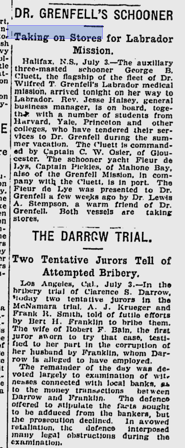
The Rev. Jesse Halsey of St. Anthony’s, Labrador, one of Dr. W. T. Grenfell’s right-hand men, is just now on a visit to New York in the interests of the Grenfell mission. After a ten days run with the dogs he reached the coast and sailed for Boston in a small sailing craft, arriving there three weeks ago. He departs again in a few days for Labrador. Mr. Halsey, after two years in Princeton, graduated from Union Theological Seminary in 1910. He distinguished himself in his theological course and had excellent opportunities for work in the States, many influential Presbyterian pulpits being open to him. He elected, however, to go to Labrador. Here he has done “a man’s work,” not only doing the usual duties of pastor and preacher, but donning his overalls and working whenever occasion required as carpenter, plumber, and odd-jobber. “The saint in overalls” is the name bywhich he is known by his Labrador colleagues. Mr. Halsey is married and has one child. He will preach on Sunday for the Rev. Gwilym O. Griffith of the Sixth Avenue Baptist Church, who was a fellow student of his at Princeton. On Sunday evening he will give an illustrated address on the work of the Grenfell mission.

Tuesday, November 25, 2014

"He breaks the ‘Bread of Life’ with clean hands."

from a student of Jesse Halsey's at McCormick
 
FOREWARD

It may be a presumptuous for a student to undertake the task of writing a biography of his professor, but the joy that the writer has gleaned from making new and rich discoveries of insights into the character of his “Ideal” has and will out-weigh any possible misunderstandings relative to gathering and interpreting the facts.

The writer wishes to thank all who have asked him in obtaining information about Dr. Halsey: Dr. John Frederick Lyons for assisting in finding some of the articles that Dr. Halsey wrote and The Reverend L.W. Harvison a personal friend and admirer of Dr. Halsey who gave many interesting facts about him as a pastor in the Seventh Presbyterian Church, Cincinnati, Ohio.

The “biographer” wishes to beg pardon from Dr. Halsey for the poor attempt at writing his biography. The writer will be very happy to have corrections made where needed.

“My Ideal”

Dr. Jesse Halsey was born in Southampton, Long Island, New York. “Go where you will through these United States, when you find certain names you know their forbears came sometime or other from Southampton—such names as these: Howell, Sayre, HALSEY, Pierson, Cooper, Herrick, Fordham, and Topping.[1]

Along with his big wrists and heavy hands go his covetous ability of doing a thousand-and-one things properly and well. The present writer, observing that these characteristics are generally those of men who have spent many of the formative years on a farm, was not surprised to learn that his “Biographee” was once a farm boy. Could any but a farmer’s heart “see” “farm houses low and sturdy with grey weathered shingles punctuate the flat countryside. Shingles three feet long, rived from red cedar that grew in the swamps, worn thin now where they have defied the east-wind-driven storms of two hundred winters and the bristling heat of as many summers, but with butts still thick enough to cast healthy shadows in endless parallel windows where the long sweeping roofs on the north side slope almost to the ground . . .

“Leaning barns and wood sheds where eel-spears and clam rakes and harpoons prod the latest agricultural machinery. A discarded seine is sometimes seen, used now as a net for tennis or volleyball, but a swift reminder of days when corn was grown with fish for fertilizer—‘two bunkers to a hill.’”[2]

After having done countless chores on the farm and having laid an academic foundation he went to Princeton where he sat at the feet of the famous teacher who conceived the idea for the League of Nations, Woodrow Wilson. A little insight into a teacher-student relationship is suggested by the two swapping dictionaries. After Princeton, Dr. Halsey went to Union Seminary.

Dr. Halsey served with Dr. Wilfred Thomas Grenfell in Labrador, doing countless and diverse duties from fixing plumbing to assisting at the operating table. With Dr. Grenfell, Dr. Halsey shared the rewards of skillful service joyfully rendered. “Dr. Grenfell always had a high regard for him. The same is true of men like Dr. Henry Sloane Coffin and Dr. Robert E. Speer,” writes the Reverend L.W. Harvison.

During the First World War, Dr. Halsey served abroad as chaplain, ministering to our men “whatever, whenever, and wherever.” At the close of the war he “returned from Russia and spoke at the synod of Ohio concerning the fame of Wilson and America in Russia at that time.”[3]

Accepting a pastorate in Cincinnati, Dr. Halsey soon became a “leader of a small growing group of ‘liberal’ ministers at a time when it was dangerous to be known in that Presbytery as a liberal. Largely under his influence, the spirit of that Presbytery was changed from one of belligerent fundamentalism to one of a harmonious fellowship of men of divergent theological beliefs.[4]

While pastor of the Seventh Presbyterian Church there in Cincinnati, Dr. Halsey organized what is now known as the “Presbyterian Ministers’ Breakfast Club.” It meets the first Monday in each month in the dining room of that church. This club grew out of a need for ministers to “get together” in attempting to solve problems and to lay plans. Thanks to the resourcefulness of Dr. Halsey the club was organized and given such a start as to be still a high-light of the month for the ministers.

He is the type of man to whom men instinctively turn for help in time of trouble. He has gone beyond the bounds of organized religion to be friendly to men of other faiths and cults. To other ministers he has been a kind of “pastor’s pastor” or a bishop without Episcopal authority because he has cared nothing for authority over others. “He has unstintedly given of his time to help others and has always been interested in the pastors of the small churches who have been in need.”[5]

Not only is he an outstanding churchman, but a citizen. At Cincinnati he was a positive force for civic righteousness. “There are things to see in Cincinnati—as in any other big city. I am not thinking of them except as they help one to feel the pulse of the municipality and gauge its inner spirit. The Chamber of Commerce will direct you to the sights of the town. I would guide you to its heart.”[6]

“His church was always interested in missions and gave generously. He was interested in improving conditions of church life in the deteriorated West End of Cincinnati. I have known him to drive thirty miles to take food and money to an old man and his wife who were strangers but appealed to him in need. I do not suppose that even he knows how much of his money he has given away to those in need. But these things were never done with an eye to publicity . . . He is a man of humility and utterly devoid of pretension. He has taken criticism humbly where many of us might have been disposed to defend ourselves against it.[7]

Even his best friends do not consider him as a great preacher, yet he is a great preacher from the standpoint that when he preaches it is truth coming out of his big heart and personality. “He is a man who, as much or perhaps more than any other I know, incarnates his gospel.”[8]

He has given many the impression of being blessed with a strong physical constitution, by maintaining a physical pace that is beyond the energy and inclination of most men. He did much of his reading late at night after his family retired and while most of his fellow ministers were asleep.

He breaks the ‘Bread of Life’ with clean hands. “I think he has never said anything ‘off-color’ or smutty.”[9]

“He is a man with a variety of interests: music, art glass, poetry, short stories, cooking, painting, and whatnot . . . He is at much at home in a pair of overalls with a rake or shovel in his hands as in a pulpit robe . . . In Cincinnati, he organized a group of ministers to paint the interior of my church. It would be interesting to know just how many churches he has helped to decorate on the inside and outside.”[10] During the fall and winter of 1945, he was not only instrumental in getting the chapel organ put in, but he did some of the work. During the Christmas holidays he and a few students painted the interior of the chapel.

Dr. Halsey has always been a man of open-mindedness, but he has been unfailing in loyalty to Christ. As a professor of Pastoral Theology he attempts to see (and does see) both sides of the question. He can see with the eyes of the so-called “liberals,” “conservatives,” “radicals,” and whatnot. He sees through the eyes of pupil as well as teacher. He is a friend to everyone.

The “biographer” has made reasonable effort to find and read as much of his writings as possible. Again the old saying, “Great teachers do little writing” is illustrated. The most widely known of his work as a composter and compiler I believe, is his most helpful suggestions for funerals: LIVING HOPE.

The article on the newly revised Book of Common Worship, “A Sense of Direction”[11] gives insight into the Pastor as a lover of good form in worship. (Dr. Halsey served on the revision committee.) The article on “Books of Common Worship” that appeared in the winter number of “Religion in Life” (1933) gives a rather complete list and helpful comments on the various books. Dr. Halsey’s rich, suggestive and helpful prayers, responses, and litanies often have some quotation or paraphrase from works of such great men as Dr. W.E. Orchard and Dr. John Hunter.

Dr. Halsey generously gives much credit to many great men as having exerted influence upon him. It was Dr. Richard S. Campbell, says Dr. Halsey, who influenced him to enter the ministry. About a dozen great men who influenced Dr. Halsey had as their model Maltie Babcock. “Behind him (Dr. Halsey) have been certain persons of Christian influence: his father, his sister, Dr. Grenfell, Dr. Coffin, and others I may not know.”[12]

Dr. Halsey has been shepherding the “budding undershepherds” here at the seminary since 1939. He was not here long before the students found in him a confidential and able counselor. One student remarked, “Dr. Halsey has more ‘horse-sense’ than all of the other professors put together.’”

Dr. Halsey’s office is the most popular office for students seeking sound advice, or coming with sorrows or joys. He gives the student the impression that he has all the time needed to listen to some problem.

It is unfortunate (for the students) that Dr. Halsey’s many duties require his presence off the campus. [Amen is written in the margin by JH.]

In class he is careful to give the student a wholesome combination of the scholarly with the practical. He also sees that every student who takes his courses shall at least know something about weddings and funerals.

The present writer has heard him called or referred to as “Skipper” and “Uncle Jesse.” Perhaps his “nick-names” will suggest a much better biography than a hurried student can possibly write.

[handwritten at bottom] Humbly I say “thank you.” I’ll try to live up to the implications. JH


[1] “The East riding of Yorkshire,” Jesse Halsey, The Presby. Tribune, July 1940, p. 12.
[2] IBID, p. 11.
[3] From a personal letter from L.W. Harvison, Harvey, Ill. Oct. 24, ’46.
[4] IBID.
[5] IBID.
[6] “The Spirit of Cincinnati,” Jesse Halsey, The Presbyterian Tribune, May 16, 1935.
[7] From a personal letter from L.W. Harvision.
[8] IBID.
[9] IBID.
[10] IBID
[11] Jesse Halsey, The Presbyterian Tribune, July 1944, p. 17.
[12] From a personal letter from L.W. Harvison.


The Jesse Halsey Manuscript Collection. Special Collections, Princeton Theological Seminary Library.

Wednesday, October 1, 2014

Clamming in Labrador

"The Boss & the Gang (College Students from U.S. College)"
Repeatedly, I asked Joe Souley, John Patey, and the other fishermen who worked at the time “on the Room” (mission) if there were no clams in the harbor. The bottom at low tide looked just right for long clams, but they always said, “No.” One day I took a bucket and spade and went up to the “top” of the harbor (a mile) and came back with some good-sized one. The mud was full of them. When I showed them to Joe, he blurted, “Skipper, them are no clams, they be Cocks and Hens.” “Don’t you ever eat them?” I asked. “Not if we can help it, all durin’ the Starvation Winter we had nothin’ else, and never ate ‘em since.” Our reasonably meager diet was often increased by clam bisque, clam-pie, and fried clams; soon other Mission folk followed and after a meal at our house, Joe and some other of the harbor folk followed suit—but gingerly. They had had enough.

They didn’t know that many other groups, Indians and settlers, have survived starvation winters by the same means as is attested by the great shell heaps long the coast from Maine to Florida.

Joe Souley was a great person. He could neither read nor write but he knew a lot about life and human nature. He has sailed the seven seas and could describe ports, like Liverpool, that I had seen so accurately that I trusted his description of those I had not seen. And year after when I saw Yokohama, and Fuji, it looked just as Joe said it ought to.

Joe had worked in a copper mine up the coast at Tilt Cove and knew how to use dynamite. He taught me how to blast, but he couldn’t temper drills. They would be too soft and not hold an edge, or too brittle and break. I had watched Andy Jagger in the blacksmith’s shop on the way home from school, blown the bellow fro him, broken his twist drills, and learned many things from him. I remembered that he heated things he wanted to temper to a “cherry-red” and then dipped them in oil. Just what color cherry-red was while in a forge fire memory didn’t say, but trail and error demonstrated that it could be done.

Great boulders stood in the way of our pipe lines and cellars and much blasting was indicated.

(After his first Cottage Hospital was under roof, the Doctor, so he told me, had thought of a cellar and got a miner to blast—the roof was damaged! So we did our blasting first.)

Joe would have me hold the drill, then with a giant sledge he would begin to strike while I turned the drill in the hole. Then brave man, he took his turn holding while I . . . swung the sledge, fortunately for him I never missed—my old grandfather coming to the rescue. (I am a great believer in atavism—or whatever it may be called. Cap’n Harry, my grandfather, was a skilled mason (he built most of Greenwich Village in New York, over a hundred years ago.) He once was known to have cut the center out of a millstone to convert it into a well curb, cut it—on a bet—in thirty minutes. He knew how to swing a maul; I’m sure he was there fifty years later, for my help. (What’s fifty years among Yankees?)

--Jesse Halsey
1912

Tuesday, February 11, 2014

Jesse Halsey: Pastor, Presbyter, and Friend


McCormick Speaking |Vol. VII | March, 1954 | No. 6 

By John W. Christie
Minister of the Westminster Presbyterian Church, Wilmington, Del.

When I went to a Cincinnati pastorate during the first World War, Dr. Jesse Halsey was in Russia under the aegis of the Y.M.C.A.; but his name came up more frequently than that of any other minister in the town. Newcomer that I was, I found it impossible to believe that any one man could do all the things that people said this man did—preach, visit those sick or in prison, use the printing press, do plumbing, paint houses, repair pipe organs, cook, etc.

One day, as I looked out of my study window, I saw a man approaching, carrying a collection of beautiful Arctic furs. It was Jesse Halsey, just returned from the Murmansk coast where he had, for a season, represented both the United States and Britain, and where the British admiral had been sufficiently familiar with him to roar and swear at him affectionately.

One did not need to be in his company long to discover that he possessed unusual qualities. He knew and loved books, and The Book. He needed not that any should testify of men, for he knew what was in man. He knew how to do almost everything that anybody does with his hands, and he was always doing something with those hands for anyone in sickness or distress.

He had an incorrigible faith in people. Like his Lord, he believed that one who was lost was only lost, and that he might be found and saved. He knew how much the humble and the poor needed encouragement and friendly help. He knew also how much the successful but spiritually destitute likewise need help.

God gave him an amazing stock of good Long Island common sense, plus an abundance of the wisdom that cometh down from above. His counsel, therefore, was sought by all.

He labored more than other men, and he loved more than they did. He was tireless in his exertions—others he was forever sparing, never did he spare himself.

He had a most sensitive appreciation of what was significant in art, music, and literature. His mild eye was forever discovering truth and beauty in the things that hourly happen to us. Twenty times a day he would see or listen to something notable, suggestive, or moving. Then from his pocket would come an envelope or a bit of paper and a stubby pencil. Every night, when he emptied his pockets, he had a store of simple and unhackneyed illustrations.

His church members loved and admired him; so did his neighbors of all creeds; so also did his assistant and his church custodian!

He was a good presbyter. In troublous times he kept his temper and his tongue and steadfastly loved his brethren, though never yielding his conscience or his convictions to their dictation. He could suffer fools gladly as none other could. He was the friend of forlorn causes, and he shamed the rest of us into duty by his example.

Jesse Halsey was an excellent preacher, but his daily life was his best sermon. For many, indeed, it was his life that made his Gospel credible.

Dr. Grenfell, for whom he was chaplain in Labrador for three years, shall have the last word here. I saw the letter in which, shortly before he died, Sir Wilfred wrote, “I have seen more of Jesus Christ in you than any man I ever knew.”

Thursday, February 6, 2014

Among the Deep Sea Fishers


"For the Early Days"


Anne Grenfell | 1910


from "Down North" | c1941


One day in the late spring of 1907, I was riding to the University on one of those (then) novel double-decker trams that ran in Glasgow. (The paper, this very day as I write, shows a picture of two bombed and gutted standing inert on the car-track) when I noticed a meager item on an inside page of an evening paper of how a mission doctor in Labrador had been carried off shore on an ice flow and had lived to tell the story. That was the first I ever heard of Grenfell. Two years later, I was on his staff—not as preacher but as plumber.

It happened like this. He came to Princeton Seminary to speak for a week at Chapel. Chapel was a dreary performance held at the end of the afternoon with a handful present and a cut and dried professorial performance in exegesis as diet. I seldom went. But hearing that Grenfell was coming that day, I went and took several other fellows along. The place was filled the second day; and before the week was out the crowd jammed the largest hall on the University campus.

In one of his talks he told the story of that ice pan experience (of which I had read on the Glasgow bus), in another he intimated that students sometimes would “down” with him in the summer to do odd jobs. I made an appointment at the house of the professor where he was staying. “Yes,” he took students along to help; “What was I going to be?” “A preacher!” “No, he didn’t need a preacher, they had too many on the shore already. “Well,” I ventured, “What do you need?” “A plumber,” he snapped back, “a plumber for our new hospital.” I signed up, then and there, knowing that water runs down hill and inheriting from my practical builder-mason-grandfather, a manual knack for doing things, and knowing how to solder and wipe a joint, and a few other things, from a Yankee blacksmith who had a shop on the back street where I used to stop in to blow the bellows and fuss around on the way home from school.

In May (Divinity Schools have a short term), I started out for Labrador. It took nearly a month to get there, for it was a late season and the ice hugged the land so that schooners and mail boats couldn’t get “down along” shore. When we reached St. Anthony all set “to plumb” the hospital, I found that the hospital wasn’t even built. The Chief was like that: ambition always running ahead of any possible performance on the part of his helpers.

Not only was the hospital unbuilt, not even a foundation was in, no excavating done either. So after putting a new window in the log bunk house for light and air (terribly dull tools they had and my new plumber’s kit didn’t fit the wood working job, all their tools were dull except the axes; a Newfoundlander can build a ship with his ax and after I had fussed for half a day with brace and bit (dull in spite of my file) and key hold saw pecking at the logs, Old Skipper Joe Souley came along and in ten minutes with his ax cut the hole in the side of the bunk house where I installed my window.

There being no one more capable available, I set about excavating for the new hospital cellar. We struck solid rock. I knew nothing about blasting—except that one did it before building. (The Doctor having finished his first hospital realizing that it needed a cellar, undertook to blast one and blew off his roof.) Skipper Joe (my friend of the ax) had worked in a mine; he knew how to blast! But he didn’t know how to sharpen drills. Here my Yankee blacksmith came to my aid; (by quasi proxy). I had watched him and had a dim notion of how it was done and after considerable experimenting—just the right heat “cherry red” dipped at the right moment in oil, the drill was just the right temper, not too hard to be brittle and break under the sledge as it bit its way into the rock and not too soft—not cutting at all but just further blunting itself.

I would hold the drill; Joe would strike it with the big sledge, strike with an unerring accuracy; when my turn came to strike and he to hold, like the brave man he was, he held the drill while I swung the sledge, fortunately for him I never missed—my old grandfather coming to the rescue. (I am a great believer in ativism—or whatever it may be called. Cap’n Harry, my grandfather, was a skilled mason (he built most of Greenwich Village in New York, over a hundred years ago.) He once was known to have cut the center out of a millstone to convert it into a well curb, cut it—on a bet—in thirty minutes. He knew how to swing a maul; I’m sure he was there fifty years later, for my help. (What’s fifty years among Yankees?)

When the holes were drilled we began to blast. It was cold; dynamite will not explode when it is “frozen.” Joe would build a fire in the forge and put me to blowing the bellows, with a pail of water on the coals. When it began to boil he would pile sticks of dynamite cob-house fashion on the pail there to “thaw.” “Let out a reef, Skipper,” Joe would say. I would accelerate and the sparks would fly all round the pail and all over the dynamite. “No harm, Skipper, she can’t bust abroad without the cap.” When the sticks were sufficiently softened, Joe would cut a length of fuse and fasten on a cap (detonator) to the end of the fuse. The cap is a hollow tube an inch long made of soft, malleable copper. Joe would take the thing between his teeth (he had two that met) and craunch the cap on to the fuse. (When it became my turn (under his tutelage) I used the pliers (as Dupont suggested). Not so Skipper Joe Souley—“Teeth’s quicker.” Then we would insert the cap and fuse in a stick of dynamite, put it down in the drilled hole in the rock on top of one, two, or three other sticks of dynamite and then with a stick, tamp dirt into top of the hold. Then we’d pile a lot of logs on top with a few lengths of old anchor chain to (hold her down), light the fuse and run. At least I would run, Joe was too old, or too fat, or to lazy, or too proud to run. He would amble along and maybe get behind the forge house before the blast brought down its concomitant shower of small rocks and gravel.

It took all summer to build the hospital cellar and frame up the hospital. In the fall, I came back to Seminary in New York, bringing an esquimoux boy to Pratt Institute in Brooklyn to learn lathe work and other things that I didn’t know much about. Theology played second fiddle, I fear, that winter. I got hold of an old friend who was a master plumber and heating engineer and learned to figure radiation, etc., etc., ad infinitum (to use theological language). By the next spring I had collected in Boston a schooner load of radiators, boilers, pipe fittings, tools, tile, linoleum, and what-not enough to plumb and heat the new hospital and the old hospital and several other hospitals and mission buildings at various stations along the shore.

In May (this is 1910), I graduated as a Bachelor of Divinity, was married, and in June set out for Labrador on a honeymoon.

There we stayed three summers, two winters. There our two older boys were born. There I would still be if I had been a doctor instead of a preacher. When the plumbing work was done, I became business manager for the mission. When the expert accountant, Price, Waterhouse recommended that the business office be put in St. John’s Newfoundland, rather than on the field, I lost interest in the business job, even though they had been interested in me. I had been buying thousands of dollars worth of supplies of all kinds, running a big schooner on several voyages back and forth as her skipper and how I ever kept out of jail with my accounts, I don’t quite know (or off the rocks with the schooner). It always puzzled me to make up a set of books that would balance and no wonder Price, Waterhouse wanted an accountant and not a preacher.

--Reverend Jesse Halsey