Showing posts with label 1912. Show all posts

Wednesday, December 10, 2014

“The saint in overalls”

-->
25 May 1912 | Brooklyn Daily Eagle
-->
The Rev. Jesse Halsey of St. Anthony’s, Labrador, one of Dr. W. T. Grenfell’s right-hand men, is just now on a visit to New York in the interests of the Grenfell mission. After a ten days run with the dogs he reached the coast and sailed for Boston in a small sailing craft, arriving there three weeks ago. He departs again in a few days for Labrador. Mr. Halsey, after two years in Princeton, graduated from Union Theological Seminary in 1910. He distinguished himself in his theological course and had excellent opportunities for work in the States, many influential Presbyterian pulpits being open to him. He elected, however, to go to Labrador. Here he has done “a man’s work,” not only doing the usual duties of pastor and preacher, but donning his overalls and working whenever occasion required as carpenter, plumber, and odd-jobber. “The saint in overalls” is the name bywhich he is known by his Labrador colleagues. Mr. Halsey is married and has one child. He will preach on Sunday for the Rev. Gwilym O. Griffith of the Sixth Avenue Baptist Church, who was a fellow student of his at Princeton. On Sunday evening he will give an illustrated address on the work of the Grenfell mission.

1912 | Nassau Presbytery

10 April 1912 | Brooklyn Daily Eagle

"Southampton public school has distinction of having two Labrador children on its roll."

 The children were brought here by Mrs. Jesse Halsey, wife of a minister at Dr. Grenfell's station at St. Anthony's, Newfoundland. The Rev. Mr. Halsey is a native of Southampton and has been located in Labrador for a number of years and tkaes a great interest in the education of the children at the Far North Mission. He will soon join his wife here, having been granted a leave of absence. 
4 Nov. 1912 | Brooklyn Daily Eagle
The two children, who are being education in the Southampton school through the generosity of Mr. Halsey, are Alfred, aged 11 years, and Alice, aged 15, children of Edward Evans, a reindeer herder employed by Dr. Grenfell. As they were under 16 years of age and not accompanied by their parents, they wre temporarily held by the immigration inspectors in Boston, where they arrived October 15 on the auxilary schooner George B. Cluett. The vessel was twenty-four days on the passing from St. Anthony's, and during the most of the time was best with furious gales and heavy seas.

Helen I. Halsey on board The Geo. B. Cluett
Archibald Ash of Red Bay, N.F. and John Newell of St. Anthony's were also passengers who made the trip to Boston. This is Mr. Ash's second visit to the United State. He has attended Pratt Institute, Brooklyn, and will re-enter that school to take a course in electrical engineering. His previous study was in mechanical engineering. On his return to Labrador he was given the work of making plans for a public building and he prepared the same in a faultless manner. Mr. Newell will study carpentry. When they have completed their studies, they will return North to engage in teaching. 

Wednesday, October 1, 2014

Clamming in Labrador

"The Boss & the Gang (College Students from U.S. College)"
Repeatedly, I asked Joe Souley, John Patey, and the other fishermen who worked at the time “on the Room” (mission) if there were no clams in the harbor. The bottom at low tide looked just right for long clams, but they always said, “No.” One day I took a bucket and spade and went up to the “top” of the harbor (a mile) and came back with some good-sized one. The mud was full of them. When I showed them to Joe, he blurted, “Skipper, them are no clams, they be Cocks and Hens.” “Don’t you ever eat them?” I asked. “Not if we can help it, all durin’ the Starvation Winter we had nothin’ else, and never ate ‘em since.” Our reasonably meager diet was often increased by clam bisque, clam-pie, and fried clams; soon other Mission folk followed and after a meal at our house, Joe and some other of the harbor folk followed suit—but gingerly. They had had enough.

They didn’t know that many other groups, Indians and settlers, have survived starvation winters by the same means as is attested by the great shell heaps long the coast from Maine to Florida.

Joe Souley was a great person. He could neither read nor write but he knew a lot about life and human nature. He has sailed the seven seas and could describe ports, like Liverpool, that I had seen so accurately that I trusted his description of those I had not seen. And year after when I saw Yokohama, and Fuji, it looked just as Joe said it ought to.

Joe had worked in a copper mine up the coast at Tilt Cove and knew how to use dynamite. He taught me how to blast, but he couldn’t temper drills. They would be too soft and not hold an edge, or too brittle and break. I had watched Andy Jagger in the blacksmith’s shop on the way home from school, blown the bellow fro him, broken his twist drills, and learned many things from him. I remembered that he heated things he wanted to temper to a “cherry-red” and then dipped them in oil. Just what color cherry-red was while in a forge fire memory didn’t say, but trail and error demonstrated that it could be done.

Great boulders stood in the way of our pipe lines and cellars and much blasting was indicated.

(After his first Cottage Hospital was under roof, the Doctor, so he told me, had thought of a cellar and got a miner to blast—the roof was damaged! So we did our blasting first.)

Joe would have me hold the drill, then with a giant sledge he would begin to strike while I turned the drill in the hole. Then brave man, he took his turn holding while I . . . swung the sledge, fortunately for him I never missed—my old grandfather coming to the rescue. (I am a great believer in atavism—or whatever it may be called. Cap’n Harry, my grandfather, was a skilled mason (he built most of Greenwich Village in New York, over a hundred years ago.) He once was known to have cut the center out of a millstone to convert it into a well curb, cut it—on a bet—in thirty minutes. He knew how to swing a maul; I’m sure he was there fifty years later, for my help. (What’s fifty years among Yankees?)

--Jesse Halsey
1912

Wednesday, May 7, 2014

Women Should Wash, Iron, Cook, and Live Long


“Modern woman is dying because the life in her is becoming stagnant for want of real work. She ought to get down and scrub the floor, do her own washing, ironing and general housework, in order better to enjoy life. She ought to think for herself, also, instead of running to libraries to get out a book and find out what some one else has thought.”

“I know what I’m talking about,” Miss Page smiled-serenely, “when I urge women to work with their hands and work hard. For six years I was connected with a sanitarium for nervous invalids in Kingston, N.Y. The head physician and myself both came to the conclusion that what sent most of our women patients to us was not too much but too little work.”

“. . . It’s important to exercise one’s muscles, but it’s also important to exercise one’s brains. We moderns fall in the latter respect quite as often as in the former. We take our romance ready-made from the 15-cent magazine. And most of the rest of our thoughts and beliefs are hand-me-downs.”

Wednesday, February 5, 2014

from "Among the Deep Sea Fishers" | April 1912


Annual Report of the Grenfell Association of America

The schooner Geo. B. Cluett sailed from New York on her maiden trip on August 1st, 1911, carrying a very large cargo of miscellaneous supplies for the Mission stopping at Boston and Halifax to add still more to her already full cargo. She had been chartered by Mr. W. R. Stirling of Chicago for a pleasure trip to Labrador, with the understanding that he should take on his outward trip these supplies and leave them at the various mission stations, which he did. After this the vessel took the party well up on the Labrador coast, returning to Boston early in October, having proved herself with a few exceptions all that could be expected of such a boat.

She made her second trip to the North, leaving Boston in November, which seemed a hazardous, but absolutely necessary step to take, at this season of the year. She was loaded with the winter’s supplies of coal, food, and building materials, as well as having on board Mr. and Mrs. Halsey and their baby. She made the trip safely and expeditiously to St. Anthony, and returned to St. John’s, where she was chartered to carry a load of fish to Pernanbuco, Brazil. She made this trip in 30 days, leaving Brazil for the West Indies, arriving at Barbadoes in eight days, making a record trip between the two ports for a vessel of that kind.

Her next venture will be to carry a cargo of molasses from the West indies to St. John’s, after which we hope she will again be in New York, ready to take the furnishings for the new Institute to St. John’s, returning once more to the United States for the summer’s supplies for the Mission. After this it is hoped to charter her for the summer.

….A Special Study and Survey of the Needs and Possibilities of the Mission.

—In view of the action taken at our meeting a year ago regarding the possible taking over of the management of the Labrador Medical mission by the Grenfell Association of America, it was deemed advisable to send and expert in such matters to Labrador to make a careful study of the situation and report the exact condition at each point where work was being carried forward under the direction of the Mission. Mr. Cecil S. Ashdown, a representative of Price, Waterhouse & Company, was selected to do this very important work. He left New York early in June for St. John’s, spending the summer making a careful survey of the entire field, which he has embodied in a most exhaustive report. Too much praise cannot be given to Mr. Ashdown for the painstaking manner in which he performed his duties.

… A result of this survey has been the formation at St. Anthony of a special committee which reports monthly to our Executive Committee, and Dr. J.M. Little, who was with us two years ago, has been appointed officer in charge at St. Anthony, and is chairman of this committee.

… Rev. Jesse Halsey, who has been connected with the Mission for some time under a merely nominal salary, has been chose as purchasing agent and general business manager of the entire Mission.

The purchasing of supplies, which in former years was done almost wholly from the field, has been transferred largely to this office in the interests of economy. We might also add that this has brought an added degree of responsibility to our office.

Willis E. Lougee, Secretary
5th March, 1912.

from "Among the Deep Sea Fishers" | April 1912


On Little Things
January, 1912.

Yours gratefully,
Wilfred T. Grenfell

Note by the Editor—After this article had been sent by Dr. Grenfell to the magazine, the Rev. Mr. Halsey brought to Dr. Grenfell’s attention a “little thing” which is so badly wanted as to deserve a special paragraph to itself. Mr. Halsey writes (and Dr. Grenfell add, “I hope very much we may get this”): “Here is something we need most of all to make a ‘go’ of the shop—one chain mortiser, number 3 standard, with compound table and a set of chain saws from a quarter of an inch to once inch ¼, 3/8, 7/16, 1/2, 5/8, ¾, and 1 inch.

from "Among the Deep Sea Fishers" | July 1912


St. Anthony Items
March 1st, 1912

Dear Mr. Editor,

Our chief is away. We get occasional hurried glimpses of his activities by letter, but we wish he were here. However it can’t be helped so we have to do the best we can without him. This is the first day of spring and I am writing a few of our doings through the winter to try and interest those interested in us. It does not seem much like spring, as the poets describe it. The mail has just arrived and it has taken the mail man with his team of dogs five days to bring it on its last relay of eighteen miles for it has been blowing north-east and “dirty.”

. . .The fuel problem gets more and more difficult as the wood gets cut out so that this winter the people found it impossible to keep their own fires going and provide ten sticks for each child for the school. We had therefore to close the school and divide the children between a big room at the orphanage and the lower ward at the hospital, both of which buildings, thanks to Mr. Halsey, are now steam heated. In this ward at the hospital also is held the night school five evenings a week, where Mr. Halsey, Mr. Blackburn and Mr. Fallon teach. I meant to say that Mr. Fallon also came on the last boat.  . . .Mr. Evans has had complete charge of the reindeer; has not only made trips and proved their speed in travelling under adverse conditions, but has taken charge of and driven our second dog team, doing much hauling and courier service.

Helen I. Halsey with Charles Henry
Mr. Halsey has been our general manager and overseer and besides his night school, holding services and preaching has generally had his coat off to help along some job or do a kindness to whoever comes within his radius. Mrs. Halsey takes care of the music in church and out, giving music lessons in her spare time and at present is mother two infants besides her own Charles Henry, while their mother has a much needed rest in the hospital.  . . . Mrs. Little took on the new job ob teaching me this winter instead of sixty children and I guess wishes she was “back on the old job.” Modesty forbids me to talk about myself. Too bad!

We are a happy busy family and only wish we had more of the friends and workers of the mission along with us to enjoy the winter. . .

This has proved a very vague outline of our winter’s doings. The life is so different from that at home that it is difficult to describe, but I shall have failed utterly if my readers do not understand that the mission is trying to teach Christ’s love through service in many forms and that its members are tasting the happiness that comes in doing it.

John M. Little, Jr.

from "Among the Deep Sea Fishers" | July 1912


St. Anthony, Newfoundland
April 20, 1912

Dear Mr. Editor,

The snow is still piled here around all our buildings. One of the cottages is absolutely shut in by a wall twenty feet high. All winter long it has been snowing and adding to our pile. The trees on the hill-top back of the Mission settlement are entirely buried and only here and there a green tip stand s out to modify the unrelieved whiteness of the whole landscape.

While the winter has not been as cold as last by the thermometer, it has been much more disagreeable. Three or four heavy snow storms with high winds and low temperature have made us realize what a northern winter really can be when it tries.

The month of February, however, was very mild, and during that time we were hauling out our firewood with the reindeer. Owing to the deep snow and the inaccessibility of the moss on which the deer feed, the have not been in the best of condition this winter and consequently could not pull as heavy loads as they sometimes do. They have however, pulled a creditable quantity of firewood for us.

The gasoline wood-saw given us last year by Mr. Rosenwald has proved one of the most useful of acquisitions. Last fall all the winter’s wood supply was sawed up during odd afternoons by some of the older boys, and as soon as the snow has gone the wood that has been hauled this winter will be sawed up and have a chance to season a little before it is needed for next winter’s firing. We really need a large woodshed in which we could store the firewood a year ahead; it would then be possible to burn seasoned instead of green and half-green wood during the winter.

The fuel question is one that is of grave importance, and we hope that the Geo. B. Cluett will make trips enough in the future to bring us a sufficient quantity of hard coal so that we shall not have the dread of fuel famine that we have always had formerly. We also need a sufficiently large quantity of soft coal from Sydney, which we may be able to sell to our employees. They find it very difficult to get firewood, and we might save much of their time by providing them with coal at cost.

We are expecting this summer to get down a large cargo of soft coal from Sydney for this purpose as well as for our own use. We find that hard coal is the most economical fuel for our use and it is absolutely necessary that we have enough coal to run the hospital and orphanage heaters. Wood is very expensive before it reaches our wood fire: hauling costs so much. In winter when it is necessary to give out work for poor relief we might cut wood here, but otherwise it would be much better and cheaper to rely on coal for fuel.

Doctor Little has been more than busy at the hospital all winter. Without the assistance of another doctor he has done all the travelling besides the regular hospital work. While he has been away, Miss Brown has been “doctor in charge” at the hospital. More patients than usual have spent the winter at the hospital. There have been a great many cases of tubercular bones, hip disease, etc., which are of a very discouraging nature, as it is rather depressing to doctor and nurses, day after day, to see the same faces without any improvement in condition.

The carpenter shop has been running full force all winter, making doors and sashes for the new buildings, the erection of which we are contemplating next summer. These will be a hostel or rest house where friends of patients who come here in the summer may be entertained at a moderate cost, or a house in a part of which we may be able to entertain friends of the Mission who come from the States or Canada, and who would come in increasing numbers if there were adequate accommodations for the entertainment in St. Anthony.

We also expect to build during the coming summer a small marine railway or slipway where our won boats and those of the fishermen may be dry docked for repairs. During the warmer days of the past month we have been finishing the upstairs hall or assembly room of the school house and the unfinished downstairs school room. The room upstairs is to have a large fireplace and will be fitted up with games and will be used as a reading and recreation room for the fishermen who call on us spring and fall, and for the use of the young people locally.

We also expect to have shower baths installed in the school house during the coming summer. The grounds will also be graded and fenced when our student volunteers visit us this summer.

Through the kindness of Mr. Stirling some changes have been made in the Guest House, which have made it much more comfortable during the past winter. Adequate heating facilities have been arranged; a bathroom is now being installed, and a new coal stove, several additional windows, and other minor changes are contemplated before our summer visitors arrive. Indeed, it would be difficult to overestimate the benefit of Mr. Stirlings’s visit to us last summer. We have felt since then that we had “at the other end” a friend who thoroughly understood conditions and needs here and who was intelligent and interested. We have never doubted the willingness of our friends, but naturally, when one has visited this coast he understands as never before the needs that we are seeking to meet. By his words of kindly encouragement and by his many generous gifts we shall long remember Mr. Stirling.

The night school has been carried on by Mr. Fallon, Mr. Blackburn, and myself, since the first of January. Three nights a week we have had serious study work and on Friday nights Mr. Fallon has given the boys some sort of an entertainment, either with phonograph, magic lantern, or games. Mr. Blackburn has conducted the book-keeping class for young men. The day school, under the charge of Miss Appleton with Miss Copping’s assistance, has prospered. During the coldest weather the school was divided, part meeting in one of the vacated wards of the hospital and part in the orphanage. When the weather made possible, school was held in the school house with a curtain drawn across the room as a partition.  Another winter adequate heating facilities will have been installed in the school house.

Mr. Forbes and Mr. Evans have given a recital at the church for the benefit of a new organ. The Methodist choir, under Mrs. Halsey’s direction, have given us special music at Christmas and Easter, with an excellent concert at the time of the sports.

As is our custom, the early part of March the sports were held for two days. People come for miles around to contest for the valuable and useful prizes that are offered. A spirit of real “sport” is growing, however, and there are some who contend for the joy of the contest rather than for the prize to be gained. This spirit is especially noticeable in our boys who have been at school in the States and have seen real sports in our schools.

If I may be allowed to make a request or two, I would suggest that some of our friends who send us magazines keep the files intact, tying a year’s subscription together, as so many people ask us for magazines that contain the other parts of continued stories.

Some kind friends of my own have been keeping files of McClure’s, Scribner’s, Century, Harper’s, and the World’s Work for several years and when the file is complete they tie them in one bundle and send them to us, and this winter I have had great pleasure in looking through these magazines, month by month. They happened to be two years old, but this did not matter greatly as to the interest with which I read them.

On the Strathcona people have asked me for the Youth’s Companion or the Ladies’ Home Journal of the week or month before that they might read the opening chapters of a continued story.

We are expecting a larger number of student volunteers than ever this summer and will have a very busy season no doubt with all the new work that we have in prospect. We are anxiously awaiting the snow to disappear that we may start our spring work.

Yours very truly,
Jesse Halsey

from "Among the Deep Sea Fishers" | July 1912


New York, May 5, 1912

Dear Mr. Editor:

Some of your readers may be interested in knowing a little something of the trip that I have just completed from St. Anthony.

Two weeks ago, Thursday morning, with Alec Simms, Dr. Little’s driver, and a team of eleven fine dogs, I left St. Anthony for Boston. For six days I averaged over fifty miles a day; the first day we made sixty-five. From St. Anthony we went across country to Flowers Cove on the Belle Isle Straits, where we spent the night. The next four days I was scudding along the bays that indent the coast of the Straits.

The going was fine, thawing somewhat in the afternoon and freezing hard at night with an early start we made good time.

Alec brought me to a place called Parson’s Pond, about half of the distance. The going as we had come father south had become soft and we thought it unwise for him to venture any farther from home, it being so late in the spring.

After leaving him, I came on by way of Bonne Bay to Deer Lake where the railway touches. The last half of the journey was made by walking or with the mail-men. None of the dogs that I found South were quite equal to our own, though our mail-men who go from Bonne Bay to Deer Lake had a splendid team of nearly twenty dogs hitched to a shed nearly twenty feet long. This was piled with mail as there had been no communication with the outside world for nearly two months, and I had to run behind a good part of the time.

The first part of the trip was nearly level, being along shore and only rough where the ice was heaped up as we crossed some wide bays. This last stage of the journey, however is up hill and down,, and with the slight crust on top and the rackets cutting through, it was very difficult walking.

Owing to the snow and other hindrances, it took nearly three days to accomplish the last one hundred and fifty miles by railway. This was about the same rate of travel that I had made with dogs and I must say that I prefer the travel with sled to that on the Reid-Newfoundland Railway in winter.

This journey of two hundred to two hundred and fifty miles (distances always seem longer than they are given by the people) was made in six days, which is only possible under the most favourable conditions of weather and snow.

Yours very truly,
Jesse Halsey

from "Among the Deep Sea Fishers" | July 1912


Items from the Grenfell Association of America

The George B. Cluett, after discharging her cargo in St. John’s, sailed for New York, bringing Mr. Karnopp down to look after the shipping of the furnishings for the Institute. 

She had a hard battle to fight coming through the fields of ice, so was somewhat longer on the way than had been anticipated. Her log showed that she was only about one hundred miles from the Titanic when the latter went down. Capt. Pickels brought her safely through, however, and after spending some time in Bridgeport having her engine repaired and other necessary work done, she finally reached New York. Mr. Karnopp was obliged to return to St. John’s before the loading was completed, but it was looked after by Mr. Halsey, who had come down from St. Anthony to purchase the summer’s supplies, and Capt. Pickels. After many delays such as seem incident to the running of boats, the Cluett, which had to stop at Boston to take on institute furnishings, finally go on her way to St. John’s. . . .

Mr. Halsey left St. Anthony by dogteam about the middle of April, coming about half the way with the dogs and the other half on foot, until he reached the railroad arriving in New York the latter part of April. This was rather strenuous travelling, and he found the paved streets of New York rather hard on feet that had grown accustomed to the soft seal skin boots in the north. Mr. Halsey has had charge of the purchasing of supplies for the mission and is now waiting for the Geo. B. Cluett to arrive so that he can superintend the loading of the cargo. The boat will come to Boston, where Mrs. Fowler’s party will go aboard. They hope to get away by the 25th of June. 

J. L. G., Secretary


Items from the New England Grenfell Association

My dear Miss White:
 
 .. . . As one of my pupils wrote later in an English exercise: “Our fingers was so cold that we couldn’t write.” The best we could do was to play games, sing songs, recite “verses” (anything with a jingle or a rhyme in it delights the hearts of these children) and read in relays around the stove, until far on into the day when things began to get warmed up. As soon as we told this story to Dr. Little and Mr. Halsey, they began to plan different arrangements for us. . . .

Our new schoolroom, as no doubt Mr. Halsey will tell you, was the new downstairs ward in the hospital, which, it happens, has not been needed for patients this winter. It is a large, pleasant room well lighted with southwestern exposure and a goodly supply of radiators. We now learned what it was to be too warm, for almost as soon as we had moved the weather began to grow mild and continued unseasonably moderate all through February. . . .

Affectionately yours,
Betsy L. Copping

***
February 22nd, 1912.

My dear Miss White:

Mr. Halsey has had entire charge of opening all boxes sent here since Mr. Webster left, so I have been unable to find out about hose you referred to, but I am sure all have been acknowledge as great care has been taken in that line since the St. Anthony Committee took charge.

… Sincerely yours,
John J. H. Evans

from "Among the Deep Sea Fishers" | October 1912


Dr. Grenfell’s Log
St. Anthony, July 4th, 1912

The school was still hard at work. It had been greatly improved, and under the care of two teachers a great deal of special work had been done, while Mr. Halsey of Princeton, who had wintered there, had pushed adult class work to good effect.


Items from the New England Grenfell Association

… Many Boston friends are anticipating the home coming of Dr. and Mrs. Little this autumn for a well earned furlough; Dr. Little having been at St. Anthony for three years past without any rest and last winter without any assistant. He has been a tireless worker and faithful member of the staff and his name is known and loved the entire coast. His annual report shows a great work done and Mrs. Little much beloved by all at St. Anthony, brings with her, John Mason Little, 3rd, born on July 1st, at St. Anthony Hospital.

E.E. W. Secretary, September 10th, 1912

from "Among the Deep Sea Fishers" | January 1913

--> Our Stewardship in 1912

St. Anthony is losing this year the services of our beloved friend, chief of outside workers, and "private parson," the Rev. Jesse Halsey. His house stands empty, and we lament his absence every time we look at it. We have never had any man whose Christ-like spirit in everything he touched has more gripped the love and imagination of our men. It is only a question of finances which makes us obliged to cut down this small salary. The price of a single dinner in so many of the large houses would add a year of his invaluable work.

Wilfred T. Grenfell


Items from the New England Grenfell Association

The coming of the schooner Geo. B. Cluett for the winter supplies was anticipated by Boston friends with more interest than usual. Her passenger list was a large one for this time of the year, among the passengers being Dr. and Mrs. John Mason Little, Jr., with their infant son of three months; Mrs. Halsey and her two boys (the youngest two months of age), and two native children whose father is a reindeer herder at St. Anthony and whose mother is not living. These two children (a girl and a boy) Mr. and Mrs. Halsey are to shepherd: the girl being old enough to act as a nursery maid, and both will attend school in Southampton, N.Y., which is the home of the Halseys this year!

Helen I. Halsey on board The Geo. B. Cluett
The voyage was the longest and most tedious ever reported by any of the Mission schooners, because of the constant and continuous head winds, and occupied twenty-one days between St. Anthony and Boston: the boat arriving on October 15th at noon. By telephone message from the Chamber of Commerce an hour in advance, many of the friends of the passengers on board were able to be at the wharf and see the Cluett come in, much to the surprise and delight of all. All on board gave great praise to, and expressed appreciation of the seamanship and cheerful optimism of Captain Pickels, which helped them to keep up their courage daily. The captain made the most of every breath of wind and caught and made use of it at every opportunity—but the chart showed that on some days the schooner was blown back almost faster than she could make up on the following day, and also showed a very peculiar zigzag path.

Beside a small amount of freight, the Cluett brought from St. Anthony a young black bear in the hold. The bear was for the Zoo in the Franklin Park of Boston. It was no small amount of labour to take the bear from the schooner to the park, and although it was all done in a scientific manner, by three of the men from the Zoo, the time occupied was no less than three hours, and young bruin showed some fight before he was finally placed behind bars in the cage brought in which to transport him.

Rev. Jesse Halsey returned early in November after superintending the building of the little home for the medical officer at St. Anthony, which was begun early in the season. The house was roofed in before Mr. Halsey left, and the work in the interior will go on early in the spring. It is hoped that it will be ready for Dr. Little upon his return in the coming summer. Mr. Halsey's three years of service have increased the possibilities for greater efficiency not only in the hospital but also the school, the orphanage, and the homes for the general workers. He has been the one man able to teach the native men about the plumbing, etc., etc. He is a graduate of Union Theological Seminary with a decided turn for mechanics--indeed, he might be called the Christian plumber of the Mission, for he has put furnaces into the orphanage and hospital at St. Anthony and has constructed a reservoir from which he has brought running water into these buildings. Skillful as he is in the mechanical line, he was no less successful when acting in the capacity of Christian teacher, in the absence of Dr. Grenfell, on Sundays in the church and hospital, and in teaching winter evening school, preparing the young men coming to Pratt Institute. It was a fortunate happening for both the Mission and the man when Mr. Halsey heard Dr. Grenfell lecture as he was graduated from Union Seminary, and he at once decided to join the volunteers in the Mission.

E. E. W., Secretary
17th December 1912

Thursday, January 30, 2014

Evening Telegram (St. John's, N.L.), July 4, 1912

CABLE NEWS.
Special to the Evening Telegram

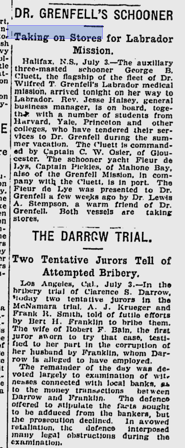
Halifax, July 3--The three-master schooner, George B. Cluett, Dr. Grenfell's flagship arrived today en route to Labrador. Rev. Jesse Halsey, General business manager, a number of students from Harvard, Yale, Princeton and other Colleges have tender their services. Capt. Osler, of Gloucester, is in command. The schooner-yacht, Fluer de Lys, Capt. Pickies is also here. She was presented to Grenfell a few weeks ago by Dr. Stempson. Both vessels remain to take in stores.,

Thursday, October 3, 2013

Mother's Day: The Creation, Promotion and Meaning of a New Holiday in the Progressive Era

By Kathleen W. Jones
Texas Studies in Literature and Language, Vol. 22, No. 2, An Issue Devoted to Popular Culture Studies (SUMMER 1980), pp. 175-196
Although the sentimentalized image of American motherhood was a product of the nineteenth century, it was not until the Progressive era that Americans adopted a special holiday in honor of that vision. The plan to reserve one Sunday each year for honoring mothers originated with Anna Jarvis, a Philadelphia spinster who intended to memorialize the anniversary of her mother's death through a public holiday. However, initial observances of the new holiday, in May of 1908, did not win immediate popular approval for the continuation of the project. This essay will examine the cultural motives and pressures that transformed Mother's Day from the crank idea of one woman into an annual social custom.
I shall show how the holiday was conceived by Jarvis, furthered by the American Sunday school movement, but not popularly accepted until the meaning of the new celebration was defined by the Protestant churches and then redefined into a secular celebration of traditional but menaced American values. Ministers and lay contributors to weekly church magazines used the holiday to express their fear that middle-class Protestant culture, the culture so aptly characterized by the symbol of "Mother," was increasingly threatened in the Progressive era. Through sermons and didactic stories, concerned Protestants made of Mother's Day an adult celebration of their version of American values. When the holiday proved to be a powerful tool to sustain morale during World War I, the celebration of Mother's Day became a secular expression of loyalty to national ideals. Thus the history of the creation and promotion of the new holiday suggests that during the Progressive era the observance of Mother's Day fulfilled a social function beyond the purely personal mother-child relationship it ostensibly honored. . . .
. . . By 1912 religious publishing firms were offering to the church schools a selection of Mother's Day materials designed to attract youngsters to the Sunday meetings. Church presses produced special programs for Mother's Day, invitation cards, and celluloid carnations to distribute as mementoes. Teachers and ministers were assured that advance publicity through postcard invitations and newspaper coverage (churches were encouraged to buy space if necessary) would secure a large audience. The "successful observance" of the day was defined in terms of attendance, and ministers were advised that because of the "human appeal of the day" it was a "unique opportunity ... to reach the unchurched and the occasional church-attendant."* Sunday schools were instructed to issue special invitations to mothers and to seat them in a place of honor for the day. It was even suggested that the churches provide rocking chairs and child care for very young children, thereby enabling more mothers to attend. Leaders hoped that the attention to mothers would enlist the cooperation of the home in the Sunday school's effort to gain recruits.

*Rev. Jesse Halsey, "The Work of the Pastor: Suggestions for Mother's Day," Homiletic Review 71 (May 1916), 381. The Homiletic Review was published for use by Protestant ministers and contained sermon outlines and suggestions for prayer meetings as well as feature articles on the role of the minister.

Tuesday, September 11, 2012