Showing posts with label George B. Cluett. Show all posts

Wednesday, December 10, 2014

"Southampton public school has distinction of having two Labrador children on its roll."

 The children were brought here by Mrs. Jesse Halsey, wife of a minister at Dr. Grenfell's station at St. Anthony's, Newfoundland. The Rev. Mr. Halsey is a native of Southampton and has been located in Labrador for a number of years and tkaes a great interest in the education of the children at the Far North Mission. He will soon join his wife here, having been granted a leave of absence. 
4 Nov. 1912 | Brooklyn Daily Eagle
The two children, who are being education in the Southampton school through the generosity of Mr. Halsey, are Alfred, aged 11 years, and Alice, aged 15, children of Edward Evans, a reindeer herder employed by Dr. Grenfell. As they were under 16 years of age and not accompanied by their parents, they wre temporarily held by the immigration inspectors in Boston, where they arrived October 15 on the auxilary schooner George B. Cluett. The vessel was twenty-four days on the passing from St. Anthony's, and during the most of the time was best with furious gales and heavy seas.

Helen I. Halsey on board The Geo. B. Cluett
Archibald Ash of Red Bay, N.F. and John Newell of St. Anthony's were also passengers who made the trip to Boston. This is Mr. Ash's second visit to the United State. He has attended Pratt Institute, Brooklyn, and will re-enter that school to take a course in electrical engineering. His previous study was in mechanical engineering. On his return to Labrador he was given the work of making plans for a public building and he prepared the same in a faultless manner. Mr. Newell will study carpentry. When they have completed their studies, they will return North to engage in teaching. 

Wednesday, February 5, 2014

from "Among the Deep Sea Fishers" | January 1912


Items from the New England Grenfell Association

Since the last issue of this magazine the new schooner, the George B. Cluett, arrived in Boston on October 15th, upon return from her summer cruise on the Labrador. The George B. Cluett is a beautiful three-masted schooner but had not been thoroughly completed before she went north early in August, when she was chartered by Mr. W. R. Stirling of Chicago; hence the schooner was needing repairs, especially to her engine bearings, which necessitated her spending a short time here in dry dock. Meanwhile, the Revered Mr. Halsey and Mrs. Halsey had come down from St. Anthony for a brief furlough and to look after the cargo which they were to take back on the George B. Cluett as soon as possible. Mr. Halsey brought a complete list of the needs and beside these we had in storage many cases of clothing, etc., which the Lorna Doone was unable to take north in June. . .

There were also wedding gifts for Doctor and Mrs. Little, and a consignment of goods for Dr. Greeley at Pilley’s Island, where a small cottage hospital had been opened. . .

E. E. W. Secretary
12 December 1911

from "Among the Deep Sea Fishers" | January 1912


The First Cruise of the George B. Cluett

… However, she got away on the following Saturday morning, and arrived in St. Anthony the next week, Friday, having made the trip in just seven days. Mr. Halsey wrote of the latter part of the trip: “I would not have given ten cents for our $500 deck cargo, but the captain and men worked like Trojans and not a thing was lost!” . . .

“We had a very rough trip down to St. Anthony. The Rev. Jesse Halsey and wife and child went with us. Mrs. Halsey made a good sailor, but Mr. Halsey could not get over seasickness so he did not enjoy the trip very much. The weather was very rough at St. Anthony while we were discharging cargo, but notwithstanding the stormy passage we had coming down, the cargo came out in good condition.”

–H.C. Pickels, Schr. Geo. B. Cluett

from "Among the Deep Sea Fishers" | April 1912


Annual Report of the Grenfell Association of America

The schooner Geo. B. Cluett sailed from New York on her maiden trip on August 1st, 1911, carrying a very large cargo of miscellaneous supplies for the Mission stopping at Boston and Halifax to add still more to her already full cargo. She had been chartered by Mr. W. R. Stirling of Chicago for a pleasure trip to Labrador, with the understanding that he should take on his outward trip these supplies and leave them at the various mission stations, which he did. After this the vessel took the party well up on the Labrador coast, returning to Boston early in October, having proved herself with a few exceptions all that could be expected of such a boat.

She made her second trip to the North, leaving Boston in November, which seemed a hazardous, but absolutely necessary step to take, at this season of the year. She was loaded with the winter’s supplies of coal, food, and building materials, as well as having on board Mr. and Mrs. Halsey and their baby. She made the trip safely and expeditiously to St. Anthony, and returned to St. John’s, where she was chartered to carry a load of fish to Pernanbuco, Brazil. She made this trip in 30 days, leaving Brazil for the West Indies, arriving at Barbadoes in eight days, making a record trip between the two ports for a vessel of that kind.

Her next venture will be to carry a cargo of molasses from the West indies to St. John’s, after which we hope she will again be in New York, ready to take the furnishings for the new Institute to St. John’s, returning once more to the United States for the summer’s supplies for the Mission. After this it is hoped to charter her for the summer.

….A Special Study and Survey of the Needs and Possibilities of the Mission.

—In view of the action taken at our meeting a year ago regarding the possible taking over of the management of the Labrador Medical mission by the Grenfell Association of America, it was deemed advisable to send and expert in such matters to Labrador to make a careful study of the situation and report the exact condition at each point where work was being carried forward under the direction of the Mission. Mr. Cecil S. Ashdown, a representative of Price, Waterhouse & Company, was selected to do this very important work. He left New York early in June for St. John’s, spending the summer making a careful survey of the entire field, which he has embodied in a most exhaustive report. Too much praise cannot be given to Mr. Ashdown for the painstaking manner in which he performed his duties.

… A result of this survey has been the formation at St. Anthony of a special committee which reports monthly to our Executive Committee, and Dr. J.M. Little, who was with us two years ago, has been appointed officer in charge at St. Anthony, and is chairman of this committee.

… Rev. Jesse Halsey, who has been connected with the Mission for some time under a merely nominal salary, has been chose as purchasing agent and general business manager of the entire Mission.

The purchasing of supplies, which in former years was done almost wholly from the field, has been transferred largely to this office in the interests of economy. We might also add that this has brought an added degree of responsibility to our office.

Willis E. Lougee, Secretary
5th March, 1912.

from "Among the Deep Sea Fishers" | July 1912


St. Anthony, Newfoundland
April 20, 1912

Dear Mr. Editor,

The snow is still piled here around all our buildings. One of the cottages is absolutely shut in by a wall twenty feet high. All winter long it has been snowing and adding to our pile. The trees on the hill-top back of the Mission settlement are entirely buried and only here and there a green tip stand s out to modify the unrelieved whiteness of the whole landscape.

While the winter has not been as cold as last by the thermometer, it has been much more disagreeable. Three or four heavy snow storms with high winds and low temperature have made us realize what a northern winter really can be when it tries.

The month of February, however, was very mild, and during that time we were hauling out our firewood with the reindeer. Owing to the deep snow and the inaccessibility of the moss on which the deer feed, the have not been in the best of condition this winter and consequently could not pull as heavy loads as they sometimes do. They have however, pulled a creditable quantity of firewood for us.

The gasoline wood-saw given us last year by Mr. Rosenwald has proved one of the most useful of acquisitions. Last fall all the winter’s wood supply was sawed up during odd afternoons by some of the older boys, and as soon as the snow has gone the wood that has been hauled this winter will be sawed up and have a chance to season a little before it is needed for next winter’s firing. We really need a large woodshed in which we could store the firewood a year ahead; it would then be possible to burn seasoned instead of green and half-green wood during the winter.

The fuel question is one that is of grave importance, and we hope that the Geo. B. Cluett will make trips enough in the future to bring us a sufficient quantity of hard coal so that we shall not have the dread of fuel famine that we have always had formerly. We also need a sufficiently large quantity of soft coal from Sydney, which we may be able to sell to our employees. They find it very difficult to get firewood, and we might save much of their time by providing them with coal at cost.

We are expecting this summer to get down a large cargo of soft coal from Sydney for this purpose as well as for our own use. We find that hard coal is the most economical fuel for our use and it is absolutely necessary that we have enough coal to run the hospital and orphanage heaters. Wood is very expensive before it reaches our wood fire: hauling costs so much. In winter when it is necessary to give out work for poor relief we might cut wood here, but otherwise it would be much better and cheaper to rely on coal for fuel.

Doctor Little has been more than busy at the hospital all winter. Without the assistance of another doctor he has done all the travelling besides the regular hospital work. While he has been away, Miss Brown has been “doctor in charge” at the hospital. More patients than usual have spent the winter at the hospital. There have been a great many cases of tubercular bones, hip disease, etc., which are of a very discouraging nature, as it is rather depressing to doctor and nurses, day after day, to see the same faces without any improvement in condition.

The carpenter shop has been running full force all winter, making doors and sashes for the new buildings, the erection of which we are contemplating next summer. These will be a hostel or rest house where friends of patients who come here in the summer may be entertained at a moderate cost, or a house in a part of which we may be able to entertain friends of the Mission who come from the States or Canada, and who would come in increasing numbers if there were adequate accommodations for the entertainment in St. Anthony.

We also expect to build during the coming summer a small marine railway or slipway where our won boats and those of the fishermen may be dry docked for repairs. During the warmer days of the past month we have been finishing the upstairs hall or assembly room of the school house and the unfinished downstairs school room. The room upstairs is to have a large fireplace and will be fitted up with games and will be used as a reading and recreation room for the fishermen who call on us spring and fall, and for the use of the young people locally.

We also expect to have shower baths installed in the school house during the coming summer. The grounds will also be graded and fenced when our student volunteers visit us this summer.

Through the kindness of Mr. Stirling some changes have been made in the Guest House, which have made it much more comfortable during the past winter. Adequate heating facilities have been arranged; a bathroom is now being installed, and a new coal stove, several additional windows, and other minor changes are contemplated before our summer visitors arrive. Indeed, it would be difficult to overestimate the benefit of Mr. Stirlings’s visit to us last summer. We have felt since then that we had “at the other end” a friend who thoroughly understood conditions and needs here and who was intelligent and interested. We have never doubted the willingness of our friends, but naturally, when one has visited this coast he understands as never before the needs that we are seeking to meet. By his words of kindly encouragement and by his many generous gifts we shall long remember Mr. Stirling.

The night school has been carried on by Mr. Fallon, Mr. Blackburn, and myself, since the first of January. Three nights a week we have had serious study work and on Friday nights Mr. Fallon has given the boys some sort of an entertainment, either with phonograph, magic lantern, or games. Mr. Blackburn has conducted the book-keeping class for young men. The day school, under the charge of Miss Appleton with Miss Copping’s assistance, has prospered. During the coldest weather the school was divided, part meeting in one of the vacated wards of the hospital and part in the orphanage. When the weather made possible, school was held in the school house with a curtain drawn across the room as a partition.  Another winter adequate heating facilities will have been installed in the school house.

Mr. Forbes and Mr. Evans have given a recital at the church for the benefit of a new organ. The Methodist choir, under Mrs. Halsey’s direction, have given us special music at Christmas and Easter, with an excellent concert at the time of the sports.

As is our custom, the early part of March the sports were held for two days. People come for miles around to contest for the valuable and useful prizes that are offered. A spirit of real “sport” is growing, however, and there are some who contend for the joy of the contest rather than for the prize to be gained. This spirit is especially noticeable in our boys who have been at school in the States and have seen real sports in our schools.

If I may be allowed to make a request or two, I would suggest that some of our friends who send us magazines keep the files intact, tying a year’s subscription together, as so many people ask us for magazines that contain the other parts of continued stories.

Some kind friends of my own have been keeping files of McClure’s, Scribner’s, Century, Harper’s, and the World’s Work for several years and when the file is complete they tie them in one bundle and send them to us, and this winter I have had great pleasure in looking through these magazines, month by month. They happened to be two years old, but this did not matter greatly as to the interest with which I read them.

On the Strathcona people have asked me for the Youth’s Companion or the Ladies’ Home Journal of the week or month before that they might read the opening chapters of a continued story.

We are expecting a larger number of student volunteers than ever this summer and will have a very busy season no doubt with all the new work that we have in prospect. We are anxiously awaiting the snow to disappear that we may start our spring work.

Yours very truly,
Jesse Halsey

from "Among the Deep Sea Fishers" | January 1913

--> Our Stewardship in 1912

St. Anthony is losing this year the services of our beloved friend, chief of outside workers, and "private parson," the Rev. Jesse Halsey. His house stands empty, and we lament his absence every time we look at it. We have never had any man whose Christ-like spirit in everything he touched has more gripped the love and imagination of our men. It is only a question of finances which makes us obliged to cut down this small salary. The price of a single dinner in so many of the large houses would add a year of his invaluable work.

Wilfred T. Grenfell


Items from the New England Grenfell Association

The coming of the schooner Geo. B. Cluett for the winter supplies was anticipated by Boston friends with more interest than usual. Her passenger list was a large one for this time of the year, among the passengers being Dr. and Mrs. John Mason Little, Jr., with their infant son of three months; Mrs. Halsey and her two boys (the youngest two months of age), and two native children whose father is a reindeer herder at St. Anthony and whose mother is not living. These two children (a girl and a boy) Mr. and Mrs. Halsey are to shepherd: the girl being old enough to act as a nursery maid, and both will attend school in Southampton, N.Y., which is the home of the Halseys this year!

Helen I. Halsey on board The Geo. B. Cluett
The voyage was the longest and most tedious ever reported by any of the Mission schooners, because of the constant and continuous head winds, and occupied twenty-one days between St. Anthony and Boston: the boat arriving on October 15th at noon. By telephone message from the Chamber of Commerce an hour in advance, many of the friends of the passengers on board were able to be at the wharf and see the Cluett come in, much to the surprise and delight of all. All on board gave great praise to, and expressed appreciation of the seamanship and cheerful optimism of Captain Pickels, which helped them to keep up their courage daily. The captain made the most of every breath of wind and caught and made use of it at every opportunity—but the chart showed that on some days the schooner was blown back almost faster than she could make up on the following day, and also showed a very peculiar zigzag path.

Beside a small amount of freight, the Cluett brought from St. Anthony a young black bear in the hold. The bear was for the Zoo in the Franklin Park of Boston. It was no small amount of labour to take the bear from the schooner to the park, and although it was all done in a scientific manner, by three of the men from the Zoo, the time occupied was no less than three hours, and young bruin showed some fight before he was finally placed behind bars in the cage brought in which to transport him.

Rev. Jesse Halsey returned early in November after superintending the building of the little home for the medical officer at St. Anthony, which was begun early in the season. The house was roofed in before Mr. Halsey left, and the work in the interior will go on early in the spring. It is hoped that it will be ready for Dr. Little upon his return in the coming summer. Mr. Halsey's three years of service have increased the possibilities for greater efficiency not only in the hospital but also the school, the orphanage, and the homes for the general workers. He has been the one man able to teach the native men about the plumbing, etc., etc. He is a graduate of Union Theological Seminary with a decided turn for mechanics--indeed, he might be called the Christian plumber of the Mission, for he has put furnaces into the orphanage and hospital at St. Anthony and has constructed a reservoir from which he has brought running water into these buildings. Skillful as he is in the mechanical line, he was no less successful when acting in the capacity of Christian teacher, in the absence of Dr. Grenfell, on Sundays in the church and hospital, and in teaching winter evening school, preparing the young men coming to Pratt Institute. It was a fortunate happening for both the Mission and the man when Mr. Halsey heard Dr. Grenfell lecture as he was graduated from Union Seminary, and he at once decided to join the volunteers in the Mission.

E. E. W., Secretary
17th December 1912

Thursday, January 30, 2014

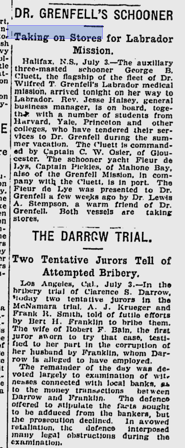
Evening Telegram (St. John's, N.L.), July 4, 1912

CABLE NEWS.
Special to the Evening Telegram

Halifax, July 3--The three-master schooner, George B. Cluett, Dr. Grenfell's flagship arrived today en route to Labrador. Rev. Jesse Halsey, General business manager, a number of students from Harvard, Yale, Princeton and other Colleges have tender their services. Capt. Osler, of Gloucester, is in command. The schooner-yacht, Fluer de Lys, Capt. Pickies is also here. She was presented to Grenfell a few weeks ago by Dr. Stempson. Both vessels remain to take in stores.,

Wednesday, January 29, 2014

from "A Labrador Doctor"

By Sir Wilfred Thomason Grenfell
from Chapter XX “Marriage”
1919

The journey from Lake Forest to Labrador would have been a tedious one, but by good fortune a friend from New York had arranged to come and visit the coast in his steam yacht, the Enchantress, and was good enough to pick me up at Bras d’Or. Dr. Alexander Graham Bell, who had previously shown me much kindness, permitted us to rendezvous at his house, and for a second time I enjoyed seeing some of the experiments of his most versatile brain. His aeroplanes, telephones, and other inventions were all intensely interesting, but among his other lines of work the effort to develop a race of sheep, which had litters just as pigs do, interested me most.

Francis Sayre, whom I had heard win the prize at Williams with his valedictory speech, was again to be my summer secretary. On our arrival at St. Anthony we found a great deal going on. The fame as a surgeon of my colleague, Dr. John Mason Little, had spread so widely that St. Anthony Hospital would no longer hold the patients who sought assistance at it. Fifty would arrive on a single mail boat. They were dumped down on the little wharf, having been landed in small punts from the steamer, as in those days we had no proper dock to which the boats could come. The little waiting-room in the hospital at night resembled nothing so much as a newly opened sardine tin; and to cater for the waiting patients was a Sisyphean task without the Hercules. Through the instrumentality of Dr. Little’s sister a fund of ten thousand dollars was raised to double the size of the hospital, and the work of building was begun on my return. Although the capacity was greatly increased thereby we have really been unable ever to make our building what it ought to be to meet the problem. The first part, constructed of green lumber hauled from the woods, and other wings added at different periods of growth, the endeavor to blast out suitable heating-plant accommodations—all this has left the hospital building more or less a thing of rags and patches, and most uneconomical to run. We are urgently in need of having it rebuilt entirely of either brick or stone, in order to resist the winter cold, to give more efficiency and comfort to patients and staff and to conserve our fuel, which is the most serious item of expense we have to meet.

But at that time with all its capacity for service the new addition was rising, sounding yet one more note of praise in better ability to meet the demands upon us.

And pari passu came the beautiful offer of my friend, Mr. Sayre, to double the size of our orphanage, putting up the new wing in memory of his father. This meant that instead of twenty we might now accommodate forty children at a pinch. Life is so short that it is the depths of pathos to be hampered in doing one’s work for the lack of a few dollars. Of great interest to my fiancée and myself was the selection of a piece of ground adjoining the Mission land, and the erection for ourselves of the home which we had planned and designed together before I had left Lake Forest. We chose some land up on the hillside and overlooking the sea and the harbour, where the view should be as comprehensive as possible. But we feared that even though our new house was very literally “founded upon a rock,” the winds might some day remove it bodily from its abiding-place, and therefore we riveted the structure with heavy iron bolts to the sold bedrock.

One excitement of that season was Admiral Peary’s return from the North Pole. We were cruising near Indian Harbour when some visitors came aboard to make use of our wireless telegraph, which at that time we had installed on board. It proved to be Mr. Harry Whitney. It was the first intimation that we had had that Peary was returning that year. Whitney had met Cook coming back from the polar sea on the west side of the Gulf, where he had disappeared about eighteen months previously. I had met Dr. Cook several times myself, and indeed I had slept at his house in Brooklyn. He had visited Battle Harbour Hospital in 1893 when he was wrecked in the steamer in which he was conducting a party to visit Greenland. We had again seen him as he went North with Mr. Bradley in the yacht, and he had sent us back some Greenland dogs to mix their blood with our dogs, and so perhaps improve their breed and endurance. These, however, I had later felt it necessary to kill, for the Greenland dogs carry the dangerous tapeworm which is such a menace to man, and of which our Labrador dogs are entirely free so far.

The picture of this meeting on the ice between Cook and Whitney gave us the impression of another Nansen and Jackson at Spitzbergen. Whitney had welcomed Cook warmly, had witnessed his troubles at Etah, and his departure by komatick, and had taken charge of his instruments and records to carry South with him when he came home. But his ship was delayed and delayed, and when Peary in the Roosevelt passed on his way South, fearing to be left another winter Whitney had accepted a passage on her at the cost of leaving Cook’s material behind. He had met his own boat farther south and had transferred to her. He left the impression very firmly on all our minds that both he and Dr. Cook really believed that the latter had found the long-sought Pole.

A little later, while cruising in thick weather in the Gulf of St. Lawrence, my wireless operator came in and said: “There can be no harm in telling you, Doctor, that Peary is at Battle Harbour. He is wiring to Washington that he has found the Pole, and also he is asking his committee if he may present the Mission with his superfluous supplies, or whether he is to sell them to you” Seeing that it is not easy to know whence wireless messages come if the sender does not own up to his whereabouts, I at once ordered him to wireless to Peary at Battle the simple words: “Give it to them, of course,” and sign it “Washington.” I knew that the Commander would see the joke and if the decision turned out later to be incorrect, it could easily be rectified by purchasing the goods. A tin of his brown bread now lies among my curios and one of his sledges is in my barn.

On our arrival at Battle Harbour we found the Roosevelt lying at the wharf repainting and refitting. A whole host of newspaper men and other friends had come North to welcome the explorer home. Battle was quite a gay place; but it was living up to its name, for Peary not only claimed that he had found the Pole, but also that Cook had not; and he was realizing what a hard thing it is to prove a negative. We had a very delightful time with the party, and greatly enjoyed meeting all the members of the expedition. Among them was the ill-fated Borup, destined shortly to be drowned on a simple canoe trip, and the indomitable and athletic Macmillan who subsequently led the Crocker Land expedition, our own schooner George B. Cluett carrying them to Etah.

My secretary, Mr. Sayre, was just about to leave for American, and at Peary’s request he transferred to the Roosevelt with his typewriter, to help the Commander with a few of his many notes and records. I dare say that he got an inside view of the question then agitating the world from Washington to Copenhagen; but if so, he has remained forever silent about it. For our part, we were glad that some one had found the Pole, for it has been a costly quest in both fine men and valuable time, energy, and money. It has caused lots of trouble and sorrow, and so far at least its practical issues have been few.

Thursday, January 19, 2012

George B. Cluett

Edward Post White, Jr. at the helm of the George B. Cluett

From the Suffolk County News, 5 Jul 1912: 
"Hampton Terry, son of Mr and Mrs. L. Emory Terry and Edward White, Jr., son of Mr. and Mrs. Edward P. White of Southampton, will accompany the Rev. Jesse Halsey on his return to Labrador and will spend the summer there. Both are pupils of the Southampton High School and are just completing their year's work there. They left Friday to join Mr. Halsey in Boston, whence their ship will sail. Mr. Halsey has been engaged during the past year in assisting Dr. Wilfred T. Grenfell in his mission work in Labrador and has charge of the station at Battle Harbor."

Wednesday, February 2, 2011

Summer 1912


Another important event for all of us is associated with that year. This was romance, the marriage of Dr. Little and Ruth Keese (L.M.K.) after three years of happy association. They were married by Mr. Jesse Halsey at the assistant doctor’s house, and the union of two persons so beloved by everyone was hailed with joy. The wedding was one of the simplest and most beautiful I ever witnessed, just a small gathering of friends brought together informally in the little room decorated with spruce boughs and yellow-leaved birch branches. Ruth Keese, in her familiar blue linen gown, and Dr. Little, in well known tweeds, entered the house together and after chatting with guests came forward with joined hands to stand before Mr. Halsey when he entered in his clerical gown to perform the short ceremony. In the dining room, Mrs. Grenfell had prepared a beautiful table for the wedding feast, to which all members of the staff contributed. Then, after congratulations and best wishes to the newlyweds, we left them.

Another exciting event of that summer was the arrival at St. Anthony of a beautiful three-masted schooner with a party of Mrs. Grenfell’s friends aboard, bound for a trip down the Labrador coast. The ship, donated to the Mission by Mr. George B. Cluett of Troy, N.Y., and built with special reference to its requirements, had been chartered by Mr. W.R. Stirling of Chicago for a Labrador cruise, and this was her maiden voyage. At Boston, she had taken on a cargo of Mission supplies, and her stop at St. Anthony was to deliver them as well as to pay a social visit.

Mr. Stirling’s small party, which included his daughter, Miss Dorothy Stirling, Miss Harriot Houghteling and other friends of Mrs. Grenfell, spent their time on shore, and St. Anthony was gay until they sailed away after a brief visit, taking Dr. Grenfell with them as skipper for the northern voyage. One can imagine the enjoyment of such a trip under the Doctor’s guidance and the thrilling anticipation of possible hazards from icebergs or shoals along the uncharted coast.

For my own part, the hazards of a voyage on the George B. Cluett became my most notable experience of the following year, 1912. In late June, with other Mission personnel—doctors, nurses, collegians going north for a summer of volunteer service—I sailed from Boston for St. Anthony on the schooner instead of taking the conventional route by rail and steamer. The voyage was uneventful, but the last day our calm security vanished as we faced threatened disaster from fire, shoals, fog, heavy seas and finally near collision with an iceberg, a twenty-four-hour experience which, in detail, would be worth telling.