Showing posts with label Christmas. Show all posts
Showing posts with label Christmas. Show all posts
Thursday, September 24, 2015


Wednesday, January 7, 2015

Christmas 1918
 |
| The Messenger | 22 Dec 1918 |
The minister
wishes to convey his Christmas greetings to the members of the congregation.
May this Christmas bring you joy. We have been thankful for victory, now with
the Christmas song in our ears we think of the blessings of peace on earth and
long for the reestablishment of good-will. No dream of prophet or seer ever
excelled the ambition of statesmen today to establish a lasting peace and a
League of Nations. One’s imagination fails to measure the possibilities of
development that lie bound up with that dream—war no longer possible.
America has
taken a leading part in making peace possible, her President is the leader of
the other nations as they seek to realize their dreams. Let us support him as
he endeavors to promote the Christian ideal in international relations.
In my interest
in world politics I haven’t forgotten my parish nor you, my friends. I am
grateful for the opportunity you have given me of having a part in war
activity, and now with enthusiasm I look forward to this winter as one that
shall mean much in the development of our church.
The Star of
Bethlehem is the Star of human hope and glory. The Christian ideal has not
failed; it is the only untried, program that remains, and men and nations are
turning toward it and preparing to follow its rays.
 |
| In Memoriam | John R. Hubbard | 22 Dec 1918 |
God is not dead,
nor doth He sleep!
The wrong shall
fail,
The Right
prevail,
With peace on
earth, good-will to men!
Thursday, December 11, 2014

Season's Greetings | 1944
 |
| 1944 Christmas Card | Westhampton |
Westhampton, N.Y.
Christmas Day
1944
Dear Dad—
Merry Christmas! Wish we could all be there to wish you all
that greeting. Maybe some Christmas we can all be together in the old homestead.
What fun that would be. Somehow Christmas just doesn’t seem like Christmas
without you and Mother, Honey, Abbie, and dear old Freck and Bill. I look back
on those days in Cincinnati, what a job you and Mother must have had selecting
the things for your children, trying to satisfy each and everyone of us. Then
too we had a lot of Fairy God Fathers and Mothers whose Christmas gifts were
usually those of untold splendor. I am using today a toolbox and a beautiful
set of augur bits, given to Freck and me by Mrs. Smythe or Miss Becky many
years ago. Even Freck’s old lathe that “Santa” brought him works in my shop.
Somewhere in Southampton a train engine locomotor waits for future use given by
Mrs. Reed. There are other things I don’t remember, but which I still have
around.
Today we received a present that has been the trump of the
day and the grandest gift imaginable from the swellest person I know. War Bonds
for all four of us from My Dad—I can’t begin to thank you . . . I don’t know how,
but any way we appreciatie them more than words can express.
Today I am lazy and nearly exhausted—for nearly a month my
machines have been busy sawing, drilling, etc., making toys. Then week before
last I stayed in on my work full time usually from 9 AM to after midnight. In
that time I made a barn, a train, a farm wagon model with team, a doll house,
and drilled several cradles, in addition to the one that went to Sophie. Each
and every item was sold representing about 50 dollars worth of toys. On top of
that I made a gun for Chaddie and a rocking horse for Billy. I finished the
latter at 11 last night. It is a cute little horse and cuter still when its
young master swings into the saddle and rides away. He can really make it go.
Abbie certainly showered Chaddie with presents, we had a box
from her and in it was a machine gun, a helmet, and a periscope. He is tickled
pink with the helmet as well as the other equipment.
It looks as though we might have a white Christmas. It
snowed last Monday and it snowed quite a bit, although there is still quite a
bit on the ground it is going fast.
Today has been above freezing and it’s a heavy fog all day and
occasional rain.
THANK YOU FOR MY BOND –BILLY
Fran just plopped his majesty in my lap and I thought he
better learn to write early—
Friday morning I played Santa at the school party. Charlie
is not at all sure it was Santa in fact he had a darn good notion it was me.
When he came home I was working in my shop when I came upstairs he looked me
over very closely. I had make up on, but washed it all off. My lips however
showed signs of having been actual.
He mentioned the fact that I had paint on my face and he was quite positive
that I was Santa. We changed the subject so may be he has forgotten.
There has been ice in the bay for a week or so, at last maybe
with this thaw we are having I will break up enough to be able to go out and
make a couple of dollars. If N.Y. has a meat shortage, which is threatened by
the dealers or something, maybe clams should sell at a good price.
I wish you all could have been here today to help eat our
32# turkey. Next year I will have to raise some so that you can have one for
Thanksgiving day and Christmas. Maybe a goose for New Years.
Our box went express last Thursday I hope it arrived in time
to greet you today. Yours will be here I guess sometime this week as you said
it was sent express on Thursday.
Before I forget.
Charlie’s Birthday Aug. 5, 1936
Billy’s Birthday Nov. 3, 1943
Jean Grace Raynor May 16, 1944
Thanks again the 4 of us for your wonderful gifts.
A Merry Christmas—belated but in time to wish you a very
Happy New Year.
Love from us all.
Your son,
Charles


"Where the hearth is warm and friends are near . . ."
 |
| Abigail Fithian Halsey | 1923 | Southampton
Jesse Halsey notes on the back of the card that: “Dr. John Withrow Pres Cin Board of Education christened her 'Happy Halsey' when she taught in Cin Univ School.”
|
Thursday, December 4, 2014
"Seek Hundred 'Hungriest Children'" and "Foreign Mission Report Will Be Explained"
 |
| 1932 |
Wednesday, February 5, 2014
from "Among the Deep Sea Fishers" | April 1911
Toronto,
April, 1911

Dr. Grenfell’s absence in England has meant the cessation of the
“log” and there is but little information to hand of the winter doings at the
hospitals. The Christmas festivities at St. Anthony seem to have been most
successful. A member of the staff writes: “We are now well started on the new
year and bright Christmas season when so far away from our own kith and kin. I
must tell you about our employees’ dinner which we served in the waiting room
on Monday following Christmas to forty-three people. I had the room cleared and
picnic tables made in such form that Dr. Little and Mr. Halsey were able to sit
at the two ends and carve. It gave more dignity to the occasion and was a great
joy to the people. The tables we made as pretty as possible with our simple
decoration of paper napkins, mottoes, pickles, cheese, berries, raisins, figs,
etc. Then we served soup, venison, potatoes, cabbage, plum pudding, ice cream,
etc. At the end of the meal each person received a box of candy and a gift as
well. Mr. Forbes managed the phonograph throughout the meal, and before they
all departed a flashlight was taken. All went quietly and smoothly and from
what I have heard was evidently a great success. Dr. Little I know was pleased.
The orphans’ tree followed at 4 p.m. and gave a tremendous deal of pleasure,
not only to children, but to the grown people as well, for Santa Claus in the
person of Mr. Halsey and his two sons, Mr. Write and Mr. Evans, came flying
down the Fox Farm Hill on a komatik drawn by two reindeer. It was so very real
and made it so much more impressive.”

Dr. Little writes under date of the 15th of January:
“All goes well at St. Anthony. Dr. Wakefield started yesterday for the Straits
with ten fine dogs and Aleck Simms as driver. . . We have all been struggling
through a grippe epidemic but it is over and all are well. There is no special
news. Things are pretty well started. Night school with two classes, men and
boys; club for the men; Legion of Frontiersmen; Bible class for the girls;
choir, etc. etc. All are awfully good about doing anything.”
While in England the Kin honoured him [Grenfell] by giving him a
long and special audience, and though he was ostensibly taking a holiday he did
not by any means neglect the opportunity of arousing interest in his work. The
following report of one magnificent meeting in Queen’s Hall, London, shows that
his simple earnest tale of the needs of his people and his aims for their
betterment has lost none of its power:

“An expectant crowd that filled Queen’s Hall from area to top
gallery welcomed ‘Grenfell of Labrador’ with British enthusiasm on Monday
evening. Norman Duncan has made Dr. Grenfell’s work known far and wide in this
country, and although one of the journalists who interviewed the Doctor last
week confessed to an absolute ignorance of the geographical situation of
Labrador, probably every one in the audience could have come through an
examination with better results than that. From the first row Field Marshal
Lord Grenfell followed his relative’s story with keen interest, and there were
many well known people in the audience.
Sir Ernest Shackleton presided with that peculiar sea-dog air of
his. He told us that there were five members of his Antarctic expedition
present, and not a few of us who have read his book would have dearly liked to
see those men paraded on the platform. Standing in the centre of the platform,
his broad shoulders on the slant and his hands clasped for all the world as if
he were hauling in the slack of the mainsheet, the hero of the South Polar
expedition declared, in his bluff way, that the mass of the civilized world had
come to appreciate the great work done by a man who was trying to do his best
for the bodies and the souls of ‘nameless men who nameless rivers travel, and
in strange valleys meet strange deaths alone.’ A happy, poetical description of
Dr. Grenfell’s life work!
Tuesday, September 24, 2013
Editorial for Presbyterian Tribune c1949
-->
By Jesse Halsey
“Christmas is
coming . . .” and what happens will depend upon where you live. What can
Christmas mean to Christians in Korea, south or north? What can Christmas mean
to millions in countries like East Germany where it used to be the great day of
the year and now, because of religious repressions and economic strictures,
little in material ways is possible. What about Yugoslavia with a non-existent
harvest and a winter of starvation ahead? How does one keep Christmas without toys
for the children and food for the table? It is all very well for us who have so
much to be merry at Christmas, but what about the others?
In my last talk
with Dr. Robert E. Spear, he said that, the greatest mystery of Divine
providence was the fact that America had so completely escaped the judgments of
God, abroad in so many parts of the earth. With our superabundance of good
things, we are doubly obligated as individuals to share—“We bear the Christian
name and mark.” And as churches, the needs of brother Christians in many lands
claim our consideration just now for the Christmas—the Christ spirit—must “get
abroad” else the whole thing is a mockery!
From a national
point of view, we are learning that freedom is expensive. Most of us believe it
is worth all that it costs. Uncle Sam is often pictured as Santa Claus by the
caricaturists. The Marshall Plan is sometimes dubbed in terms of Kris Kringle
beneficence. Just the same, increasingly, the country will bear the burden of
rearmament and huge military expenditure. Along with it might it not be that
some gestures of hope and goodwill, might be used?
At last report,
the American Commissioner in West Germany had at his disposal some $50,000
contributed by friends for the relief of refugees and the feeding and housing
of those who have managed to escape from the tyrannies of East Germany. Such
persons—refugees from the Bolshevik terror—aided and rehabilitated, would be worth
in terms of propaganda, the equivalent of many guns.
All through
Indiana and Illinois, near hundreds of rural stations, there are great metal
beehives of corn. In the western states the superabundance of nature (wheat) is
often rotting on the ground for want of shelter. Potatoes in excess—subsidized for
destruction—have become almost a national scandal.
Would it not be
the very best strategy in the face of the world situation to dispatch some of
these surpluses to the Adriatic and to Yugoslavia? If potatoes will not stand
the voyage, certainly grain will. The best anti-communist, pro-American
propaganda at our disposal is American surplus grain in hungry countries here
and there the world around. Communism thrives on starvation. Communism
literally goes on its belly. In playing Santa Claus, Uncle Same might be
showing good business sense. Twenty or more divisions of Serbian soldiers right
on the spot are one of earth’s most dangerous points! Would it not be excellent
business for our government to help in the face of Yugoslavia’s famine?
We (editorial
plural) have mixed our metaphors, jumbled our idealism with prudential
economics in rather characteristic American style; this I confess. But more
than ever before, we are convinced that food is akin to friendship, and that
gestures of help are the best propaganda. Believing in preparedness, defending
right with might, I still would leave no door or help unopened, trusting that
friendship is better than ferocity and that the Christmas spirit is not
confined to one day in December.
Thursday, May 10, 2012
From the Manse | 1937
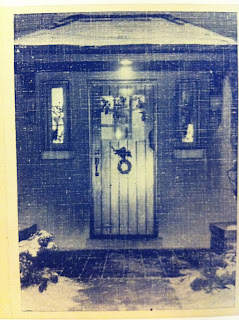
FROM THE MANSE
Never, through the years, have we been quite so grateful as
this year, for the warm security and comfort of the lovely house that the
generosity of the congregation has provided for the minister and his family.
Built and maintained by the Church, we are privileged to live beneath the shelter
of its roof. You have been good to us. From our home, which your thought has
built, each member of our household gathered here for Christmas, sends Hearty
Greetings and Good Will.
THE HALSEYS
Christmas, A.D. 1937.
Tuesday, December 13, 2011
The East Riding of Yorkshire
By Jesse Halsey, c1938
The East Riding of Yorkshire. Thus it was called in the
early days. The name has changed but the savor of the old time lingers.
Farmhouses low and sturdy with gray weathered shingles
punctuate the flat countryside. Shingles three feet long, rived from red cedar
that grew in the swamps, worn thin now where they have defied the east-wind-driven
storms of two hundred winters and the bristling heat of as many summers, but
with butts still thick enough to cast healthy shadows in endless parallel
windows where the long sweeping roofs on the north side slope almost to the
ground.
“Regardless of the direction of the highway those houses
were set by their builders always facing the south—and the sun and the sea.
Farm houses like that, gray and weathered but trim and tight against the
weather, were built, some on village streets and some at the hub of the
surrounding acres.
Tiny windowpanes peek out, diamond, and square and oblong,
most from the days when glass came from over the water and was priced in
shillings and pence and is bubble-scarred and blue streaked and is enchantingly
distorting as one peers out.
Lanes there are that wind as one did the cow-paths. Lanes
with names like this: Job’s Land, Gin Lane, Loylsome Lane, Hither Lane, Further
Land, Middle Lane. Some lead through the woods and some across the meadows but
all come at long last—or short—to some water, great or small, fresh or salt—any
one of a dozen bays or ponds, or the beach banks and the Ocean.
Squat and square brick chimneys anchor the houses to the
ground. Within, these chimneys are fed by fireplaces, one in each and every
room. Floorboards creak when you enter, boards half as wide as puncheon head.
Low ceilings, paneled woodwork, musical H and L hinges on gently squeaking
doors.
Leaning barns and wood sheds where eel-spears and clam rakes
and harpoons prod the latest agricultural machinery. A discarded seine is
sometimes seen, used now for a net for tennis or volley ball, but a swift
reminder of days when corn was grown with fish for fertilizer—“two bunkers to a
hill.”
By trim white Churches, surmounted by pointing spires, one
comes upon ancestral burying rounds where rhymed epitaphs quarrel with life’s
adventures to attempt to perpetuate the excellence of some village worthy—or mayhem
his idiosyncrasies.
Names nostalgic attach to the villages, reminiscent of Old England—Southwold,
Maidstone, Southampton. The music of the Indian words echoes in geographic
designations –Quoque, Quioque, Ponquogue, Kumsebog, Shinnecock, Amagansett,
Montauk, as the New Yorkers say. Or as the natives say, Montawk. (I am a
native.)
Hamlets, two house or a dozen, a mile apart, or two, the
names come back as you flash through, remembering the days when in the springless
farm wagon it took half the day to take a grist to the mill. Littleworth, Good
Ground, Scuttle Hole, and Hecox. Tuckahoe, Seabonac, North Ben, or Hog Neck.
Towd and Cobb and Little Cobb, Flying Point, the Sea Poose, and Wickapoque.
Then there was—and is—Scuttle Hole and Wainscott, Sag and Sag Harbor, Water
Hill and North Sea and Canoe Place.
Captain’s Neck is there, and Cooper’s Neck, First Neck, and
Halsey’s Neck is there, and Cooper’s Neck, First Neck, and the Great and Little
Plains.
Windmills, a dozen or so, some in wreck, some in good
repair, one, or maybe two, still grinding! And Whalebone Landing, Sandy Hollow,
and Coopers Hill, The Twelve Acres or Reeves’ Orchard. In each of these my
grandfather owned parcels of woodland. They furnished fuel aplenty for his many
fire-placed house. He had inherited the woodland from his father, and he from
his, for seven generations since the settlement date. I own it now. It is worth
little, that land, but it has furnished fuel for Halsey households for nigh on
to three hundred years, one generation after another—ten of them now. A cutting
of new growth, is ready, say, once each thirty years.
Some of the wood from those parental acres I heap upon the
fire tonight—steady burning hickory with a back of fragrant cedar—and in its
glow of memory many things come back some out of the dim past. For I have lived
a long time. Sometimes I think it must be close on to two centuries. What I
mean is this—in fifty years, and odd, I’ve seen in the village where I was born
the change from colonial simplicity in belief, in practice, and in custom to
the usages of modern mechanized today.
I can remember for example when one family in our community
kept Sabbath from Saturday sundown to Sunday evening, when everyone kept
Sabbath in some strict form, when many people had candle moulds and some used
them. When the few cottagers were called Yorkers. When most families raised and
cured their own pork and canned their own fruit and dried their own vegetables.
When potatoes and turnips and cabbage were the sole and staple vegetables for
nine months of the year. Salt pork, salt codfish, steady diet. Carrots were for
horses, pumpkins would keep only up to Christmas and were never canned, hence
the untiring profusion of “pumpkin” pie this time of year.
It is as it were, a sprightly evening in early winter and a
fire is burning on the hearth. It seldom snaps; it never smokes for grandfather
was a skilled mason and knew his trade. Supper is over and the dishes cleared
away, from the kitchen come the sounds of cleaning up and the stirring of
buckwheat cakes being “set to rise” for breakfast. A Kerosene lamp burns on the
erstwhile dining table now covered with a turkey-red damask cloth. In a Boston
rocker by the fire sits and old man and on a foot-stool, toasting his shins,
stretches a little boy. Whether he is six or eight or ten I cannot quite
tell—no it is not the smoke, grandfather was a capable mason—it must be my
eyes. Against the wall, so near that the boy can lean on it, is a seaman’s
chest. The old man is reading, the boy listening, when he gets drowsy he leans
his head on the chest and dozes off, waking with a start as Napoleon leaves
Moscow, or Alexander reaches Babylon.
We must open that chest. Its stout rope handle smell of
oakum, its battered exterior betrays its history knocking ‘round the seven seas
in more than one forecastle. We should like to see what’s inside. The
hand-hammered strap hinges gently protest but the boy turns back the lid. I’ve
read in William James that smells quicken sure remembrance—well, they are here
in urgent suggestions of far Cathay, the Moluccas, of the Celebes and other
spice islands. The old people call it “cassia,” though we say cinnamon; this
chest must have brought home cassia on occasion: at any rate its lined with
strips of red cedar and San Domingo mahogany and sandal wood. It has fragrance when
opened that to me is pleasant, though pungent and pervasive.
The boy explores the contents while his father holds the lamp.
A broken backed leather bound Bible, with s’s that look like f’s, an old log
book, some maps and charts, a volume of town records, a bunch of yellow letters
tied with a faded blue linen rag, a copy of Pilgrim’s Progress, a Bodwich’s
Navigator and a box that used to hold a sextant. These and some sea shells from
the south seas, (the boy holds one to his ear to hear the throbbing ocean), a
few small nuggets of gold from California, more books—a lot of junk, so the boy
thought—then. Now—with reverence he closes the lid realizing that the chest is
empty—except for memories.
Thursday, September 15, 2011
Billy’s Christmas Party: A New Englander
by Jesse Halsey
Thanksgiving night our minister dreamed a dream. Vividly it
came to him. A Thanksgiving turkey, one of the perquisites of this particular
parish, may have been the cause—I cannot say (not being a Freudian psychoanalyst).
Not with the cause, but of the results of the dream am I to tell you.
The minister dreamed that his eight-year-old Billy, who had died two years before, was hungry—hungry in the midst of plenty; and that on
Thanksgiving day! The minister’s childhood was spent in New England where
Thanksgiving was celebrated like our Christmas. Billy’s few Christmases had
been spent in a time and in a part of the country where Christmas is Christmas.
So, the next day our minister determined that Billy should have his Christmas
celebration by proxy. He has that curious sort of Celtic (or is it Christian?)
faith that convinces him that those who have “gone on” know what goes on here.
So the next afternoon our minister started by making a call
on Anne James, a member of the Junior League, popular with all her
contemporaries, an effective executive, but for some years confined to a wheel
chair. She agreed to be general manager; using the telephone and direction all
our activities. The four oldest members of the congregation were made honorary
patrons. “Uncle Billy” Union, eighty-seven, loved and respected throughout our
city, was to act as honorary chairman (for forty years the said “Uncle Billy”
has entertained a score of city waife at his own Christmas Eve table). Madam
G—who spent her active life as a missionary in educational work in Egypt—loved
of all; Miss A—the oldest living communicant; and the jovial Mr. M—most
generous of souls; these were to act as honorary sponsors.
Within ten days the following penny postcard went out (the
minister has a press and does our parish printing: The cut on the card he
clipped somewhere from a church paper and had it turned into a zinc etching.):
But if a sleeping baby now layWithin a manger filled with hayAnd God’s star pointed the way,Would I believe? Would I obey?This is Your First Card WithMERRY CHRISTMAS
Two weeks ahead of time it practices economy,though not stinginess; the postman will be pleased,it is mailed early.It comes to tell you, of a Christmas Supper for theHundred Hungriest Childrenwe can find on Christmas Eve.Every group in the Church will have somepart. You are invited to seat a guest. It willcost fifty cents and no one person can entertainmore than ten. Send your reservations, andcome and see the children at 3:00 p.m. on December24. If it should grow to 200 I shall not be surprised.The difference in postage between this card(there are 700) and a sealed envelope will beour contribution to the party. So you understand,and will approve.And remember, please, that this card bringsto you and yours the sincere Christmas Greetingof your minister and his family.Seventh Presbyterian ChurchDecember Eighth, A.D. 1932
The response was immediate. Dollar bills began to come in
every mail. Many brought theirs on Sunday and others brought their fifty-cent
pieces. Old Mintie Bates, who is cared for by the parish, brought a quarter, as
did several children. Two youngsters brought their dimes.
Organization went merrily on. The acting chairman, from her
chair, directed the organization. Mrs. Jones agreed to cook and serve the meal.
Twenty volunteers from the Sewing Society rushed to her support. Six men
offered to send turkeys. “Uncle Billy” made a bid for all the fruit. Mrs. Haney
and Miss McCine volunteered to solicit the candy. Miss Kirk, a retired teacher,
her hands crippled with rheumatism, asked to make the candy bags. Mr. Breton, our leading architect, directed a
group of young people, who cared for the decoration. Mike Sigler, a Jewish
peddler at our corner, insisted on furnishing the Christmas tree. Mrs. Shore,
her sisters, her children, and her grandchildren, dressed the tree.
Christmas Eve was purposely chosen that it might be an
inconvenient time for our privileged people to show their hand and heart toward
the less fortunate. The Young People’s Society, who had Christmas activities of
their own and were interested in home celebrations as well, insisted on washing
the dishes (and incidentally, by nine o’clock that night, had the dining room
and kitchen spic-and-span). The only paid help was for additional janitor
service, due to the many tables and chairs and fact that Christmas Eve was on a
Saturday night. Everyone gladly accepted their assigned job as if it were a
Christmas privilege.
The minister felt confident that one hundred could easily be
provided for. It grew to four hundred before they had finished. Two hundred
names, and then two hundred more, of the neediest children in the city came to
us from the welfare director at City Hall. Each child was sent a personal
invitation, under a three-cent stamp. Cars were offered, although it was a busy
Christmas Eve, and, under the direction of our Boy Scouts, every child was sent
for, brought to the church, and later returned. This we thought a rather severe
test of the congregation’s loyalty.
At three o’clock our guests arrived. Kate Douglas Wiggin is
needed to describe these Ruggles! Coats were checked by Girl Reserves and all
finally seated in the big parish hall. Portable movies (or rather talkies) gave
a half-hour’s varied program; then came the skillful manipulation of the
marionettes by Mrs. G, an adept amateur. This gave the children unbounded
delight.
Promptly at four, in step to a pealing Christmas march
echoing from the whole parish house through the church organ loft, the children
went downstairs for dinner. Tables were spread for three hundred in the dining
room. (Our minister insisted on the best china. “No paper plates,” said he.
“Fear of germs? No, not at Christmas! Scald the plates, but don’t use paper.”
His word is law, so the best was used.)
The Mayor carved the first turkey; a hundred plates were
ready hot in the kitchen—turkey and all that goes with it. Another hundred
followed in a jiffy, a third, and then part of the fourth. (The Scouts had gone
out with a bus to look for the last twenty on the city streets; and the found
them. Hastily washed, they came; not dressed in their best like the others, but
happy.)
The tiny tables from the church kindergarten were arranged
around the brilliantly-lighted tree that stood in the big gymnasium adjoining
the dining room. The sliding doors between the two rooms were up and all was
festive and gay. Chairman Anne, from her wheelchair, looked on, still our
executive officer. “Uncle Billy” and his three assistant patrons all came to
act as hosts. The young people waited on tables and for an hour music and
laughter filled the rooms.
When all were fed Santa Claus appeared. From somewhere he
brought a big shopping bag for each child, with the child’s name on it (the
three hundred odd who had written invitations). In the bag was an apple and an
orange, a pound of candy (in one of Miss Kirk’s bags), a popcorn ball, and an
age-appropriate toy (furnished by the mother and father of a little maid who
went away at Christmastide). The big boys had knives; the girls, most of them,
dolls; and even the late-comers found filled bags—though necessarily unnamed
ones.
Three children ‘phoned in that they had missed the auto, so
their dinner even to ice cream, was sent them!
Everyone worked with a will; nearly four hundred of the
neediest had a gay Christmas Eve and the minister’s Billy—did he know about his
party? “Why not?” says our minister. “Why not?”
Wednesday, February 2, 2011
GRIST FROM OUR MILL
by Jesse Halsey
Budget necessity at our house demands modest Christmas expenditures, yet there is a large circle of friends who it is a real satisfaction to remember in some simple and, if possible, unusual way.
Not of necessity, but for the sheer joy of it our household plans, through the year, its simple and [meaningful?] giving. Ingenuity rather than aggregate dictates the procedure. This is abetted by the family use of the automobile. We travel considerably. The boys, with an old car of collegiate appearance, go from the Middle West to New England [ed note: JH struck “one to Central New York”], and Father once a month has a business trip to Philadelphia. His hobbies are history and photography so he often varies the routes, coming and going.
We often buy along the road. For examples, our apples come from Western Maryland, or the Shenandoah Valley, or Northern New York depending on the most recent travel adventure of the family. When in Deerfield, Mass., some fancy onions are added to the cargo. Vermont or Northern Ohio or Western Pennsylvania furnish maple syrup. The list is long, and more or less obvious, as we visit Canada and all the North Eastern seaboard and the south highlands, Green Mountain, NC.
To be more specific, one of our most successful ventures in this ingenious friendly economic game has latterly, been with cereal products. If I were in this business I should assemble some mill producers and sell them in combinations. But we have acted as our own jobbers and this is the line.
Buckwheat comes from Western Maryland, “Friendship” mill, to be exact. The Maple Syrup that went with it last year came from “Confluence” not far from where Lieut. Washington led his troops to safety across the Great Meadows after Braddock’s defeat. This year we had Vermont Syrup, some of it from the Coolidge Farm in Plymouth.
Our corn meal comes from Nettle Carrier Creek in North Central Tennessee Mountains. Here is an old water mill where white corn is ground between mill stones. The whole corn is used with the chit or germ included. In commercial products this is often eliminated as it causes corn meal to turn rancid after a little (unless it is kept in the dark). The slow motion of the cold stones doesn’t “burn” the corn as is done in the high speed burr mills (where steel teeth at a terrific rate turn the corn into powder). When we want yellow meal—not popular in the South—we get it from a water mill on Long Island, where corn bread is known as “Johnny Cake” since Civil War days.
Whole Wheat or Graham flour (there is no difference) comes from the Nettle Carrier Mill as does our Rye flour. We go there once or twice a year to visit a Mountain School and spend some hours at the mill watching the process—and Father is always taking pictures of the mill and the old miller. We have a movie of that mill. As the water is turned on the buckets fill and the wheel begins to turn.
White flour (needed in most recipes), we have not attempted to add; the great mills of the country have perfected this process; we wonder that they don’t feature other things.
Bran we get in quantity from a country mill thirty miles from our city. There are two kinds; one fine for cooking, and another coarser and heavier such is fed to live stock. This we use for baking hams. Finally there is a cracked wheat cereal from another country mill fifty miles away on the Ohio River. This we value highly.
At Christmas, packages of some of our cereals were neatly tied up and marked. Some tested family recipes were typewritten by one of the daughter of the house and added to the collection. Pancakes of several kinds, Indian Pudding, Bran Muffins, Graham Gems, and Johnny Cake, these and others.
Our most ambitious basket was prepared for our family doctor; the others were less ambitious but similar.
NEW YEAR’S GREETINGS
To All The Mitchells
The Goose came from Felicity; The Buckwheat from Friendship.
The Maple Syrup came from the Coolidge Farm, Plymouth, Vermont.
The “Injun” Meal, for Johnny Cake, came from Nettle Carrier, Tenn.
So also did the Graham Flour.
The Recipes were Grandmother’s.
The Basket was made by a Shinnecock Indian.
The Juniper came from Cody, Wyoming.
And the Halls Add Their Good Will.
Mary Ann
by Jesse Halsey
Thanksgiving is the Great Day in New England, or was so in my boyhood. We lived on Long Island, the east end of which is pure New England, while the wet end is Dutch---with a Kriskingle. So we had, both; Thanksgiving and Christmas. Grandfather was much of a Puritan and frowned on Christmas celebrations—in theory. Being a deacon he had to agree with the Parson who never would preach a Christmas sermon at Christmas nor an Easter sermon at Easter! (“It was papish.”)
But our grandmother was different. SHE was supreme in her own domain, indoors, and knew, moreover, just how to handle grandfather who was naturally fat and jolly and, as a young man, had lived in New York where Christmas and New Years were real celebrations that centered largely in the home. This was the beginning of the Nineteenth century—our grandfather’s boyhood; while our childhood was in the years near its close.
 |
| Mary Ann Cuffee |
We were lucky, I say, with a New England Thanksgiving and a Dutch-flavored Christmas. And then we were blessed with Mary Ann.
She came to help on all great occasions. Funerals, births, butchering days, Town Meeting, Thanksgiving, the Christmas week, and many other times in between. No family occasion was complete without her. The little “back chamber,” a half attic over the kitchen, was her room, never used by another so far as I know.
An Indian of the Poosepatuck tribe, she was born before Eighteen hundred, near Montauk Point, but in our time lived on the Shinnecock Reservation, where she had married. Her features were as severe, as my faded snap-shot will show, but she was the soul of goodness and withal a most excellent cook.
Snow sometimes came with Thanksgiving, and almost always by Christmas time was continuously on the ground. It was my greatest joy, as a boy, early Thanksgiving morning to drive (with some of my cronies), in the old apple-cart, or in a sleigh, to the Indian reservation, two miles away “to fetch Mary Ann.” She had a grandson just my age who always came along.
Her mind was full of old sayings—this old woman; old traditions and superstitions. She believed in ghosts “and such like;” had hard common sense, stoic discipline, but a soft spot for us boys. She remembered wigwam days and knew the nature-lore of her ancestors, could predict the weather and, as I said, she could cook.
The simplest fare became ambrosial at her touch. I mean this in a countrified sense for she knew nothing of salads and appetizers. None were needed. The odors that hung round the home for hours before a meal, though kitchen doors were closed, these were enough to set one’s appetite agog.
She had no written recipes. Like all good cooks, she just guessed, but when my oldest sister was married “Aunt Mary Ann,” as we children called her, consented to be questioned regarding her art and with Grandmother’s help the bride got some semi-recipes on paper. With the passage of the years we came to think that sister “Nynne” had caught some of the culinary secrets of Mary Ann. From her cookbook and other family sources I have tried to write down some of the old Indian’s best dishes best suited to the Holiday Season.
Historic
image courtesy Abigail Fithian Halsey Files,
Southampton Historical Museum Archives and Research Center.
Subscribe to:
Posts (Atom)

