Showing posts with label 1920. Show all posts

Thursday, December 15, 2016

Cincinnati Club Hears Address on Bolshevism


March 6, 1920 | The Southern Lumberman

Cincinnati, Ohio, March 1—An interesting talk on Bolshevism was made before the Lumbermens’ Club of Cincinnati at its monthly dinner at the Businessmen’s Club here tonight by the Rev. Jesse Halsey, pastor of the Seventh Presbyterian Church of Cincinnati. Mr. Halsey was an agent of the United States department of state in Russia for eighteen months and was an eye-witness to the development in the country during the time that Lenin and Trotsky gained control. He was stationed at Murmansk, north of Archangel, for a time and visited in Petrograd and Moscow, besides traveling over a large part of Siberia.

Mr. Halsey differentiated between Bolshevism as a political and economic program as applied to Russia and the term as it is now commonly used to denote the radical spirit of unrest throughout the world. He said many people were now applying it indiscriminately to people who differed in opinion with them over political-economic questions.

As to Russian Bolshevism as exemplified under the government of Lenin and Trotsky, Mr. Halsey declared that in practice their program had been greatly modified from the ideas they had enunciated when gaining their power over Russia.

“Bolshevism as a political program has been greatly modified in Russia,” Mr. Halsey declared. “Lenin has resorted to a system of capitalism in Russia to force production. After ten months of a government of destruction he now reverted to a system of capitalism of the most reactionary character. As applied at first the principles of Bolshevism meant nothing but destruction, and whatever of a constructive nature there has been in Russia has been along lines that in theory at least the Bolshevists have most of denounced.

“The ideal six-hour workday of the Bolshevists has now degenerated into a sixteen-hour workday, with the workmen kept under a strict military discipline to force production. The government, in order to attract Russian capital to its industries has offered high rates of interest and are now offering all sorts of guarantees and high rates of interest to foreign capital to come into the country.

“The people who have suffered most under the Red Terror of the Bolshevists were the intellectual radicals who were responsible for the overthrow of the Czar. They are the ones the Bolshevists have persecuted and not the old retainers of the Czar. As a matter of fact many of these have come to the support of the Bolshevist government and the leader of the army against the Rumanians is not a general developed under Trotsky, but an old-time general of the Czar.

“The intellectual class of Russians have been weak and indifferent to the crisis through which their country has passed. The Russians have a word, ‘Nichevo,’ which described their spirit and attitude to things. It indicates a shrug of the shoulders and ‘I can’t help it, I don’t care’ spirit.

“The Bolshevists gained their power by appealing to the emotions of war-worn and hungry people. They offered food, division of the land and peace to the country at a time when the people were dispirited and hungry. They have retained their power by military discipline over the people. They have disarmed all who belong to parties other than their own and having all the arms and ammunition in the country are able to effect their will without a military opposition.

“The Bolshevists are a majority party of the radicals, but do not represent a majority of the Russian people. At the best only between 20 and 30 percent of the Russian people were Bolshevists.

“Bolshevism will never conquer America,” Mr. Halsey asserted. “The long period of evolution in which our political and economic system has been developing together with the fact that the great mass of Americans are educated, is a great bulwark against any red revolution in America. In Russia there was no middle class and 85 percent of the people were illiterate. When Kerensky and his radical government took the helm, there was no background among the Russian people for his experiment. To America the development of our institutions since 1776 will prove an effective armor against Bolshevism.”

Wednesday, February 4, 2015

SUMMARY OF WORLD WAR WORK OF THE AMERICAN YMCA

With the Soldiers and Sailors of America at home, on the sea, and overseas    
With the men of the Allied Armies    
and with the Prisoners of War in all parts of the world


Franklin A. Gaylord


WITH THE ARMIES OF OUR ALLIES  

Down the Volga with the Red Triangle   Welfare work is necessary to Russian civil life. The funda-  mental need in Russia is aid to the peasant; and as soon as it established itself, the Red Triangle organization set up a floating exhibit  of American agricultural methods to be sent down the Volga through the  heart of Russia. It covered several hundred miles along both banks of  this great river, reaching tens of thousands of people. Thirty-one Russian  helpers aided the Y rural experts to demonstrate the films, models-,  charts, and personal talks on modern methods of farm organization  and home keeping in rural America.   The exchange of prisoners, following the Brest-Litovsk peace,  brought thousands of liberated Russians, who for three years had lived  on the border-line of starvation. Many of them died en route and the  doctors pronounced 25 per cent of the remainder tubercular. The Y was called upon to attack the problem, and, according to the civil  authorities, the service in Moscow, Petrograd, and the cities near the  border, saved thousands of these soldiers who would have died soon  after reaching home. The indispensable supplementary ration, which  was the substantial welcome of the Y, consisted of milk, eggs, palatable  bread, and other necessities, which were the height of luxury to these  returned prisoners. On many days the food supplied by the Y was  all these men got to eat.

We have followed the Triangle through the dark days in southern  and central Russia; now let us follow it to the Arctic Sea. Here, too,  the armies of the Allies were fighting their way in the World War.  This campaign had as its main military object the break-up of possible  German submarine bases on the Arctic Sea and the protection of supplies delivered to the Kerensky government at Archangel and Murmansk.   In the rigorous task in North Russia, 65 American Y secretaries,  with some 30 British Y secretaries and a number of auxiliaries of  Russian and other nationalities, were given the main responsibility  for welfare service among the troops under the exceptional conditions  of an Arctic winter in a miscellaneous force comprising twelve  nationalities.   Here the Y M C A was the only substantial force conducting welfare  work throughout this difficult operation.

Fighting against the Elements at Archangel   The number of the Allied troops reached 30,000 men at the maximum.  About half were regular allied detachments, while the rest were Russian  volunteer units. The American troops amounted to about 5000 men in  the Archangel district, and 2500 along the Murmansk Railway.   The larger Y work was based on Archangel, where the Allies main-  tained their headquarters for fighting fronts on a narrowing circle 50 miles  further south. After the first establishment of headquarters, which  had again (as in France, England, and Italy) preceded the arrival of the  American troops, secretaries were sent to the combat regions in the  south, and by Christmas, 1918, every important base in the region had  its Y hut and characteristic activities. When the town of Shenkursk  was captured by the Bolsheviks in the middle of the Winter the Y hut,  which had been a center in the midst of the fighting area, was burned  with many other buildings. In other sections Y secretaries without  permanent quarters went about with the troops on duty and distributed  comforts to troops on the front line. Four American secretaries on this  service were captured, one was awarded the French Croix de Guerre,  three were given the Russian Cross of St. George, and others were mentioned in American Army Orders for bravery under fire on the front  line.

With Reindeer Sled in the Far North   An American Y hut in Russia had the honor of being placed at  the apex of the narrow salient, pushed into the Bolshevik lines at  Oust Podenga on the Vaga River, the farthest point reached by the  Allies.   This hut, directly across the river from enemy troops and closely  camouflaged in consequence, was one of the finest field huts maintained  in North Russia. Qn the Vologda Railroad a string of specially equipped  box cars and canteens, with Y men in charge, served the outposts;  while horse and reindeer sled service was given to other outlying points  in the five or six campaigns in which the small American Army was  bearing the heaviest attacks, braving the terrible arctic conditions  and the exposed guerilla nature of the warfare. American casualties of  over 400 were due largely to exposure to the fearful cold.

Testimony of Commanding Officer in North Russia   At the time when this service was at its height Colonel Stewart,  Commanding Officer of the American Forces in Northern Russia  reported after a visit to the front: "On behalf of the officers and  fnlisted men of my command I desire to express the appreciation we all feel of the excellent work done by your representatives in the ameliora-  tion of the hardships of service of my troops. In my recent visit to  various units of my command, aggregating twenty-eight days, during  which, besides rail transportation, I covered 650 miles by sleigh, the  work of your organization was constantly brought to my attention." 

The Allied Expeditionary Army in Siberia assumed the proportions  of a powerful force in August, 1918. It varied during the succeeding  months from 60,000 to 80,000 along a front of almost 6000 miles. President Wilson officially placed America in cooperation with this force  (Aug. 3, 1918) and a few weeks later the 27th U. S. Infantry and other  units arrived from Manila. Major General Graves took command of the  American forces. The objectives were: the protection of the Vladivostok  stores, the support of the Czechs, and the restoration of the Siberian  Railroad.   Eleven armies were on the Siberian front; the largest was the  Japanese; here, also, were the British, French, Italian, Roumanian,  Polish, and Russian troops, and last of all the splendid regiments of  the Czecho-Slovak Army, which had found and fought their way across  Russia. The campaign lasted more than one year amid the most unstable  political and military conditions, and all the national forces except a  strong group of Japanese have now been removed from Siberia. But  the opportunity for service in this expedition was incalculable and the  American Y adapted itself adequately to the abnormal and fluctuating  conditions.

At Vladivostok — Over 100 Y Men in 11 Armies   The number of secretaries in Siberian work considerably passed  the 100 mark; they were assisted by 200 Czech, Russian, Japanese,  and others from various nationalities. The cost of the work was over  $2,000,000. The Y service was carried to every section of this enormous front and showed results in every one of the 11 national armies.   Seventeen were allotted to the American Expeditionary Forces, 15  served with the Czech Army, 20 in special Russian civil work, 10 administered the manifold activities of the International Hut and other activities  for the Allied units in Vladivostok, 12 were occupied in the lecture and  cinema bureau and the rest were assigned to miscellaneous activities. The  Association had 10 separate huts among the American forces and 14 isolated posts as an extension service from the hut centers. There were also  canteen cars which traveled with the troops when they were entrained. 

. . .

Homeric Epic of the Czechs Crossing Siberia  

The most dramatic event in the Far Eastern campaign is that of  the Czecho-Slovak Army Corps. These Czechs, most of them ex-prisoners of war from the Austrian Army, had fought in Kerensky's last  offensive, the only unit on the Russian side displaying the ardor which  wins victory. During the Winter of 1917-1918, they held their organization together and brought it up to a total strength of 40,000 (which  later was recruited to 60,000 or more) superbly trained men. They  started in May, 1918, to travel by train across Russia and Siberia fdr  transport across the Pacific and Atlantic and for service on the West  Front. They filled 60 trains and attached to each regimental group  there was at least one Y car. The Y men with the expedition included  a number returning to America from the Russian service, but several  had been with the Czecho-Slovaks from the beginning. They wete  called "uncles" in honor of their practical demonstration of the sympathy  which signified to the Czechs the ties of a blood relative. They bought  and manufactured supplies for the canteen cars wherever they could,  and throughout the expedition maintained a resourceful service for  the soldiers and conducted local welfare work whenever the train stopped  long enough at any one point along the route.  

This expedition was attacked by Bolsheviki in June and part of it cut off from Siberia; 15,000 men got through but the remaining 25,000  started on a long campaign which lasted the greater part of the next  year. This campaign was the chief reason for American intervention.  One detachment after another of the Czech Army fought its way through  to junction with other Czech-Allied units, all served by Y secretaries.

Fifteen or more Y secretaries were attached to the Czech Army  fighting as an Allied force along the Trans-Siberian Railroad. This  army covered an enormous area, stretching west as far as Ufa and  Samara in European Russia. The fifteen clubs maintained for this  army by the Y were scattered along 1800 miles of railroad, while to  serve the vast intervening stretches, eighteen canteen cars, like the  club cars in the Far East, were attached from time to time to the 60  trains controlled by the Czech staff.   Several Y secretaries went with the Czechs on the last stage of their  around-the-world trip to Prague, where they received a fitting share  in the welcome given to this Homeric expedition on its home-coming.  One of the Y canteen cars, which made the trip across Siberia, was  brought back to Bohemia with the army. It has been proposed that it be  erected in Prague as a public memorial to American constancy and service. 


Wednesday, December 10, 2014

"movement toward encouraging amateur dramatics"

10 Sept 1920 | Olean Evening Herald


Plan to Bring All Programs to Prevent Juvenile Delinquency Into One Bureau

 "Miss Jennie Lawton, interdepartmental field agent for the Social Hygiene Bureau, expresses herself strongly in favor of the movement. The need for such a centralized authority in juvenile cases is greatly needed she says, and the extent of juvenile delinquency in the rural districts is more considerable than people dream of."

The Brooklyn Daily Eagle| 8 Dec. 1920


Thursday, September 11, 2014

Committee of Seventy-nine to Help Protestant Conference at Geneva.

An American Ecumenical Conference Committee compose of seventy-nine church leaders, has been formed in preparation for the Protestant Ecumenical Conference, which will be held on Aug. 10 and 11, at Geneva, Switzerland. It will be the first such council since the Reformation.

ROCKEFELLER OPENS INTER CHURCH MOVE

March 23, 1920
New York Times
 
Explains Its Aims to 800 Men of National Prominence at Hotel Pennsylvania. 
$336,000,000 FUND ASKED 
Roosevelt's Name Is Cheered, but Crowd Keeps Silent Over Words of Wilson.
 
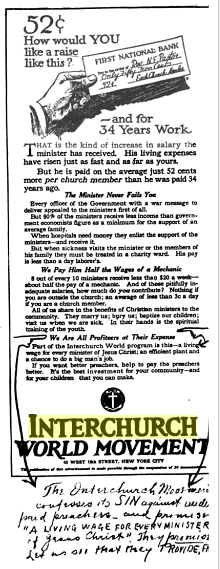
John D. Rockefeller, Jr., announced last evening at a dinner in the Pennsylvania Hotel to more than 800 business men, that he expected every one of them to do personal work in connection with the campaign from April 25 to May 2, next, to raise $336,000,000 for the Interchurch World Movement.

“The Ministerial Ordination of Women”


“The century in which we are now living is unmistakably woman’s. Today there is probably no profession, properly so called, to which woman is not admitted, except that of the Christian ministry.

Under protest woman has entered many professions for which she was not deemed qualified by man, but in which she has made good. While we admit that all professional women have not always been successful women, there are sufficient examples to prove that she is capable of attaining the standards attained by men. Many examples might be quoted to prove this. . . .

We believe that women’s ‘ability’ to qualify in any profession where intelligence and spirituality are requirements is indisputable. Sex, which was long considered a barrier to woman, has been almost forgotten as a handicap, since the world war found her ready to attempt anything, when the call was urgent and the need imperative. However, there are several natural and conspicuous reasons why it should be felt undesirable to call woman to this highest and most sacred office of the Christian Church.

With the exception of the medical profession, there is none with such continuous hours. A minister must answer calls all hours of the day and night and in all seasons of the year. It would not seem practical or possible for women who are mothers to accept such an added physical responsibility as this profession entails, nor is it acceptable to think that such a profession, if open to women, should be left wholly to unmarried women. This could possibly lead in time to a new form of celibacy.”

--Mrs. Blanche Dickens-Lewis, Synodical President of Home Missions for Ohio
March 24, 1920

Wednesday, September 10, 2014

The Overall Movement

April 26, 1920 | The Cincinnati Enquirer

"I am more interested in the Kingdom of God, than in the Presbyterian Church."

-->

Union of Churches Urged By Rev. Jesse Halsey, Who Champions World Movement

Elimination of sectarianism and willingness to go forward in one body for the sole perpetuation of the spirit of righteousness and the worship of Christ was urged by Rev. Jesse Halsey, in a sermon at Seventh Presbyterian Church, Madison road and Cleinview avenue, yesterday.

“The time has come for us to abandon personal differences and work unitedly on the task,” said Rev. Mr. Halsey. “So far as I am concerned there is nothing distinctive enough about a Presbyterian church to keep us from uniting with the Congregational, the Methodist, and the Episcopal churches in one organic body. That time of organic union may be far off, though it is a day devotedly to be hoped for. In the meantime, let us co—operate in every way possible by working toward the more remote goal.

“The Inter-Church World Movement represents the most successful attempt at such co-operation. Some things can be done together, even while the church remains divided, such as united survey, the elimination of competition in mission work, and a united drive for necessary funds.

“The average business man has little patience with overlapping and denominational competition, cares little for hairsplitting creedal differences, but is, as I see him, tremendously interested in the cause of righteousness and the essential tasks of the kingdom of God.

“I have so great a respect for the ‘Faith once delivered’ that it goes back to the day of a united Church, when men of all sorts companied together, and the sole condition of membership was the possession of the spirit of Jesus; this was the New Testament Church. There was large local differences in government in that church, many varieties of theological opinion, and much diversity in worship, but it was an effective organization for its divine purpose, held together by loyalty to Jesus and consecration to His aims.

“Such respect have I for that church and that ‘Faith’ that anything that emphasizes the decisive and distinguishing doctrines of my denomination seems too modern to enlist my allegiance. In other words, I am more interested in the Kingdom of God, than in the Presbyterian Church.

“Publicity has been given recently to an alleged opposition of Cincinnati delegates who are to attend the Presbyterian General Assembly in World Movement. This report is erroneous. No action has been taken by the Cincinnati Presbytery looking in that direction: six out of eight of Cincinnati delegates are out for the InterChurch Movement. An overwhelming majority of our people are for co-operation rather than for a sectarian denomination interest first and foremost.

“So far as the minister of this church can shape its policies, and so far as he understand the temper of the officers and members of the Seventh Church, this church shall always stand for the great essential Christian teachings concerning God and man’s duty. We welcome all the disciples in the perpetuation of a distinctly Presbyterian dogma. Our interest is in the promotion of the Kingdom of God and our creed lays an ethical emphasis rather an intellectual.

“So long as denominations exist, we will be loyal in our own regiment. We find here a congenial mode of church government, but we claim for it no divine right. When the day for a unified command comes, we will thank God. And if we understand the signs of the times, that day is approaching.”

"People are asking if, 'when Rockefeller and these other millionaires. . . '"

The Expositor | 1920

InterChurch World Movement

The Expositor | 1920

Tuesday, November 27, 2012

Jesse Halsey | Lincoln Memorial Address | 1920

Jesse Halsey | Lincoln Memorial University | 1920


The principal address during the exercises was delivered by Rev. Jesse Halsey, pastor of the Walnut Hills Presbyterian Church, Cincinnati, Ohio. His subject was “The Russian Situation as a Contrast to the True American Democracy.” He emphasized Lincoln in life and example as a true exponent of democracy.

Dr. Halsey was an active worker on the northern front in Russia for several months during the war. He was in Petrograd when the first convention of Russian democracy was held after the overthrow of Czar Nicholas. His intimate knowledge of the conditions in Russia made his address timely and fitting.

Some of the pertinent points are shown in the following paragraphs taken from his address:

“The Russians are between the upper and nether stones of Czarism: First, Nicholas Romanoff; second, Nicholas Lenine. Since the Revolution of November, 1917, Russia has been in the clasp of the new Czar, of this mania that has seized a great portion of humanity. I have seen it all, and have contrasted a bright picture of America with the dark regime of Bolshevism; America is a great high-house of just benighted peoples overall!

“On the fourth of July, 1818, the Serbian commander came as the representative of Yugoslavia and said that he had come to pay his respects to American on the anniversary of America’s birthday. He said, ‘We have done what we could, but it is up to America to finish the job. On the 11th of November 1918, we finished the job in a military way. But the job still remains unfinished so far as America is concerned. A great apathy has come over America; and unless America accepts her responsibility in the League of Nations, you can look for another war in five years. The Bolshevik Regime is drawn from the Baltic to the Pacific Front to the white side of the Black sea, with: a trained army of 1,500, 000. Without America, the League of Nations is bound to fail. Without America, Great Britain has realized her inability to cope with the Russian situation and King George has been talking of accessions to Bolshevism.

“In America we are asleep while autocracy and a new war threaten our civilization; the lack of a little schoolhouse and a Church that puts morality ahead of empire is largely responsible for the condition in Russia, eighty-five percent of her people are illiterate. There has been an expression of absolute confidence in America. Once a Pole said to me that this country was going to be free. I asked him why he thought so, and he replied, ‘Because of your country and your President, he has said that we are going to be free and we believe it, because he speaks for 100,000,000 people who believe in a Square deal.’”

When "Lincoln said on one occasion, 'Maybe my chance will come. I am going to get ready,” I hope that’s the American attitude, instead of the 'Nitschevo' attitude which: means, 'Nothing,' 'I should worry, ' 'Let George do it. ' When that becomes the American attitude, and we let someone else do the worrying we shall suffer grave consequences. Years ago we disregarded the controversies between capital and labor, and now we are reaping high prices as the harvest of our indifference. No American after the days of Abraham Lincoln can afford to say, 'Nitschevo.' It means for Russia, for any country, for any people, annihilation."