Showing posts with label Lenin. Show all posts

Thursday, December 15, 2016

Cincinnati Club Hears Address on Bolshevism


March 6, 1920 | The Southern Lumberman

Cincinnati, Ohio, March 1—An interesting talk on Bolshevism was made before the Lumbermens’ Club of Cincinnati at its monthly dinner at the Businessmen’s Club here tonight by the Rev. Jesse Halsey, pastor of the Seventh Presbyterian Church of Cincinnati. Mr. Halsey was an agent of the United States department of state in Russia for eighteen months and was an eye-witness to the development in the country during the time that Lenin and Trotsky gained control. He was stationed at Murmansk, north of Archangel, for a time and visited in Petrograd and Moscow, besides traveling over a large part of Siberia.

Mr. Halsey differentiated between Bolshevism as a political and economic program as applied to Russia and the term as it is now commonly used to denote the radical spirit of unrest throughout the world. He said many people were now applying it indiscriminately to people who differed in opinion with them over political-economic questions.

As to Russian Bolshevism as exemplified under the government of Lenin and Trotsky, Mr. Halsey declared that in practice their program had been greatly modified from the ideas they had enunciated when gaining their power over Russia.

“Bolshevism as a political program has been greatly modified in Russia,” Mr. Halsey declared. “Lenin has resorted to a system of capitalism in Russia to force production. After ten months of a government of destruction he now reverted to a system of capitalism of the most reactionary character. As applied at first the principles of Bolshevism meant nothing but destruction, and whatever of a constructive nature there has been in Russia has been along lines that in theory at least the Bolshevists have most of denounced.

“The ideal six-hour workday of the Bolshevists has now degenerated into a sixteen-hour workday, with the workmen kept under a strict military discipline to force production. The government, in order to attract Russian capital to its industries has offered high rates of interest and are now offering all sorts of guarantees and high rates of interest to foreign capital to come into the country.

“The people who have suffered most under the Red Terror of the Bolshevists were the intellectual radicals who were responsible for the overthrow of the Czar. They are the ones the Bolshevists have persecuted and not the old retainers of the Czar. As a matter of fact many of these have come to the support of the Bolshevist government and the leader of the army against the Rumanians is not a general developed under Trotsky, but an old-time general of the Czar.

“The intellectual class of Russians have been weak and indifferent to the crisis through which their country has passed. The Russians have a word, ‘Nichevo,’ which described their spirit and attitude to things. It indicates a shrug of the shoulders and ‘I can’t help it, I don’t care’ spirit.

“The Bolshevists gained their power by appealing to the emotions of war-worn and hungry people. They offered food, division of the land and peace to the country at a time when the people were dispirited and hungry. They have retained their power by military discipline over the people. They have disarmed all who belong to parties other than their own and having all the arms and ammunition in the country are able to effect their will without a military opposition.

“The Bolshevists are a majority party of the radicals, but do not represent a majority of the Russian people. At the best only between 20 and 30 percent of the Russian people were Bolshevists.

“Bolshevism will never conquer America,” Mr. Halsey asserted. “The long period of evolution in which our political and economic system has been developing together with the fact that the great mass of Americans are educated, is a great bulwark against any red revolution in America. In Russia there was no middle class and 85 percent of the people were illiterate. When Kerensky and his radical government took the helm, there was no background among the Russian people for his experiment. To America the development of our institutions since 1776 will prove an effective armor against Bolshevism.”

Wednesday, February 11, 2015

American Intervention in Russia


Atlanta Constitution | 16 July 1918    

“The protest of the Lenine government against the entente operations in the north is believed to have been a mere formality made possibly to satisfy the Germans, who are endeavoring to control the Bolshevik government. Officials say it will not be entertained because the entente does not recognize the Bolshevik as the real government of Russia and persists in regarding the nation as still in the war on the side of the entente, regardless of the peace treaty of Brest-Litovsk.”

Wednesday, January 28, 2015

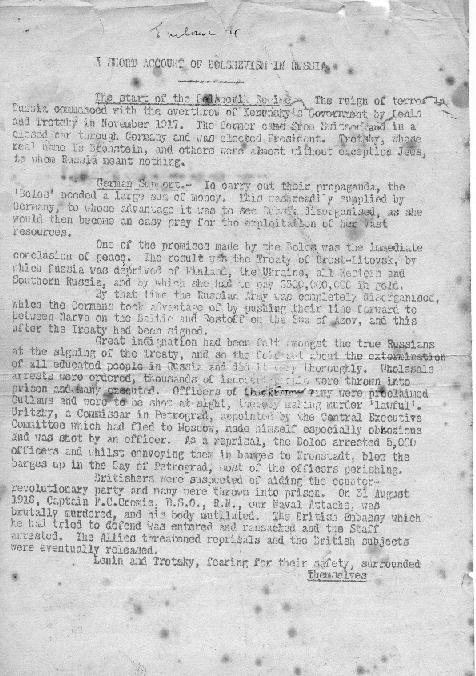
A Short Account of Bolshevism in Russia Issued from HMS Borodina | July 1919

A SHORT ACCOUNT OF BOLSHEVISM IN RUSSIA
The start of the Bolshevik Regime - The reign of terror in Russia commenced with the overthrow of Kerensky's Government by Lenin and Trotsky in November 1917. The former came from Switzerland in a closed car through Germany and was elected President. Trotsky, whose real name is Bronstein, and others were almost without exception Jews, to whom Russia meant nothing.
German Support - To carry out their propaganda, the "Bolos" needed a large sum of money. This was readily supplied by Germany, to whose advantage it was to see Russia disorganised, as she would then become an easy prey for the exploitation of her vast resources.
One of the promises made by the Bolos was the immediate conclusion of peace. The result was the Treaty of Brest-Litovsk, by which Russia was deprived of Finland, the Ukraine, all Western and Southern Russian, and by which she had to pay £300,000,000 in gold.
By that time the Russian Army was completely disorganised, which the Germans took advantage of by pushing their line forward to between Narva on the Baltic and Rostoff on the Sea of Azov, and this after the Treaty had been signed.
Great indignation as been felt amongst the true Russians at the signing of the Treaty, and so the Bolo set about the extermination of all educated people in Russia and did it very thoroughly. Wholesale arrests were ordered, thousands of innocent people were thrown into prison and many executed. Officers of the Former Army were proclaimed Outlaws and were to be shot at sight, thereby making murder 'lawful'. Uritzky, a Commisar in Petrograd, appointed by the Central Executive Committee which had fled to Moscow, made himself especially obnoxious and was shot by an officer. As a reprisal, the Bolos arrested 5,000 officers and whilst conveying them in barges to Kronstadt, blew the barges up in the Bay of Petrograd, most of the officers perishing.
Britishers were suspected of aiding the counter-revolutionary party and many were thrown into prison. On 31 August 1918, Captain F.C. Cromie D.S.O., R.N., our Naval Attache, was brutally murdered, and his body mutilated. The British Embassy which he had tried to defend was entered and ransacked and the Staff arrested. The Allies threatened reprisals and the British subjects were eventually released.
Lenin and Trotsky, fearing for their safety, surrounded themselves with Chinese and Lettish Guards, but one day a girl succeeded in firing three shots at Lenin and seriously wounded him. Again thousands of innocent people were shot as a reprisal.
Appeal of help - About this time the Russians appealed to the Entente Powers for help against the Bolshevik Terror.
In the North, with the aid of British, French, and Americans, communications were kept open and food and clothing were supplied to the starving Russians. Archangel was occupied by an Allied Force on 2nd August 1918, and the Bolos were driven out of the surrounding districts, thus enabling the population to pursue a safe and peaceful existence such as they had not known for many months.
A volunteer Army, mainly consisting of ex-officers, was started by Generals Alexeiff and Korniloff in the South. Their strength at first was only 2,500 men all told, but after successful fighting, many fresh men gathered round them and now the Army, which since the death of both Alexeiff and Korniloff, is under command of General Denikin, numbers now about 300,000 men and is well equipped with guns, ammunition, aeroplanes and tanks which have been supplied by Great Britain. The Volunteer Army has already cleared a large part of South Russian of the Bolos and is continuing to advance rapidly.
In the Ukraine, two armies, at first acting independently, met with considerable success, and having now joined hands, are pressing the Bolos hard. They are nearing Keiff, the last Bolo stronghold in the Ukraine.
From the West, the Poles have cleared the Bolos out of their country and are not working in conjunction with the Esthonians and Russians under General Udenitch. He is now within a few miles of Petrograd, where a severe battle is raging, the Bolo desperately defending the capital, which although it has long ceased to be the site of the Central Executive Committee which has moved to Moscow, is still regarded by the Bolos as a most important city, whose loss would be a great blow to their cause.
All the Commanders of the anti-Bolo armies have recognised Admiral Kolchak as their supreme Commander-in-Chief, who with his Siberian Army from the East is assisting to strangle the Bolos. He is now at Perm.
Situation in 'Soviet' Russia - The situation in Soviet Russia is becoming more and more desperate. The people realise that all the promises with which they have been lured by the Bolos are nothing but empty words. The Bolos confiscated all private estates and crown lands but no system was devised for the division of the land among the peasants, the result being plunder, destruction and indiscriminate land-grabbing, leading to an unequal distribution of land and further conflict between individual villages and peasants.
The workmen got control over the factories but were unable to manage them, owing chiefly to lack of experience and desire on the part of the workmen themselves to work conscientiously, and also to lack of raw material, due to the breakdown of the transport. In spite of large sums of money paid by the Bolo Government in their promissory notes as wages, the factories closed down one after another, thereby throwing the work men aside without any means of support.
The stock of manufactured goods being exhausted, there was nothing left to give the peasants in exchange for their produce, as the latter refused to accept the paper money which had become valueless. Therefore punitive expeditions were organised to extort corn from the peasants, which led to the extension of the Civil War to the rural districts, whereas up then the bloodshed had been almost entirely confined to the Cities where the bourgeoisie had been mercilessly hunted down. Several risings of peasants occurred but were suppressed with unheard of cruelty; whole districts were laid waste and the inhabitants shot regardless of sex and age.
In every town and village, the Central Executive Committee possessed its agent, whose duty it was to report anyone suspected of anti-bolshevik feelings and any such people were immediately arrested and thrown into prison which they seldom left alive, being either shot after a mock trial before the Revolutionary Tribunal or literally starved to death. One member of the Committee, appointed to report on the condition of the prisons, was himself arrested for daring to give a truthful account of the shocking state in which the prisoners existed.
Results. - By means of such terror, the Bolos have been able to keep the whole country subservient to their means. For the male population there is but one thing left - to enlist in the Red Army where they get sufficient food to exist. They are forced to fight for fear of being shot if they refuse to obey. Detachments of Chinese and Letts are kept for this purpose as Punitive Units and Executioners.
Food is very scarce, especially in the towns where the people are starving. As a result of bad feeding, epidemics have broken out; in Petrograd in the early summer there 2000 cases of cholera daily, the great proportion of which were deaths. 
The Bolos have done away with all law and substituted numerous decrees, one of which did away with the Church. Many of the churches were turned into cinemas and music-halls; the priests were persecuted and many murdered. Another decree did away with the marriage ceremony, which now became a simple thing. A man had only to hand a paper to a Commissar stating he wanted a particular woman as his wife, the paper was stamped and the ceremony was complete. The same paper had only to be torn up by the Commissar for the marriage to be annulled.
In certain areas the women were nationalised and any man could take any girl between 18 and 35 as his wife and leave her as soon as he wished. Any woman who refused was shot. Children were to be taken away from their parents and brought up by the state.
Present state of affairs. - The brutal and lawless method of the Bolos have been carried too far and have turned the bulk of the country against them. The men in his armies have been largely mobilised at the point of a pistol, and are peace-loving people who would rejoice at regaining their freedom to carry out their ordinary work as they did before the war.
The Bolo leaders fully realize their precarious position but still cling to their task hoping that a universal revolution will still plunge the world into a state of anarchy and chaos, such as they have done with Russia.
But their hopes are doomed with the steady pressure of all the anti-bolshevik forces by which they are surrounded, and by the desire of the Russian people to overthrow the terrible 'Bolo' rule
"BORODINO"
21 JULY 1919

Tuesday, February 26, 2013

Jesse Halsey | Russian Passport

Noted in Jesse's Bible by his wife, Helen, as the "Bogus passport which saved the lives of 2 Americans in Russia 1917 save" the document says: "This Passport entitles 780.45 Rev. Jesse Halsey to 1 week's board at "Do Svidanya" Camp, "SI Chas" beach, Upper Chatequgay Lake-in-the-Adirondacks, United States of America, and a seat near the fireplace the while you tell what little you actually know about Russia."

It was signed, however, on Monday, March 18, 1918, by Howard D. Hadley, the former American Consul at the city of Samara, and Russell M. Story, about whom Jesse later writes, "One of my colleagues [Russell Story] was a professor of history and thought that he could predict the course of the Russian revolution by the history of the French. He was daily looking for “the man on horseback” and could never quite decide which was it: Trotsky or Lenin."


Murmansk | Spring 1918

from "Russian Sideshow: America’s Undeclared War" by Robert L. Willett, 2003, Potomac Books

 
“Then came a change: in February 1918, Germany reattacked Russia in the Ukraine, although Germany was still in negotiations with the Bolshevik Soviet. In Murmansk there was a concern that the nearby Finnish border would offer Germany a haven from which it could launch a North Russian offensive. The threat of German attack brought some harmony to the three diverse Murmansk groups—the government, rebellious military, and allies—as they recognized the need for British defense and supply. At this time, an American, Lt. Hugh Martin, a passport control officer, was the senior U.S. representative on the scene. A few other Americans were also there: Allen Wardwell of the Red Cross had made his second appearance in the new city, while YMCA official Reverend Jesse Halsey was a more recent arrival.

With this new spirit of cooperation among the three Murmansk groups, the area faced a new concern: a civil war had begun in Finland, and it was feared that Germany would aid the White (anti-Bolshevik) side, possibly invading Murmansk with a combined force. In retrospect, we know that both Germany and Finland had their hands full and gave little thought to any additional fronts. However, anticipation provided fuel for those who saw the possibilities of a German threat. Historian George Kennan wrote, “In March and April there was no serious danger of attack on Murmansk by Finns under German command; but by the time the British and the French had spent some weeks acting as though there were such a danger, they succeeded in conjuring it into real existence.” As tensions heightened, the British sent another cruiser, HMS Cochrane, and the French sent the heavy cruiser Admiral Aube. At last pleas to Wilson finally caught his attention. Rumors flew about, all indicating German-Finnish forces heading toward Murmansk or its railroad.

Eventually, in April 1918, Wilson relented and reluctantly made a step toward intervention by sending the USS Olympia, Admiral Dewey’s old flagship, Capt. Bion B. Bierer commanding. However, Wilson cabled, “to caution him [Bierer] not to be drawn in further than the present action there without first seeking and obtaining instructions from home.” With Bierer’s instructions was the added information that he would be under the command of the British naval commander, Adm. Thomas W. Kemp. Admiral Kemp had telegraphed earlier:

“I beg USS Olympia may have orders to come to Murmansk and that she be put definitely and fully under my orders the same as the French cruiser Admiral Aube. There can be only one Allied head here and I consider this step indispensable for both military and political reasons.”

The decision to have American forces commanded by British officers would lead to a host of problems in coming months.

By mid-April, the USS Olympia was steaming from Charleston, South Caroline, toward Murmansk, stopping several times en route, with Captain Bierer on a collision course with the president’s cautionary advice. With him on the Olypia was the new Allied commander, British major general Frederick C. Poole, who took command of all Allied forces in North Russia on his arrival in Murmansk on May 24, 1918.

With mounting concern over threats of German and Finnish invasion, the Murmansk Soviet telegraphed the Central Soviet on May 18, 1918, “The representatives of the friendly powers, the French, American, and British missions currently at Murmansk, continue to show themselves inalterably well-inclined toward us and prepared to render us assistance, running all the way from food supply to armed aid, inclusive.”

An immediate answer on the same day was an important piece of the Murmansk story. It came from People’s Commissar Leon Trotsky, who warned:

“The Germans are advancing in small detachments. Resistance is possible and obligatory. Abandon nothing to the enemy. Evacuate anything that has any value; if this is impossible, destroy it. You must accept any and all assistance from the Allied missions and use every means to obstruct the advance of the plunderers.”

Threats of invasion by German and Finnish troops worried even Petrograd Soviets, so the telegram opened the door for cooperation between the Murmansk Soviet and the Allies, even if it eventually antagonized the Central Soviets. The wire would also haunt Trotsky in years to come as he fell from favor.

From this point on, the Allies began a gradual buildup. The French already had a Slavic command of a few soldiers in the town of Kola. Admiral Kemp had landed about 130 Marines from his ship HMS Glory on March 6, 1918; they had quietly housed themselves in barracks and awaited developments. These British marines were the first purely military troops to take part in the Allied Intervention.

On June 8, apparently at British request, but with the blessing of U.S. ambassador David Francis, Captain Bierer was ordered to land a shore party to help garrison Murmansk. Captian Bierer sent Lt. H.C. Floyd with eight officers and one hundred men and their equipment to Murmansk. Murmansk was under Soviet control, but already some Allied troops were in the city; the local Soviet anticipated a break with the Central Bolsheviks in Petrograd, so the landing was not contested. The American sailors also keep busy, assisting British and French marines in capturing the Russian cruiser, Askold, and other smaller ships, whose Bolshevik-sympathizing crews had mutinied.

On June 23, a six-hundred-man force under British major general Sir C. Maynard was put ashore with its equipment. Major General Maynard’s writings after the war indicated that the goal of these and subsequent troops was to protect Murmansk and Archangel and the southbound railway, but he also stated, “When ready to take the field, the whole force was to endeavor to join hands with the pro-Ally forces in Siberia, and then to assist in opening up a new front against Germany.” The misinformation and lack of understanding of the situation was evident in this stated goal of the expedition.

As General Maynard’s task force landed, his commander was already in Murmansk. Major General Frederick C. Poole had been an honored guest on the USS Olympia when it sailed into the Russian harbor on May 24. He was the overall commander of the Allied North Russian land forces. Poole was noted for his colonial approach to Russians: he patronized them, scolded them, misunderstood them, looked down on them, and generally made himself heartily disliked by those hapless souls he was preparing to liberate. His first contingent of British soldiers was not impressive; most of them were veterans of the western front who were classified as unfit for active service, yet they were expected to conduct themselves with typical British stoicism in an utterly hostile climate and topography.

Poole and Maynard conferred for hours as the contingent arrived. George Kennan says, “From his initial discussions with Poole, Maynard, as will be seen in his memoirs, derived a wildly distorted picture of the situation, including the impression that 15,000 White Finns, in German service, were already on the march against the Murmansk Railway. Maynard set out on a mission to strengthen his defenses, traveling south on a locomotive with several cars full of troops. His reception by the Russian railway workers and stationmasters as he rode south was decidedly antagonistic, to the point of open rebellion. Later Maynard explained, “Bolshevik Russia was a recognized enemy, and I had a free hand to take such military measures as were possible to combat a Bolshevik-White Finn combination.” South of Murmansk in the town of Kandalaksha, he was confronted by a northbound train filled with Red troops. Maynard’s unfortunate response was to mouth machine guns covering the Bolsheviks and order the Red trains to turn around and return south. He called for reinforcements from the port and visited a nearby Allied base at Kem, where he forcibly disarmed two more Red trains and sent them back south. His high-handed actions opened armed hostilities between Allies and Bolsheviks, the first real signal of the conflicts to come.

Even before Maynard’s railroad journey, the relations between the Murmansk Soviet and Central Soviet in Moscow had soured. Murmansk, concerned with its daily survival, depended almost entirely on Allied supplies. The Central Soviet in Petrograd saw things very differently. Trotsky’s invitation had disappeared: the Petrograd government now issued a decree to the Murmansk government to throw the Allies out. The tone of a June 26, 1918, telegram from Petrograd grew even more critical: “If you still refuse to understand Soviet policy equally hostile to English and Germans, blame it on yourselves.” Murmansk fired right back in the same tone, “It is all very well for you to talk that way, sitting there in Moscow.” Lenin could not tolerate that kind of behavior and promptly called the party members of the port city Soviet traitors and declared them outcasts, subject to execution. “The President of the Murmansk Soviet Yuriev (Yuryev) having gone over to the side of the Anglo-French imperialists and participating in inimical actions directed against the Soviet Republic, is hereby proclaimed and enemy of the people and outlawed.” The telegram was signed by Lenin and Trotsky.

In an action which completely frustrated the Soviets in the capital, the Murmansk Soviet signed an accord with the Allies, British, French, and even American. This agreement pledged the Allies to defend Murmansk and recognize the Murmansk Regional Soviet as the acknowledged government of the area. Captain Bierer of the Olympia signed on behalf of the American government, even though he had no authority to do so. It is interesting to note that this document was executed several days before Wilson’s Aide Memoire, which authorized intervention in Russia. The Murmansk agreement was completely unauthorized by the U.S. government, yet it was finally approved in October 1918. While it was a stroke of luck for the Allies to have the tie-in with a Russian government, even an out-of-favor one, the Allies pledged to protect those individuals who had faced the wrath of their own people by separating themselves from the Central Soviet.

Tuesday, February 12, 2013

Raymond Robins

Raymond Robins (17 September 1873 Staten Island, New York - 26 September 1954) was an American economist and writer. He was an advocate of organized labor and diplomatic relations between the United States and Russia under the Bolsheviks.

After financial troubles, his father left the children in care of his mother and left to do mining in Colorado. When his mother went into a mental asylum, his upbringing was left to relatives.[1] He was educated privately. In the early 1890s, he worked as a coal miner in Tennessee and Colorado.[1] After a bad legal experience in a land deal,[1] he studied law at George Washington University (then Columbian University) from where he graduated in 1896. He joined the Klondike gold rush in 1897, where he made some money, converted to Christianity, and became pastor for a Congregational church in Nome, Alaska. He moved to Chicago in 1900.[1] He engaged in social work there 1902 to 1905, and was a member of the Chicago Board of Education from 1906 to 1909. He served also as social service expert for the Men and Religion Forward Movement, in 1911-12, and made a world tour in its interests in 1913. He was leader of the National Christian Social Evangelistic campaign in 1915.
 
He became identified with the Progressive Party and served as chairman of the State Central Committee. In 1914, he was candidate for United States Senator from Illinois for that party, and was temporary and permanent chairman of the Progressive National Convention in 1916.
During World War I, he was engaged in Y.M.C.A. work and Red Cross work in France. In 1917, he headed the expedition for the American Red Cross to Russia, and worked unsuccessfully at establishing diplomatic relations between the United States and Russia, but some years later, in 1933, did manage to persuade Franklin Roosevelt to exchange ambassadors.[1] On his return from the 1917 expedition, he presented an elaborate report on conditions in Russia, which occasioned much discussion on account of the report's alleged leaning toward the Soviet movement. Although not philosophically sympathetic with the outcome of the Russian Revolution of 1917, he felt it was popular, and counter-revolutionary efforts were counter productive.[1]