Showing posts with label 1941. Show all posts

Wednesday, November 18, 2020

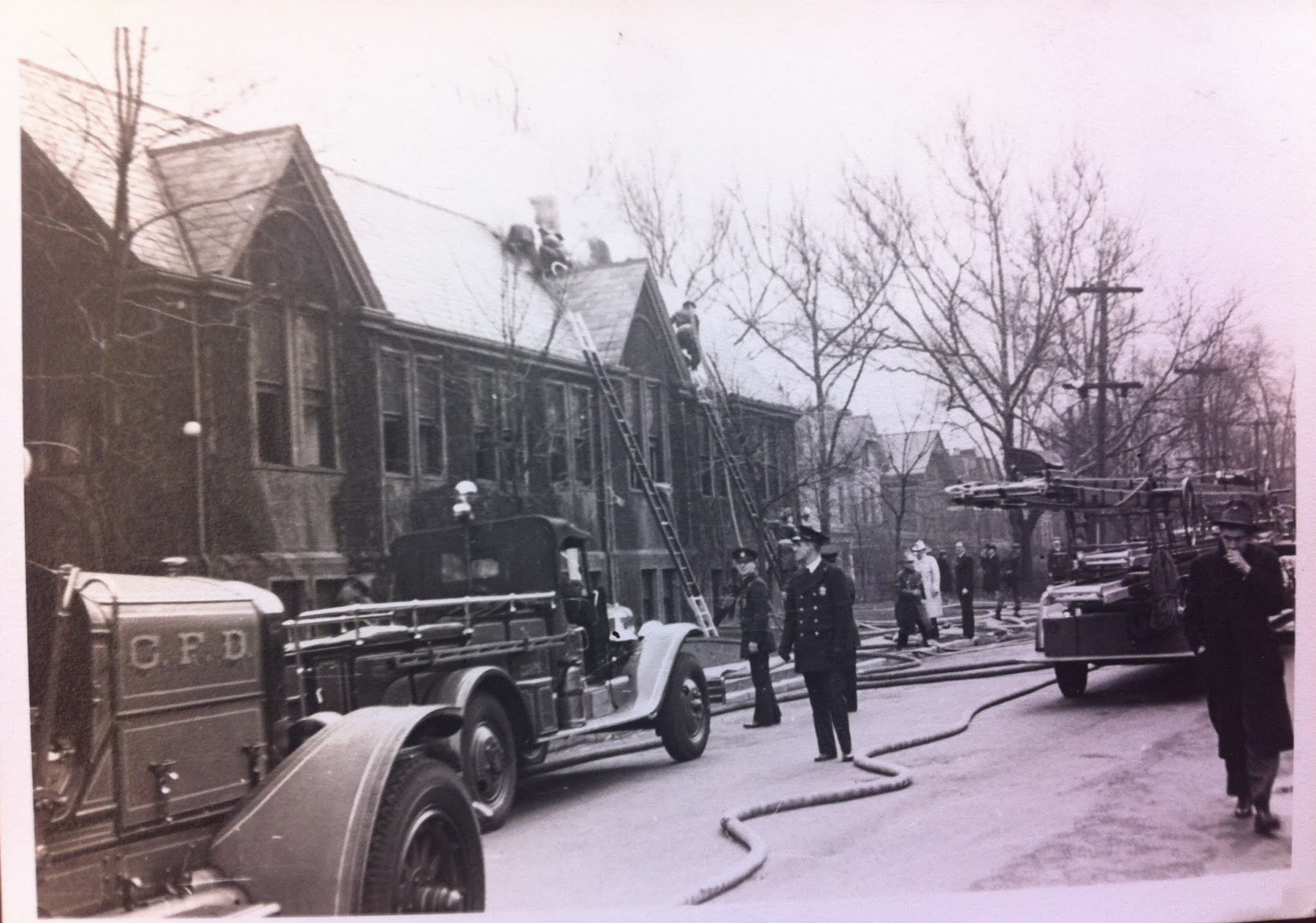
Church Service is Cut Short by $5,000 Blaze in Annex; Memorial Painting is Saved

17 March 1941 | Cincinnati Enquirer 

Fire of undetermined origin cause $5,000 damage to the two-and-one-half-story stucco annex of Seventh Presbyterian Church, Madison Road and Cleinview, Walnut Hills at noon yesterday during services.


The annex, which connects with the church, houses the pastor’s study, a library, a music room, an auditorium, and storage quarters.


The fire, starting in the upper half story of the storage room, burned fiercely under the slate roof, Assistant Chief Edward Shearwood and Marshal William Cunningham reported.


First news of the fire was given to Fire Company 23, a square away at Madison Road and Hackberry Street, when a motorist, George Hack, stopped to report that smoke was pouring from the building. The company hurried to the scene, followed immediately by other companies.


So quietly did the firemen approach that few among the congregation attending services were aware of the blaze until the pastor, Rev. Jesse Halsey, curtailed the almost completed service as smoke started to filter into the edifice.


The congregation filed out of the structure in orderly manner. Many then joined spectators on the sidewalk to watch the fire.


Rev. Mr. Halsey had been informed of the blaze some time before by the assistant pastor, Rev. Samuel Warr. Rev. Mr. Warr told his superior that firemen were on hand and that everything was under control.


Rev. Mr. Halsey and Mrs. Halsey thanked fireman and the Salvage Corps for protecting an oil mural in Rev. Mr. Halsey’s study with tarpaulins. The mural hung immediately below the point where the fire was most intense. The picture is one that Cleveland Woodward painted as a memorial to the Halseys’ son. William Halsey, who, when 7 years old, was killed by an automobile in front of the church in 1927. The building in which the fire started had been used earlier in the morning for children’s Sunday school classes. The children were out of the building, however, when the fire was detected.

Marshal Louis Schraffenberger and Captain Carl Rogers started an immediate inquiry . .   


Persons associated with the church were summoned to a hearing in Deputy Feldmeann’s office this morning.


Too Much Competition!


“There’s too much competition!”


Thus did Rev. Jesse Halsey, pastor of Seventh Presbyterian Church, impart to his congregation yesterday the knowledge that a fire in the edifice was too intense to permit him to complete the morning worship service. 


Rev. Mr. Halsey had been informed of the blaze previously by an assistant pastor, Rev. Samuel Warr. The clergymen had hoped that firemen, already on the scene, would be able to keep the flames under control sufficiently to avoid disruption of the services. 


Tuesday, December 3, 2019

Former Paris Pastor Called To Replace Rev. J. D. Halsey

13 November 1941 | Cincinnati Enquirer

New Citizens' Day | 1941


11 June 1941 | Cincinnati Enquirer
Final arrangements for the tenth annual celebration of New Citizen’s Day at 3 o’clock Sunday afternoon at the Zoo will be discussed at a meeting of the Board of Directors of the Citizenship Council at 4 o’clock tomorrow . . Dr. Jesse M. Halsey, who has been a member of the board for 20 years, will be principal speaker Sunday. Dr. David Philipson, Chairman, will preside tomorrow, welcoming those who have received naturalization papers in the last year. Siegfried Gelsmar is Chairman of the event. An election will be held tomorrow for a new Vice Chairman to succeed Dr. Earle E. Eubank, who resigned. Dr. Eubank remains a member of the board. . .

Thursday, November 7, 2019

Guests of Honor at Tea

14 June 1941 | Cincinnati Enquirer
Guests of Honor at Tea
Mrs. Jesse H. Halsey and her two interesting daughters, Miss Helen Halsey and Miss Abigail Halsey, were the charming guests of honor at a tea given yesterday afternoon at Blue Hills, Mrs. Dwight Hinckley’s attractive residence in Mount Washington.

This tribute to Mrs. Halsey, who with Rev. Mr. Halsey, pastor of Seventh Presbyterian Church, will be leaving soon to take up their residence in Chicago, and the two daughters of this household was arranged by Mrs. W. E. Talbert’s Bible Class. It assembled the women of the parish.

Masses of fragrant flowers sent as a tribute of admiration and friendship, combined with some of the superb lilies and other summer flowers from Mrs. Hinckley’s garden, were used to decorate the spacious living room, the dining room, and the terrace.

Mrs. Halsey, who is pictured above, with Miss Helen Halsey at the left and Miss Abigail Halsey at the right, wore a afternoon gown of chiffon flowered in vivid tones. Her should bouquet was of orchids.

Miss Helen Halsey and her sister wore gowns of soft blue, similar in design. Outlining the square neckline were inset bands of narrow lace, a broader panel of white lace being appliquéd to the souffant skirts. With these becoming frocks each wore a strand of waxy white camellias . . .

Thursday, December 8, 2016

75th Anniversary of Pearl Harbor

"May our country ever be the instrument of righteousness in the hand of the Eternal."

On the Sunday morning of December 7, 1941, Rev. Jesse Halsey preached his farewell sermon to the Cincinnati congregation he had served for more than 28 years and delivered the pulpit vacant. In the evening, the new pastor Rev. Clayton Williams, a former French minister who was a Paris war refugee, was installed. The succession agreement didn’t happen in the Presbytery of Cincinnati according to standard procedure, but happened via my great-grandfather’s direct order: Jesse wanted to get Rev. Williams out of Nazi-occupied France.

Pearl Harbor occurred between the two services, upsetting everything. At the evening service, Rev. Joseph R. Sizoo, of New York City, said: "If we had confidence in Jesus, we could expect him to say at this time the same thing with which he comforted people at a similar time in the first century. He would repeat today, 'at the heart of things there is a God who is not hate but love.'"


Wednesday, December 3, 2014

"I have loved this city as Isaiah loved Jerusalem"

6 December 1941
-->
“Regardless of rootage, every religious group would claim the same heritage—a belief in a God who is all powerful and loving and wise, and a belief in human brotherhood. Let us all join hands as such. Those ideals and ideas are boldly challenged today. All who stand for them had better stand together, or they will hang separately.”

His Ministry Goes Far Beyond the Pulpit

4 December 1941

Pastor Helps Friend at Job Of Painting Night Club

Cincinnati Post | December 4, 1941
"He couldn't look at himself solemnly at the end of 28 years as pastor of the Seventh Presbyterian Church on Madison road in Walnut Hills. He rather snorted at a question about his success."

Wednesday, May 21, 2014

from Grenfell, As Theologian--and More

By Jesse Halsey

He came in, leaving his snow shoes by the door, sat down by our smoking peat fire, slipped off a sealskin boot and began to manipulate its stiffness over a can that stood in the corner just the way the natives do all down the Shore; then blurted out, “Parson, is there any such entity as the Grace of God?”

This was my first contact with Grenfell, as Theologian. I had seen the surgeon operating in his new hospital; had “poured the ether” for him and once held a leg five minutes after he had amputated it, and at length heard him say:  “You can lay it down now, I’m through with it.” I’d seen him, week on end, fill the largest building on the college campus, where ordinarily “daily prayers” were sparsely attended; listened to his tales of travel with his dogs on the ice and with his hospital steamer through the ice; seen him painlessly extract money in large sums from a Boston audience, but here was a new Grenfell—the Theologian.

“Is there any such ‘entity’ as the Grace of God?” What did he mean exactly? I tried to say that grace was a quality in God, an attribute of his character; that he was gracious and merciful in his very nature and being. No, he thought “grace” must be more than just a quality, it must be an “entity.” Definition of entity? He didn’t exactly know, but a “glorious something”—and there we left it.

Wednesday, April 2, 2014

Letter from Charles H. Brown, Welfare Director of the R.K. LeBlond Machine Tool Co.

November 13, 1941

With thanks to: The Jesse Halsey Manuscript Collection. Special Collections, Princeton Theological Seminary Library.

Thursday, February 6, 2014

from "Down North" | c1941


One day in the late spring of 1907, I was riding to the University on one of those (then) novel double-decker trams that ran in Glasgow. (The paper, this very day as I write, shows a picture of two bombed and gutted standing inert on the car-track) when I noticed a meager item on an inside page of an evening paper of how a mission doctor in Labrador had been carried off shore on an ice flow and had lived to tell the story. That was the first I ever heard of Grenfell. Two years later, I was on his staff—not as preacher but as plumber.

It happened like this. He came to Princeton Seminary to speak for a week at Chapel. Chapel was a dreary performance held at the end of the afternoon with a handful present and a cut and dried professorial performance in exegesis as diet. I seldom went. But hearing that Grenfell was coming that day, I went and took several other fellows along. The place was filled the second day; and before the week was out the crowd jammed the largest hall on the University campus.

In one of his talks he told the story of that ice pan experience (of which I had read on the Glasgow bus), in another he intimated that students sometimes would “down” with him in the summer to do odd jobs. I made an appointment at the house of the professor where he was staying. “Yes,” he took students along to help; “What was I going to be?” “A preacher!” “No, he didn’t need a preacher, they had too many on the shore already. “Well,” I ventured, “What do you need?” “A plumber,” he snapped back, “a plumber for our new hospital.” I signed up, then and there, knowing that water runs down hill and inheriting from my practical builder-mason-grandfather, a manual knack for doing things, and knowing how to solder and wipe a joint, and a few other things, from a Yankee blacksmith who had a shop on the back street where I used to stop in to blow the bellows and fuss around on the way home from school.

In May (Divinity Schools have a short term), I started out for Labrador. It took nearly a month to get there, for it was a late season and the ice hugged the land so that schooners and mail boats couldn’t get “down along” shore. When we reached St. Anthony all set “to plumb” the hospital, I found that the hospital wasn’t even built. The Chief was like that: ambition always running ahead of any possible performance on the part of his helpers.

Not only was the hospital unbuilt, not even a foundation was in, no excavating done either. So after putting a new window in the log bunk house for light and air (terribly dull tools they had and my new plumber’s kit didn’t fit the wood working job, all their tools were dull except the axes; a Newfoundlander can build a ship with his ax and after I had fussed for half a day with brace and bit (dull in spite of my file) and key hold saw pecking at the logs, Old Skipper Joe Souley came along and in ten minutes with his ax cut the hole in the side of the bunk house where I installed my window.

There being no one more capable available, I set about excavating for the new hospital cellar. We struck solid rock. I knew nothing about blasting—except that one did it before building. (The Doctor having finished his first hospital realizing that it needed a cellar, undertook to blast one and blew off his roof.) Skipper Joe (my friend of the ax) had worked in a mine; he knew how to blast! But he didn’t know how to sharpen drills. Here my Yankee blacksmith came to my aid; (by quasi proxy). I had watched him and had a dim notion of how it was done and after considerable experimenting—just the right heat “cherry red” dipped at the right moment in oil, the drill was just the right temper, not too hard to be brittle and break under the sledge as it bit its way into the rock and not too soft—not cutting at all but just further blunting itself.

I would hold the drill; Joe would strike it with the big sledge, strike with an unerring accuracy; when my turn came to strike and he to hold, like the brave man he was, he held the drill while I swung the sledge, fortunately for him I never missed—my old grandfather coming to the rescue. (I am a great believer in ativism—or whatever it may be called. Cap’n Harry, my grandfather, was a skilled mason (he built most of Greenwich Village in New York, over a hundred years ago.) He once was known to have cut the center out of a millstone to convert it into a well curb, cut it—on a bet—in thirty minutes. He knew how to swing a maul; I’m sure he was there fifty years later, for my help. (What’s fifty years among Yankees?)

When the holes were drilled we began to blast. It was cold; dynamite will not explode when it is “frozen.” Joe would build a fire in the forge and put me to blowing the bellows, with a pail of water on the coals. When it began to boil he would pile sticks of dynamite cob-house fashion on the pail there to “thaw.” “Let out a reef, Skipper,” Joe would say. I would accelerate and the sparks would fly all round the pail and all over the dynamite. “No harm, Skipper, she can’t bust abroad without the cap.” When the sticks were sufficiently softened, Joe would cut a length of fuse and fasten on a cap (detonator) to the end of the fuse. The cap is a hollow tube an inch long made of soft, malleable copper. Joe would take the thing between his teeth (he had two that met) and craunch the cap on to the fuse. (When it became my turn (under his tutelage) I used the pliers (as Dupont suggested). Not so Skipper Joe Souley—“Teeth’s quicker.” Then we would insert the cap and fuse in a stick of dynamite, put it down in the drilled hole in the rock on top of one, two, or three other sticks of dynamite and then with a stick, tamp dirt into top of the hold. Then we’d pile a lot of logs on top with a few lengths of old anchor chain to (hold her down), light the fuse and run. At least I would run, Joe was too old, or too fat, or to lazy, or too proud to run. He would amble along and maybe get behind the forge house before the blast brought down its concomitant shower of small rocks and gravel.

It took all summer to build the hospital cellar and frame up the hospital. In the fall, I came back to Seminary in New York, bringing an esquimoux boy to Pratt Institute in Brooklyn to learn lathe work and other things that I didn’t know much about. Theology played second fiddle, I fear, that winter. I got hold of an old friend who was a master plumber and heating engineer and learned to figure radiation, etc., etc., ad infinitum (to use theological language). By the next spring I had collected in Boston a schooner load of radiators, boilers, pipe fittings, tools, tile, linoleum, and what-not enough to plumb and heat the new hospital and the old hospital and several other hospitals and mission buildings at various stations along the shore.

In May (this is 1910), I graduated as a Bachelor of Divinity, was married, and in June set out for Labrador on a honeymoon.

There we stayed three summers, two winters. There our two older boys were born. There I would still be if I had been a doctor instead of a preacher. When the plumbing work was done, I became business manager for the mission. When the expert accountant, Price, Waterhouse recommended that the business office be put in St. John’s Newfoundland, rather than on the field, I lost interest in the business job, even though they had been interested in me. I had been buying thousands of dollars worth of supplies of all kinds, running a big schooner on several voyages back and forth as her skipper and how I ever kept out of jail with my accounts, I don’t quite know (or off the rocks with the schooner). It always puzzled me to make up a set of books that would balance and no wonder Price, Waterhouse wanted an accountant and not a preacher.

--Reverend Jesse Halsey

Wednesday, February 5, 2014

Light in Darkness

from "Among the Deep Sea Fishers," volume 38, issue 4 (January 1941)

Wednesday, January 29, 2014

from Down North


Reverend Jesse Halsey c1941
 
One day in the late spring of 1907, I was riding to the University on one of those (then) novel double-decker trams that ran in Glasgow. (The paper, this very day as I write, shows a picture of two bombed and gutted standing inert on the car-track) when I noticed a meager item on an inside page of an evening paper of how a mission doctor in Labrador had been carried off shore on an ice flow and had lived to tell the story. That was the first I ever heard of Grenfell. Two years later, I was on his staff—not as preacher but as plumber.

It happened like this. He came to Princeton Seminary to speak for a week at Chapel. Chapel was a dreary performance held at the end of the afternoon with a handful present and a cut and dried professorial performance in exegesis as diet. I seldom went. But hearing that Grenfell was coming that day, I went and took several other fellows along. The place was filled the second day; and before the week was out the crowd jammed the largest hall on the University campus.

In one of his talks he told the story of that ice pan experience (of which I had read on the Glasgow bus), in another he intimated that students sometimes would “down” with him in the summer to do odd jobs. I made an appointment at the house of the professor where he was staying. “Yes,” he took students along to help; “What was I going to be?” “A preacher!” “No, he didn’t need a preacher, they had too many on the shore already. “Well,” I ventured, “What do you need?” “A plumber,” he snapped back, “a plumber for our new hospital.” I signed up, then and there, knowing that water runs down hill and inheriting from my practical builder-mason-grandfather, a manual knack for doing things, and knowing how to solder and wipe a joint, and a few other things, from a Yankee blacksmith who had a shop on the back street where I used to stop in to blow the bellows and fuss around on the way home from school.

In May (Divinity Schools have a short term), I started out for Labrador. It took nearly a month to get there, for it was a late season and the ice hugged the land so that schooners and mail boats couldn’t get “down along” shore. When we reached St. Anthony all set “to plumb” the hospital, I found that the hospital wasn’t even built. The Chief was like that: ambition always running ahead of any possible performance on the part of his helpers.

Not only was the hospital unbuilt, not even a foundation was in, no excavating done either. So after putting a new window in the log bunk house for light and air (terribly dull tools they had and my new plumber’s kit didn’t fit the wood working job, all their tools were dull except the axes; a Newfoundlander can build a ship with his ax and after I had fussed for half a day with brace and bit (dull in spite of my file) and key hold saw pecking at the logs, Old Skipper Joe Souley came along and in ten minutes with his ax cut the hole in the side of the bunk house where I installed my window.

There being no one more capable available, I set about excavating for the new hospital cellar. We struck solid rock. I knew nothing about blasting—except that one did itbefore building. (The Doctor having finished his first hospital realizing that it needed a cellar, undertook to blast one and blew off his roof.) Skipper Joe (my friend of the ax) had worked in a mine; he knew how to blast! But he didn’t know how to sharpen drills. Here my Yankee blacksmith came to my aid; (by quasi proxy). I had watched him and had a dim notion of how it was done and after considerable experimenting—just the right heat “cherry red” dipped at the right moment in oil, the drill was just the right temper, not too hard to be brittle and break under the sledge as it bit its way into the rock and not too soft—not cutting at all but just further blunting itself.

I would hold the drill; Joe would strike it with the big sledge, strike with an unerring accuracy; when my turn came to strike and he to hold, like the brave man he was, he held the drill while I swung the sledge, fortunately for him I never missed—my old grandfather coming to the rescue. (I am a great believer in ativism—or whatever it may be called. Cap’n Harry, my grandfather, was a skilled mason (he built most of Greenwich Village in New York, over a hundred years ago.) He once was known to have cut the center out of a millstone to convert it into a well curb, cut it—on a bet—in thirty minutes. He knew how to swing a maul; I’m sure he was there fifty years later, for my help. (What’s fifty years among Yankees?)

When the holes were drilled we began to blast. It was cold; dynamite will not explode when it is “frozen.” Joe would build a fire in the forge and put me to blowing the bellows, with a pail of water on the coals. When it began to boil he would pile sticks of dynamite cob-house fashion on the pail there to “thaw.” “Let out a reef, Skipper,” Joe would say. I would accelerate and the sparks would fly all round the pail and all over the dynamite. “No harm, Skipper, she can’t bust abroad without the cap.” When the sticks were sufficiently softened, Joe would cut a length of fuse and fasten on a cap (detonator) to the end of the fuse. The cap is a hollow tube an inch long made of soft, malleable copper. Joe would take the thing between his teeth (he had two that met) and craunch the cap on to the fuse. (When it became my turn (under his tutelage) I used the pliers (as Dupont suggested). Not so Skipper Joe Souley—“Teeth’s quicker.” Then we would insert the cap and fuse in a stick of dynamite, put it down in the drilled hole in the rock on top of one, two, or three other sticks of dynamite and then with a stick, tamp dirt into top of the hold. Then we’d pile a lot of logs on top with a few lengths of old anchor chain to (hold her down), light the fuse and run. At least I would run, Joe was too old, or too fat, or to lazy, or too proud to run. He would amble along and maybe get behind the forge house before the blast brought down its concomitant shower of small rocks and gravel.

It took all summer to build the hospital cellar and frame up the hospital. In the fall, I came back to Seminary in New York, bringing an esquimoux boy to Pratt Institute in Brooklyn to learn lathe work and other things that I didn’t know much about. Theology played second fiddle, I fear, that winter. I got hold of an old friend who was a master plumber and heating engineer and learned to figure radiation, etc., etc., ad infinitum (to use theological language). By the next spring I had collected in Boston a schooner load of radiators, boilers, pipe fittings, tools, tile, linoleum, and what-not enough to plumb and heat the new hospital and the old hospital and several other hospitals and mission buildings at various stations along the shore.

Tuesday, December 11, 2012

Preface to 150 Years of Presbyterianism in the Ohio Valley 1790-1940


Macauley somewhere intimates that those who have no pride in their forbears are likely to leave little that their descendants can take pride in. Our pioneering progenitors were men and women unafraid. They had convictions that steeled them against cowardice. Trusting in a fore-ordaining God, the events and circumstances of the changing scene were related to Eternal Patterns.

Our comforts, made possible by the privations of the Fathers, may yet prove our ruin. Unless we, in their spirit, meet the perils that multiply in our own time, dire things shall surely befall us. We have become soft. Sacrificial devotion to great causes, spending and being spent, frontier simplicity and directness practiced in some form—these things seem necessary to every generation lest moral fibre disintegrate. Active practice of the right is our salvation; not mere denunciation of evil.

Many “isms” of our time have become living religion to millions of people. We need to beware lest the Religion that lived in our Fathers degenerate, in us, to a mere “ism.”

Again we join fervently in the ancient prayer to God of every generation—theirs and ours—“Let Thy work appear unto Thy servants, and Thy glory unto their children, and let the beauty of the Lord our God be upon us; and establish Thou the work of our hands upon us, yea the work of our hands, establish Thou it.”

Jesse Halsey
General Chairman of the 150th Anniversary Committee